There is a version of Soviet history that circulates in certain corners of the left, passed around like a corrective to Reagan-era Cold War propaganda: the Soviet Union, whatever its flaws, was the world’s great anti-racist power. It denounced Jim Crow while America practiced it. It embraced Black intellectuals while white America lynched them. It built a federation of nations while the West built empires. The story is emotionally satisfying, politically convenient, and historically wrong.
The USSR did not abolish racial hierarchy. It simply rebranded it by translating domination into a different administrative and ideological vocabulary, one dressed in the language of scientific socialism rather than white supremacy, and one that remains easy to romanticize precisely because it does not resemble the most familiar Western forms of racism. To mistake the wardrobe change for a change of character is both historically inaccurate and an insult to every ethnic group that bore the costs of that system.
Sidenote: I’m writing this series because I’m tired of watching campist revisionists treat mass atrocities like minor administrative speed bumps, while those who subscribe to Western exceptionalism mistake the freedom to buy a variety of consumer goods for genuine human liberation. We need a historical memory that refuses to sanitize Soviet reality, but also refuses to reduce decades of complex history to a smug, 1990s-style lecture about how “you couldn’t buy Levi’s.” Understanding what actually happened in the USSR is simply too important to leave to either its blindest fans or its shallowest critics.
a propaganda state is an unreliable narrator
The Soviet Union’s anti-racist credentials rest almost entirely on Soviet testimony. Soviet diplomats, journalists, and filmmakers repeatedly contrasted Jim Crow segregation, colonial exploitation, and lynching in America with the USSR’s official rhetoric of “proletarian internationalism.” The Comintern courted anti-colonial movements across Africa, Asia, and the Caribbean while Moscow was marketed as the vanguard of global racial justice. These claims issued from a single source: the state itself, through every channel it controlled, to every audience it could reach.
This matters because the Soviet state did not merely produce propaganda. It eliminated the conditions under which the propaganda could be challenged. There was no independent press. There was no civil society capable of investigating, documenting, or publishing a counter-narrative. The foreign visitors who were invited to testify to Soviet racial harmony were placed on managed itineraries and shown what the state chose to show them. The minorities whose daily experiences might have offered a different account had no platform through which to offer it.
The mechanisms for silencing those who contradicted the official record were neither subtle nor metaphorical. Historians, journalists, and intellectuals who challenged Soviet narratives faced a tiered system of destruction calibrated to the degree of their transgression. The mildest response was expulsion from the Communist Party, which typically ended a career. More serious dissent meant the Gulag, the network of forced labor camps through which millions passed and in which hundreds of thousands died. Those whose cases were deemed politically sensitive enough were sometimes routed instead through the psychiatric system where Soviet authorities developed the diagnosis of “sluggish schizophrenia,” a condition that produced no observable symptoms but could be applied to anyone whose political views were judged irrational. The psikhushka (the punitive psychiatric hospital) became one of the state’s preferred tools for disappearing inconvenient thinkers without the paper trail of a formal criminal trial. Others were expelled from the country entirely. Andrei Sakharov, the Nobel Prize-winning physicist who became the Soviet Union’s most prominent dissident, was forcibly exiled to the closed city of Gorky in 1980, where he lived under round-the-clock KGB surveillance, cut off from colleagues and the foreign press, for nearly seven years. Alexander Solzhenitsyn was expelled from the USSR altogether after publishing The Gulag Archipelago, his comprehensive oral history of the camp system, assembled from the testimonies of hundreds of survivors, the single most devastating challenge to Soviet historical self-presentation that the state had ever faced. The response to it was deportation.
The story of what happened when people later tried to document what the Soviet state had suppressed is itself the most damning evidence of how seriously the state took that suppression. Memorial Society was founded in 1987 during Gorbachev’s glasnost era by Sakharov and other leading Soviet dissidents specifically to do what the Soviet state had prevented for seventy years: document the victims of political repression, compile the names, and refuse the official amnesia. Over three decades it built an archive of over 60,000 individual case files, published the Stalin Lists cataloguing 44,000 people executed on Stalin’s direct personal order, collected more than a thousand Gulag memoirs, and maintained the most authoritative database of contemporary political prisoners in Russia. In 2022 it was awarded the Nobel Peace Prize. In December 2021, before the prize was announced, Russia’s Supreme Court had already ordered its liquidation on charges of violating “foreign agent” legislation, a designation that carries strong Soviet-era resonances and that Russian authorities use specifically against organizations whose work they find politically inconvenient. The head of Memorial’s Chechnya branch, Natalia Estemirova, had been murdered in 2009. Memorial co-chair Oleg Orlov was sentenced to two and a half years in prison in 2024 for anti-war commentary. And on April 9, 2026, the Russian Supreme Court went further, designating Memorial an “extremist organization” outright.
A witness who controls all testimony, silences all contradiction, and punishes anyone who disagrees is not a witness. The problem with Soviet anti-racism is not simply that the USSR was biased. After all, any government leans toward favorable self-presentation. The problem is that the entire evidential infrastructure for the claim was state-produced, state-distributed, and state-enforced. Even today, any individual or organization attempting to dismantle this narrative, often by using the USSR’s own KGB archives, is systematically suppressed and the echo-chamber-dwelling authoritarian left is all too enthusiastic to continue this tradition.
the “friendship of peoples”
Soviet nationality policy operated under the slogan druzhba narodov, or the “friendship of peoples.” This phrase appeared on posters, in parade banners, and in school textbooks depicting tokenized smiling representatives of various nationalities in traditional folk costumes, united under the red flag.
In the early Soviet period, the policy of korenizatsiya (indigenization) did invest in minority languages, local institutions, and non-Russian administrative cadres. Historians like Terry Martin have noted this made the early USSR look, in certain respects, like an “affirmative action empire.” But this pluralism was tightly managed from the center. National identities were classified, standardized, and embedded in a developmental hierarchy drawn directly from 19th-century evolutionary anthropology. Societies were ranked on a civilizational ladder from “primitive communal” formations to examples of socialist modernity. Central Asian, Siberian Indigenous, and many Caucasian peoples were routinely described as “backward” and therefore in need of guidance from more “advanced” nations.
Within this hierarchy, Russian language and culture functioned as the institutional norm. Russian became mandatory in administration, higher education, science, and the military. Minority histories were rewritten to portray incorporation into Russia as voluntary union and historical progress. Resistance movements were reclassified as reactionary nationalism or fascist collaboration. By the mid-Stalin period, Russification intensified into a full-blown imperial project, with the empire’s peripheral nationalities positioned as developing cultures requiring tutelage from the Russian civilizational center. The slogan “friendship of peoples” masked a deeply asymmetrical empire.
This hierarchy was visually encoded into the propaganda itself. The canonical imagery of druzhba narodov followed a consistent and revealing pattern: Russian and Slavic figures were depicted in the visual language of modern socialist labor with workers’ overalls, military uniforms, and plain factory dress, while figures representing Central Asian, Caucasian, and other “eastern” or “southern” nationalities were shown in elaborately detailed folk costumes, marked as ethnic, traditional, and pre-modern.
The most iconic monument to this idea, the Fountain of the Friendship of Nations built at Moscow’s VDNKh exhibition complex in 1954, places 16 gilded female statues representing the Soviet republics in their respective national dress around a central sheaf of wheat. Russia does not appear as a named statue, because Russia is the industrial park around them. Scholars of Soviet visual culture, including Mollie Arbuthnot in her analysis of propaganda posters from Soviet Uzbekistan, have shown how clothing in Soviet imagery was systematically coded as either “modern” or “ethnic” or “backward,” producing a visual vocabulary in which national identity was worn on the body as a sign of developmental stage. The Russian worker needed no folk costume because the Russian worker represented the universal modern, while everyone else was a variant, a culture, or a tradition in need of elevation. The image of multiethnic harmony therefore contained within it, rendered in pigment and gold, the very hierarchy it claimed to celebrate: non-Russian peoples as colorful periphery, Russia as the invisible but structuring center.
deportations and documentation
The Soviet state built an extraordinarily precise machinery for tracking, classifying, and controlling its population by ethnicity. And when that machinery was pointed at specific groups, the results were catastrophic. Three interlocking mechanisms deserve sustained attention, because they are the concrete reality beneath the propaganda surface.
the deportations
Between 1941 and 1944, the Soviet state forcibly relocated eight entire ethnic groups from their ancestral homelands. These were not wartime inconveniences or hasty security measures. They were meticulously planned operations, months in preparation, executed by tens of thousands of NKVD troops, and justified explicitly on ethnic grounds.
The Volga Germans were first: beginning in August 1941, more than 846,000 ethnic German Soviet citizens were deported to Kazakhstan and Siberia following the German invasion. Then came the Kalmyks in December 1943. 93,000 people, of whom at least 16,000, died from exposure and forced labor in the first years of exile. Then the Balkars in March 1944: 37,713 people, with estimates suggesting between 20 and 65% eventually died in exile. Then the Karachays, the Meskhetian Turks, the Chechens and Ingush.
The Chechen and Ingush deportation, known as Operation Lentil, was launched on February 23, 1944. Approximately 496,000 Chechens and Ingush were loaded onto cattle cars and shipped to Central Asia. Archival records confirm more than 123,000 died, some estimates range to 200,000, and Chechen sources have claimed as many as 400,000. In the village of Khaibakh, where impenetrable snow made transport impossible, NKVD forces simply locked hundreds of villagers inside a barn and set it on fire. A third of the Chechen and Ingush population did not survive and the Checheno-Ingush Autonomous Soviet Socialist Republic was abolished and struck from Soviet maps.
The Crimean Tatars followed in May 1944. At least 191,000 were deported in 72 hours and tens of thousands died in transit and exile. The Soviet government subsequently launched a systematic campaign to erase Tatar cultural presence from Crimea by renaming settlements, destroying mosques and historical sites, and repopulating the peninsula with Slavic settlers. Stalin’s forced resettlement of over 1.5 million people, mostly Muslim minorities, during and after World War II is now viewed by many human rights experts as among his most extensive genocidal acts. The Supreme Soviet of the USSR finally acknowledged in 1989 that these deportations had been “illegal and criminal”, but offered no meaningful reparation to the peoples whose homelands had been permanently altered.
The justifications rooted in paranoia and devoid of sound evidence were security, collaboration with the enemy, and collective disloyalty. But the mechanism was the identification of ethnicity as an inherited, indelible marker of political unreliability, and the collective punishment of entire peoples on that basis. That is the structure of racialized thinking, whether or not the word appears.
internal passports and propiska
If the deportations were the most extreme expression of ethnic control, the internal passport system was its everyday enforcement. In December 1932, Stalin’s government introduced mandatory internal passports for all Soviet citizens aged sixteen and older. The document recorded the holder’s nationality (ethnicity), residence, marital status, employment, and social class. Criminal records were stamped directly into it. Without it, a person could not legally work, study, marry, or access social services.
Attached to the passport was the propiska: a residence permit, physically stamped into the document, tying every Soviet citizen to a specific, state-approved address. Changing one’s registered residence required permission from the Ministry of Internal Affairs. This was not a bureaucratic formality. Without a valid propiska for a city, a person was legally barred from state housing, most employment, school enrollment, and welfare. Moscow and Leningrad operated the most restrictive regimes where, for much of the Soviet period, it was nearly impossible to obtain a Moscow propiska without being born there, marrying a resident, or being formally assigned to the city by the state.
Rural residents were treated even more harshly. In the early Soviet period they were excluded from the passport system altogether, which meant they could not leave their collective farms for more than 30 days without official permission from local authorities comprising an internal border regime that effectively bound them to the land in conditions that historians have described as neo-serfdom.
The propiska gave the state an instrument of population management of extraordinary precision. It determined who could live in a city, attend a university, access a hospital, or apply for a professional position. It was routinely enforced in a discriminatory manner against ethnic minorities.
the fifth point
The most revealing element of the internal passport system was a single data field: natsionalnost’, nationality or ethnic origin. Because it appeared as the fifth entry in the Personal Record Sheet required by all state employers and personnel departments, it became known colloquially as the fifth point.
The fifth point was not voluntary. If both parents shared a nationality, that was the child’s permanent nationality. If the parents were of different nationalities, the child could choose between those two options only when receiving their first passport at age 16. There was no opt-out, no “Soviet” identity box to check, no mechanism for a person to simply exist as a citizen rather than as an ethnic category. The state decided who you were, in writing, and that categorization traveled with you everywhere.
The fifth point made ethnicity governable, surveyable, and consequential at every stage of life, from school enrollment to employment to the ability to exit the country. It was precisely this documentation that drove the refusenik movement, as Soviet Jews sought emigration and found that their ethnicity made them simultaneously suspect and trapped.
What these three systems share is a common logic. Deportation removes an ethnic population from territory. The propiska controls where individuals of any ethnicity can exist and what they can access. The fifth point ensures their ethnicity is known, recorded, and consequential at every administrative moment. Together, they constitute not the absence of racial governance but its thorough institutionalization. This racialization was implemented through the vocabulary of security, modernization, and socialist administration rather than the vocabulary of biological race.
soviet antisemitism
A clarification before proceeding: I am anti-Zionist. Zionism is a harmful nationalist ideology that has led to the ongoing genocide of the Palestinian people. Anti-Zionism is not antisemitism. Criticizing a political ideology is not the same as targeting the ethnic or religious group that ideology claims to speak for.
The Bolsheviks formally outlawed antisemitism in 1918, but this legal prohibition did not translate into anything resembling protection. In the 1920s, the Yevsektsiya (Jewish sections of the Communist Party) were tasked with eradicating religious Judaism, Zionism, and “bourgeois nationalism.” Synagogues were confiscated or repurposed as clubs and warehouses. Rabbis were surveilled and arrested. The General Jewish Labour Bund, which had advocated for Jewish cultural autonomy within a socialist framework, was suppressed. Independent Jewish intellectual life effectively disappeared. Ideological language frequently blurred the boundary between anti-capitalist rhetoric and ethnic scapegoating: Jews were framed as “petty bourgeois,” “speculators,” and “rootless cosmopolitans”, all of which were coded accusations in a society already saturated with antisemitic tropes.
Under Stalin, this dynamic escalated into something unmistakably resembling a state antisemitic campaign. In 1948, the Jewish Anti-Fascist Committee, an organization the Soviet state itself had created during World War II to mobilize international Jewish support for the war effort, was dissolved. Its chairman, the celebrated actor Solomon Mikhoels, was murdered in a staged traffic accident. In 1952, thirteen leading Yiddish writers were executed in what became known as the Night of the Murdered Poets. Later that year, the Doctors’ Plot accused mostly Jewish physicians of conspiring to assassinate Soviet leaders in collaboration with Western intelligence agencies, becoming a conspiracy accusation that revived medieval blood libel motifs in the language of modern espionage. Historians continue to debate whether Stalin intended mass deportation of Soviet Jews before his death in 1953, but archival evidence confirms that preparations for large-scale repression were underway.
The cynicism of Soviet “anti-Zionism” is most clearly exposed by a detail that is rarely given sufficient weight: Stalin did not oppose Zionism. He supported it when it was useful. In November 1947, Soviet ambassador Andrei Gromyko spoke in favor of the UN partition plan and the creation of a Jewish state, and the USSR organized its Eastern European satellite states into the decisive bloc that secured the two-thirds majority needed for the vote to pass. On May 17, 1948 (three days after Israel’s declaration of independence) the Soviet Union became the first state in the world to grant it formal recognition, ahead of the United States. Stalin also allowed Czechoslovakia to ship heavy weapons to the new Israeli army, and Ben-Gurion later acknowledged those arms were decisive to Israel’s survival in the 1948 war.
When Israel aligned instead with the West, the Soviet position shifted. And within the same years that Stalin was arming the Zionist state, he launched his most virulent campaign against Soviet Jews on domestic soil. The Jewish Anti-Fascist Committee was dissolved in 1948. The Night of the Murdered Poets came in 1952. The Doctors’ Plot followed. The man who had helped create Israel was simultaneously imprisoning, executing, and surveilling Jewish intellectuals within the USSR under the banner of fighting Zionist infiltration. The word “Zionist” carried no consistent political meaning in this context. It was not a critique of a nationalist project. It was a synonym for “Jew” when Jews needed to be targeted, making it deployable or discardable depending entirely on the strategic calculus of the moment.
The 1973 documentary Secret and Explicit: The Aims and Acts of Zionists exemplifies how brazen the Soviet Union was in its antisemitism: the film reused imagery from the Nazi propaganda film Der Ewige Jude, visually associating Jews with parasitism and subversion, while presenting itself as political critique. The semantic maneuver of converting “Zionist” into a euphemism for Jewish suspicion allowed the Soviet state to operationalize ethnic stigmatization while formally maintaining its anti-racist doctrine.
performative black solidarity
The Soviet Union’s relationship with Black American intellectuals is routinely cited as evidence of its genuine anti-racist commitment. Paul Robeson praised the USSR. Langston Hughes traveled there in 1932. Angela Davis became an icon of Soviet political culture in the 1970s. These relationships were real, and the political affinities they reflected around anti-colonial struggle and anti-fascism were sincere on the part of many of the individuals involved.
But the Soviet state’s role in these relationships was something considerably less than sincere. Foreign visitors, especially politically valuable ones, followed highly managed itineraries designed to showcase model factories, workers’ clubs, and cultural institutions. Soviet media widely publicized these visits as evidence that the oppressed of the capitalist world recognized the USSR as a beacon of equality. This staging served a clear geopolitical function: highlighting American racial violence was an effective way to undermine U.S. moral authority during the Cold War and to court anti-colonial movements in Africa, Asia, and the Caribbean.
The case of Robert Robinson, an African American engineer who moved to the USSR in the 1930s and later wrote in his memoir, Black on Red, that he became trapped there for decades, experiencing isolation, surveillance, and bureaucratic control, illustrates what solidarity looked like once the cameras were off and the propaganda value had expired.
Theophilus Okonkwo provides another example of what happened when propaganda value wore off. Okonkwo, a Nigerian student who arrived in Moscow in the late 1950s, was initially celebrated at Soviet “friendship meetings” as an African freedom fighter and hired by Moscow Radio to provide anti-colonial commentary. When he later became disillusioned with the political constraints placed on him, he discovered what Soviet solidarity was actually worth. His photograph, taken shirtless at a university gym, had been doctored without his consent and published in the Soviet magazine The New Times with broken chains added to his wrists and a whip-wielding white man falling away in terror, the entire image deployed internationally as a symbol of African liberation from colonialism. When Okonkwo left the USSR and began speaking publicly about Soviet racism and political repression, the state-controlled press promptly ran pieces “unmasking” him as an American agent and academic failure.
african students
Beginning in 1960, following a secret Central Committee decree aimed at expanding cultural ties to sub-Saharan Africa, the Soviet government dramatically increased scholarships for African students. The numbers grew rapidly, from 72 sub-Saharan African students at the start of the 1959–60 academic year to over 500 by 1961 and some 4,000 by decade’s end. Patrice Lumumba People’s Friendship University was opened specifically to educate students from Africa, Asia, and Latin America, and was trumpeted internationally as proof of Soviet commitment to the formerly colonized world.
What these students found when they arrived is documented in detail by historian Julie Hessler, drawing on Soviet ministerial archives, Komsomol records, and Central Committee files. From almost the moment the first significant cohort of African students arrived, racial harassment was a documented and recurring reality. As early as 1962–63, the Ghanaian Embassy received so many complaints of unprovoked physical assaults by Soviet citizens that it formally requested an official investigation. The resulting report, signed by top officials of the Soviet Ministry of Higher Education and approved by the Ministry of Foreign Affairs, had to acknowledge, despite its obvious reluctance, that documented incidents of assault had occurred. Even then, the framing was revealing: the letter to the Ghanaian Embassy described racism as the behavior of “isolated unconscious or hooligan elements,” insisting that feelings of racial inequality were “alien” to the Soviet people as a whole.
This framing of racism as incidental, an anomaly, or the act of a criminal fringe became the permanent Soviet institutional position. It allowed the state to avoid the only conclusion the evidence supported: that anti-Black racism was a structural feature of Soviet social life, not an exception to it.
The documented incidents were not marginal. African students reported being accosted on the Moscow metro by drunk Russian passengers who demanded they give up their seats, telling them that in their own countries they would not even be allowed in the same subway car as white people. Others described being physically assaulted by groups of young Russian men with no apparent provocation. In one corroborated case, a student from Sierra Leone was visiting his Russian girlfriend’s apartment when neighbors tipped off the police, who demanded entry for the sole purpose of subjecting the student to a demeaning interrogation. In another documented episode, a Malian student was beaten and left unconscious requiring hospitalization; police were present in the area but declined to detain anyone or open an investigation. Students also reported widespread racial profiling, being stopped on the street, searched, and questioned for no reason other than their appearance.
The cumulative effect was a social climate of what Hessler’s sources describe as generalized disrespect. African students found themselves shunned at university cafeterias. They were subjected to racist slurs comparing them to chimpanzees and met with questions that assumed Africans had no contact with science or modern life.
december 1963 protests
The tension finally broke into the open on December 18, 1963, when 500 to 700 African students staged a march through Moscow and halted at Red Square. The immediate trigger was the death of Edmund Assare-Addo, a Ghanaian medical student whose body had been discovered near Moscow. Soviet authorities attributed his death to exposure from alcohol-induced stupor. His fellow students, who had accumulated years of documented grievances, took a different view. They marched carrying placards reading “Moscow — center of discrimination,” “Stop killing Africans!” and “Moscow, a second Alabama.”
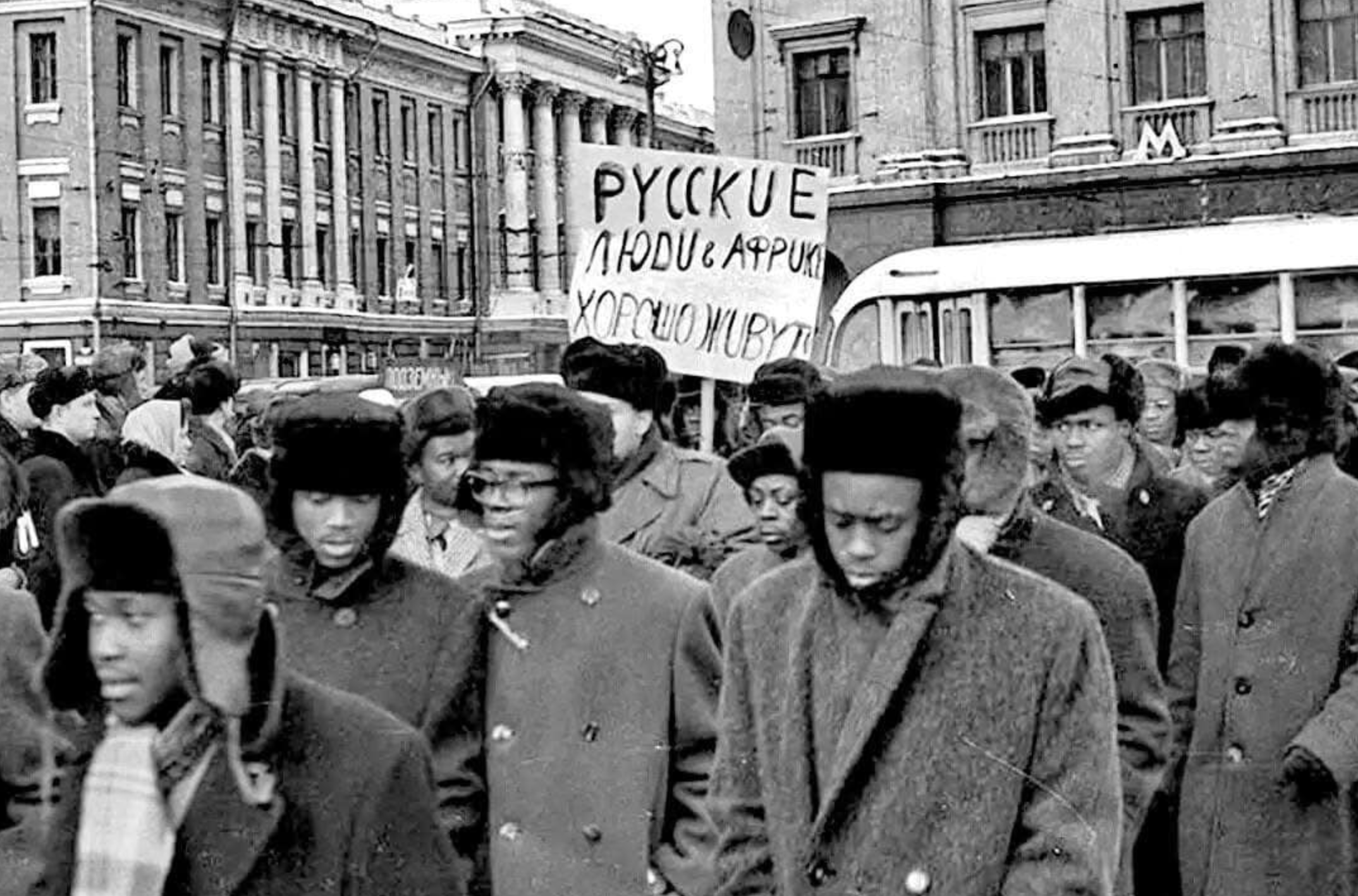
The student memorandum presented to Soviet authorities that day was measured and specific: it demanded a public investigation into Assare-Addo’s death, accountability for documented incidents of physical violence against African students, and a guarantee of personal security. The final line of the memorandum captured the underlying betrayal concisely: the students called for Soviet friendship to find expression not only in words, but in deeds.
The Soviet government handled the immediate confrontation skillfully, convening two cabinet ministers to meet with students and holding an open assembly. But the internal response, documented in archival materials, tells a different story. Within days, Ministry of Higher Education officials were in communication with the KGB and Ministry of Foreign Affairs requesting the repatriation of named student “ringleaders.” The protest was treated not as evidence of a genuine problem demanding a structural response, but as a provocation to be managed and suppressed. The Komsomol at Lumumba University received explicit instructions on “the line of behavior” to adopt, and proceeded to run a campaign of political re-education among the student body, framing the demonstration as an act of ingratitude orchestrated by foreign agents. Students who had participated and sought to withdraw from the university were summoned before a University Council and subjected to extended moral interrogation before their petitions were approved, with the rector threatening to inform their home governments of their “depraved” behavior.
Students who dared to offer substantive criticism of Soviet life during these proceedings were singled out. One Sierra Leonean student, the president of his university’s national association, criticized the administration for surveilling students and setting contingents against each other. He was identified in the university’s report to the ministry as the student who had displayed the worst ingratitude for Soviet educational assistance, and was followed to West Germany after his expulsion.
treatment of interracial families
The social reality for interracial couples was brutal. Being with an African man was treated as a moral failing. Soviet women who dated these students were constantly labeled as prostitutes and faced intense shaming from their own families and communities. If a woman got pregnant, the pressure to conform was immense. They were routinely pushed to either get an abortion or put the child up for adoption just to avoid the stigma. Since the state rarely allowed Soviet women to follow their partners back home to Africa, many of those who kept their babies were left to raise them completely on their own, essentially abandoned by the state and ostracized by their neighbors.
The experience of the children themselves was devastating. You can find a number of personal stories from Afro-Russians, like TV host Yelena Khanga, about growing up feeling completely isolated and rejected by their peers in school. Khanga spoke about a Russian boyfriend who called her a “little monkey” as some kind of warped, racialized term of endearment. It’s a perfect, painful illustration of how deep the anti-Blackness went. It was embedded in the personal relationships and the language people used every day.
cinematic propaganda
Nothing better illustrates the Soviet system’s capacity for simultaneous moral performance and ideological contradiction than its own propaganda films. The 1936 musical The Circus, directed by Grigori Aleksandrov, is frequently cited as definitive evidence of Soviet racial enlightenment: an American circus performer flees Jim Crow America with her mixed-race child and finds acceptance in the USSR, culminating in a famous scene where Soviet citizens of many nationalities pass the child through a crowd, singing a lullaby in multiple languages.
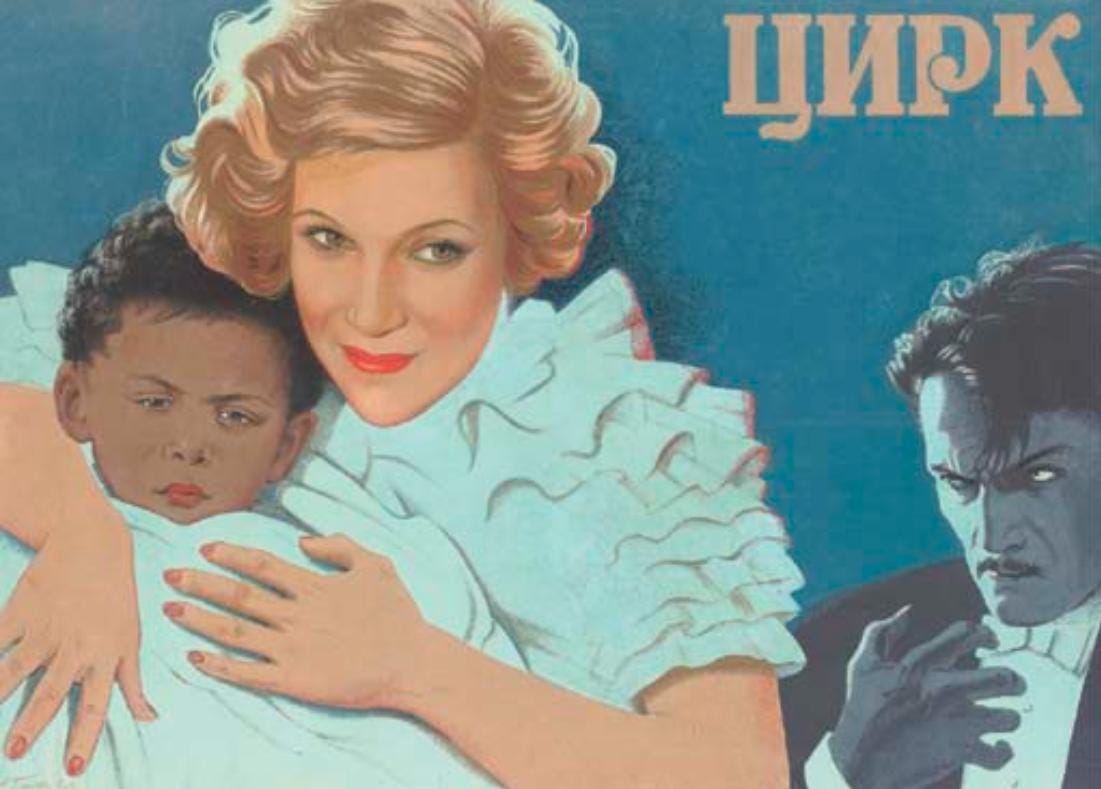
The film premiered as the Great Purge was about to begin, which resulted in the arrest, imprisonment, and execution of hundreds of thousands of Soviet citizens. Within a decade, entire ethnic groups would be deported from their homelands. The state that portrayed itself on screen as having transcended racial hierarchy was simultaneously building the machinery of ethnic collective punishment.
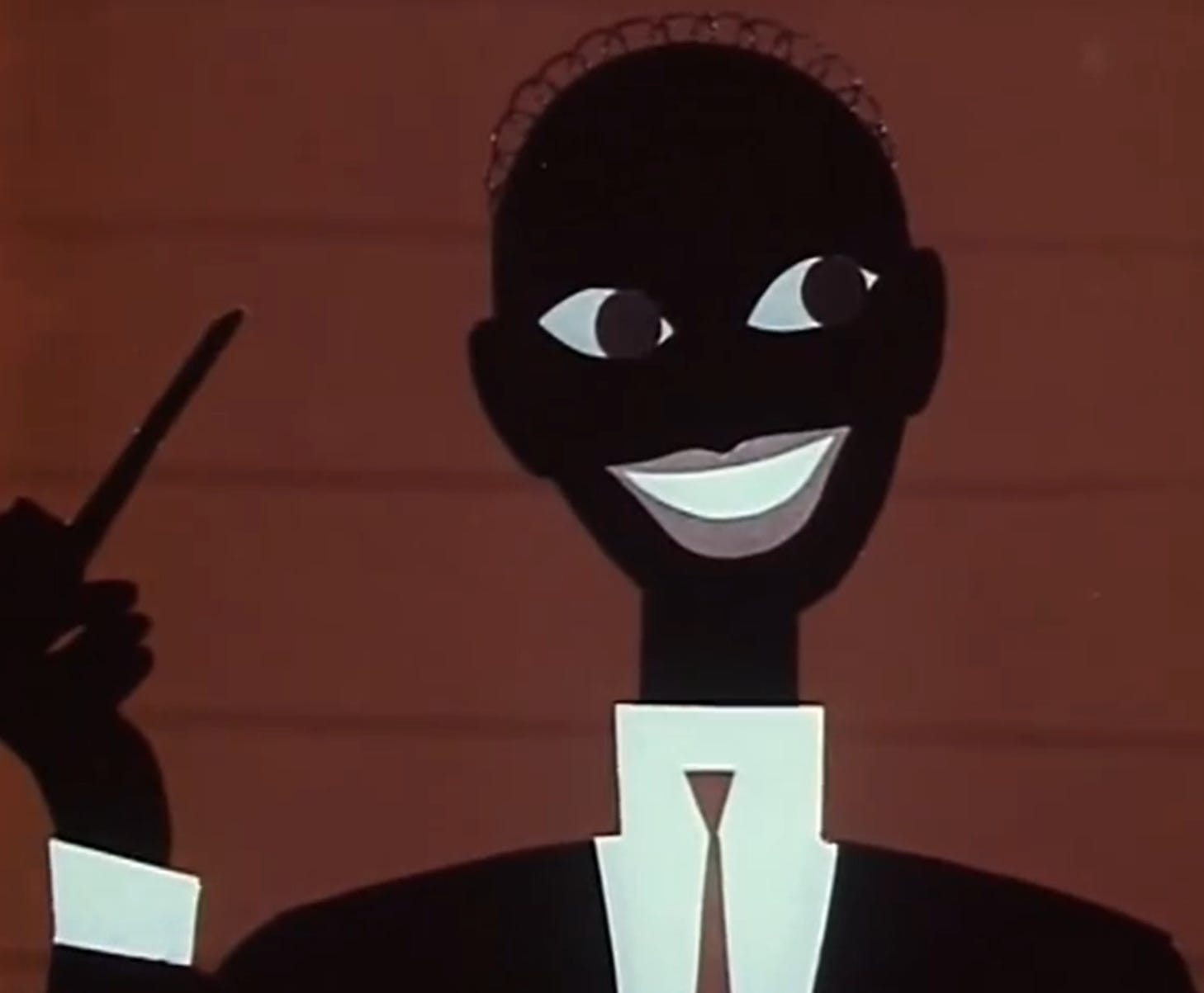
And the films themselves reproduced the imagery they claimed to condemn. The 1963 animated film Mister Twister, whose explicit message is a condemnation of American segregation, depicts its Black character using visual conventions strikingly similar to American minstrel imagery: extremely dark skin, exaggerated facial features, bright red lips, an oversized smile.
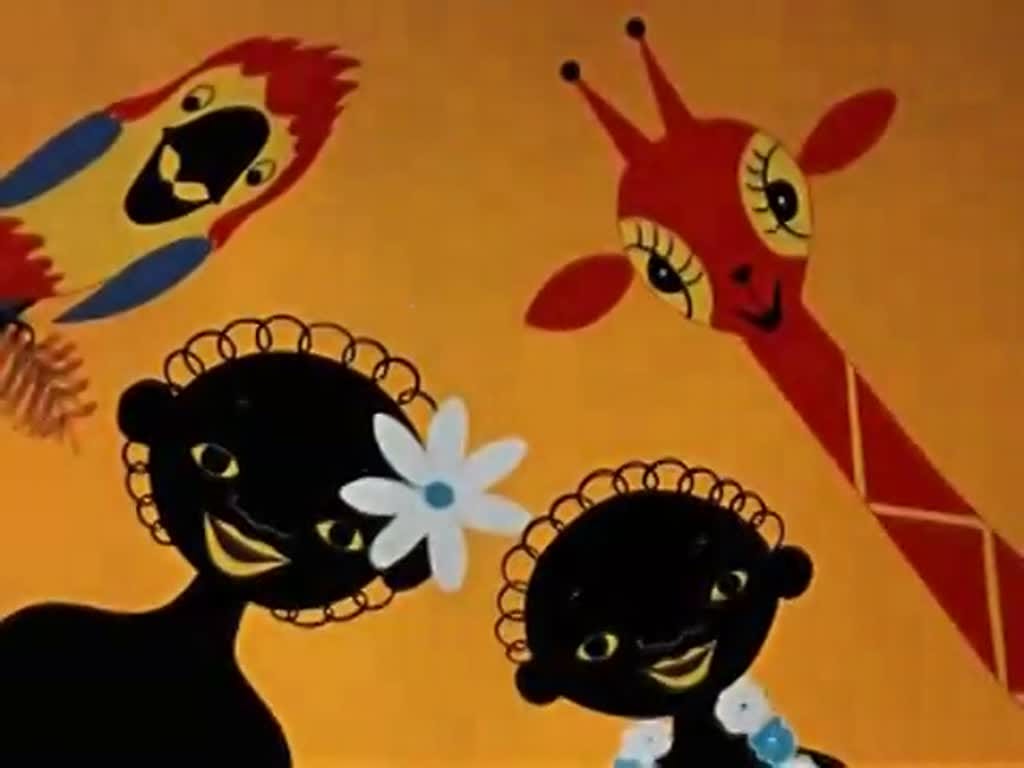
The children’s animation, Katorok, about the island of Changa-Chunga depicts African children as possessing a magical ability to communicate with animals, utilizing a colonial trope framing Africans as existing in mystical harmony with nature rather than within complex human societies. These films exhibited the reproduction of racist visual language within an anti-capitalist narrative frame.
the neo-nazi blindspot
Within the borders of the world’s self-proclaimed anti-fascist state, neo-Nazi ideology was incubating.
Reports of neo-Nazi group formation within the USSR begin appearing in the late 1950s, often initially tied to Nazi aesthetics via uniforms, symbols, and rituals before developing into explicit ideology. By the perestroika era, ultranationalist formations had gained considerable visibility. The Pamyat movement became notorious for antisemitic conspiracy framing, using familiar thinly-veiled coding through “anti-Zionism” and “anti-Masonry.” Figures like Valery Yemelyanov produced antisemitic conspiracy literature framing history as a civilizational war against Jewish-Masonic domination. Alexey Dobrovolsky, a foundational figure in Slavic neopaganism, explicitly tied his revivalist project to antisemitic and racist narratives.
What is most damning is not that these movements existed because after all, extremist ideologies have appeared in many societies. What is damning is that they were largely ignored. The Soviet state that maintained a powerful public identity as the world’s leading anti-fascist society did not consistently expose, publicly condemn, or systematically dismantle the neo-Nazi subculture growing within it. It was treated as politically insignificant rather than ideologically threatening. The Soviet state was more committed to performing anti-fascism internationally than to practicing it domestically.
None of this means that American racism was anything other than what it was – an systemic horror that still managed to live on in American society. The contrast the Soviet Union drew between its own rhetoric and American practice was, in that limited and cynical sense, not entirely false.
But the fact that the United States failed to live up to its own stated ideals does not mean that the Soviet Union lived up to its own. The choice is not between Jim Crow and the USSR. It’s between honest historical reckoning and nostalgic mythology, and the latter serves no one except those who wish to launder imperial violence out of a deep need to avoid questioning their own world view or defy the echo chambers they choose to exist in.
The Soviet Union governed through civilizational ranking disguised as developmental science, bureaucratic ethnicity fixed into internal passports and residence permits, collective suspicion applied to entire peoples on ethnic grounds, and imperial memory politics that reframed conquest as liberation. It deported populations, executed intellectuals, dismantled communities, and incubated the very ideologies it claimed to have defeated. That it did so without always using the word “race” is a measure of its intentionally deceitful sophistication, not its virtue.
radical dumpling: screaming into the void about anti-fascism and anti-imperial consistency, from somewhere between east and west.
This article originally appeared on the author’s Substack.
More content from this blog
- The Last Safe Space? Taiwan’s Fragile Role in Asia’s Shrinking Civic Space, by Antonio Prokscha – 29 October 2025
- Project 2025. The Far-Right Playbook for American Authoritarianism, by GPAHE
- Are “Illegal Africans” Invading North Africa?, by Shreya Parikh – 3 February 2026
- Mandarin Hegemony: The Past and Future of Linguistic Hierarchies in China, by Gina Anne Tam – 18 April 2024
- Confronting Complex Alliances: Situating Britain’s Gender Critical Politics within the Wider Transnational Anti-Gender Movement, by Sarah Lamble – 23 May 2024
Except where noted otherwise, original writing and translations produced by the Left Renewal Blog Collective are published under a Creative Commons Attribution–NonCommercial–ShareAlike 4.0 licence. Republished and translated material remains subject to the licence and terms of its original publication.