Content warning: this piece describes and links to images and video of organized violence against women and girls, some of them minors.
I didn’t sleep last night. I was scrolling Threads before bed when I caught the edges of it, scattered posts arguing about Time Fengjun (时代峰峻), the words “Yangtze International(长江国际),” a few chaotic seconds of video that made no sense on their own. I went looking for what it was. By the time I understood, it was very late and I was furious, and sleep was no longer an option.
What I found was footage from outside the building, Yangtze International, which houses the trainee center of Time Fengjun, the agency that manufactures China’s boy idols. It is the company that built TFBOYS and Teens in Times, and it has spent fifteen years perfecting a particular machine: recruit boys as young as ten or eleven, put them through years of singing and dancing and camera training, stream their adolescence to fans who “raise” them by voting and spending, and turn the most bankable of them into national stars. The current crop is a fifth generation of trainees, some of them eleven and twelve years old, not yet debuted.
For years, this address had been a place that people would travel to from far and wide to visit. The girls who came to wait for the trainees called themselves the eighteenth-floor girls (18楼女孩), after the floor where the agency is. They made the spot a place that people would want to visit. People could go there to catch a glimpse of an idol arriving or leaving. They could also leave a gift or stand and think about the place their devotion pointed to. One picture that was spreading online really said it all: “Not every girl dreams of Shanghai Disneyland; for some, it’s Time Fengjun in Chongqing.” To them, the building was like a castle, a place you make a special trip to.

This past week, it became the opposite of a sanctuary.
Here is roughly how it was built, as best I can reconstruct it from the timelines fans themselves have pieced together. It dates back to late May and early June of this year, when a wave of men began posting on Douyin that the idols “had stolen their lives,” that these “tower people (楼人),” as the slang called them, were uglier than the men complaining yet somehow made money and were loved by girls. They began banding together to attack the idols and their fans online. By late July a few of them started going to the building itself, blocking the underage trainees’ cars and hurling abuse while live-streaming it. When fans found the streams and argued in the comments, the men doxxed them, photoshopped them into pornographic images, and spread rumors. Through July it was all online. Then it came down to the street, coordinated in group chats, the men gathered below the Time Fengjun offices for days running, not once but as a proper campaign.
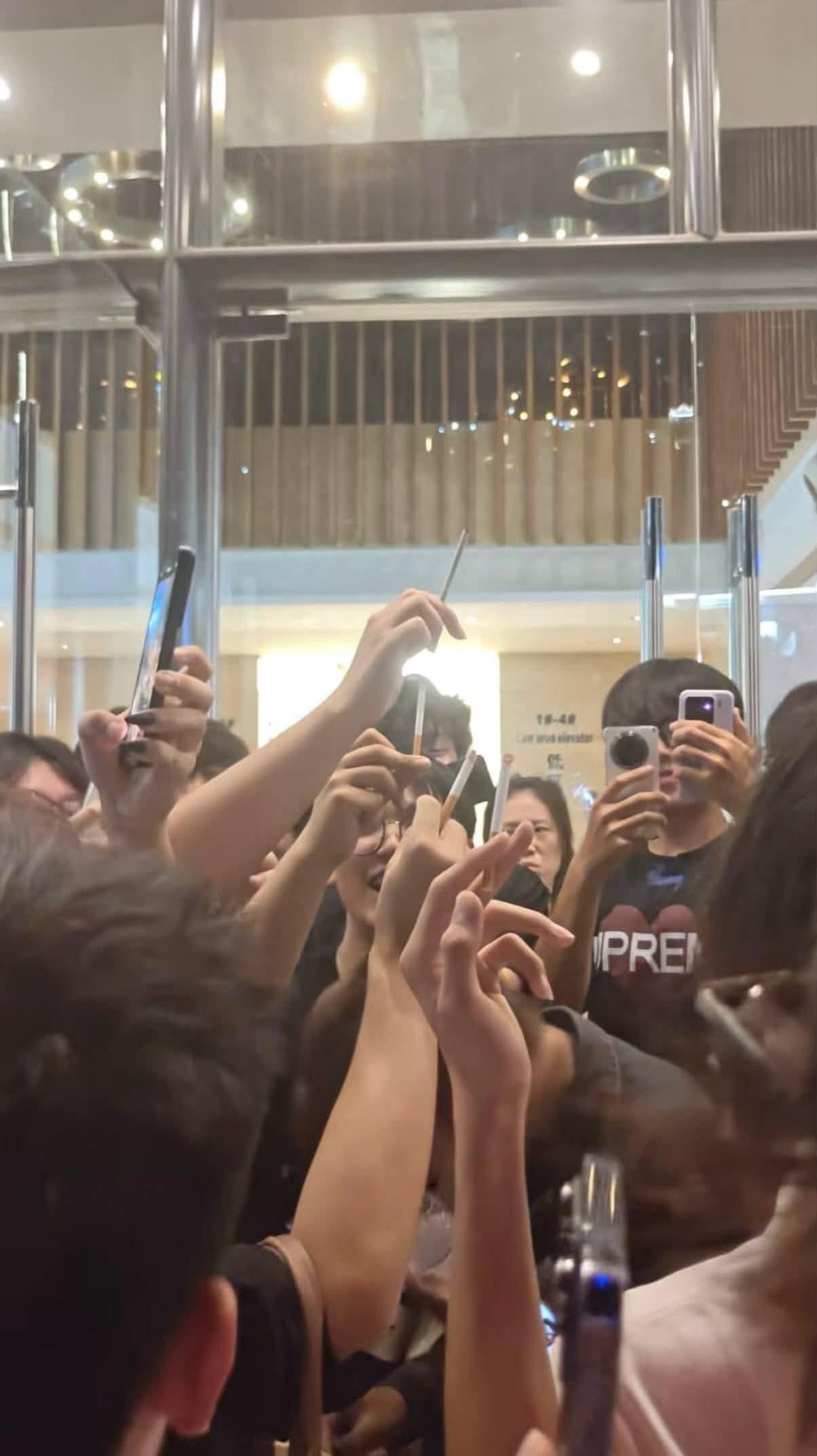
The timeline of the days themselves is short and ugly. On the 15th, a male streamer stood outside and taunted the fifth-generation trainees with jiahao (嘉豪), an internet slang for a certain kind of try-hard teenage boy, all black hoodie and studied cool. Shouting it at the idols was a way to call them posturing children. A fan argued back, and was screenshotted and turned into a crude pornographic sticker.
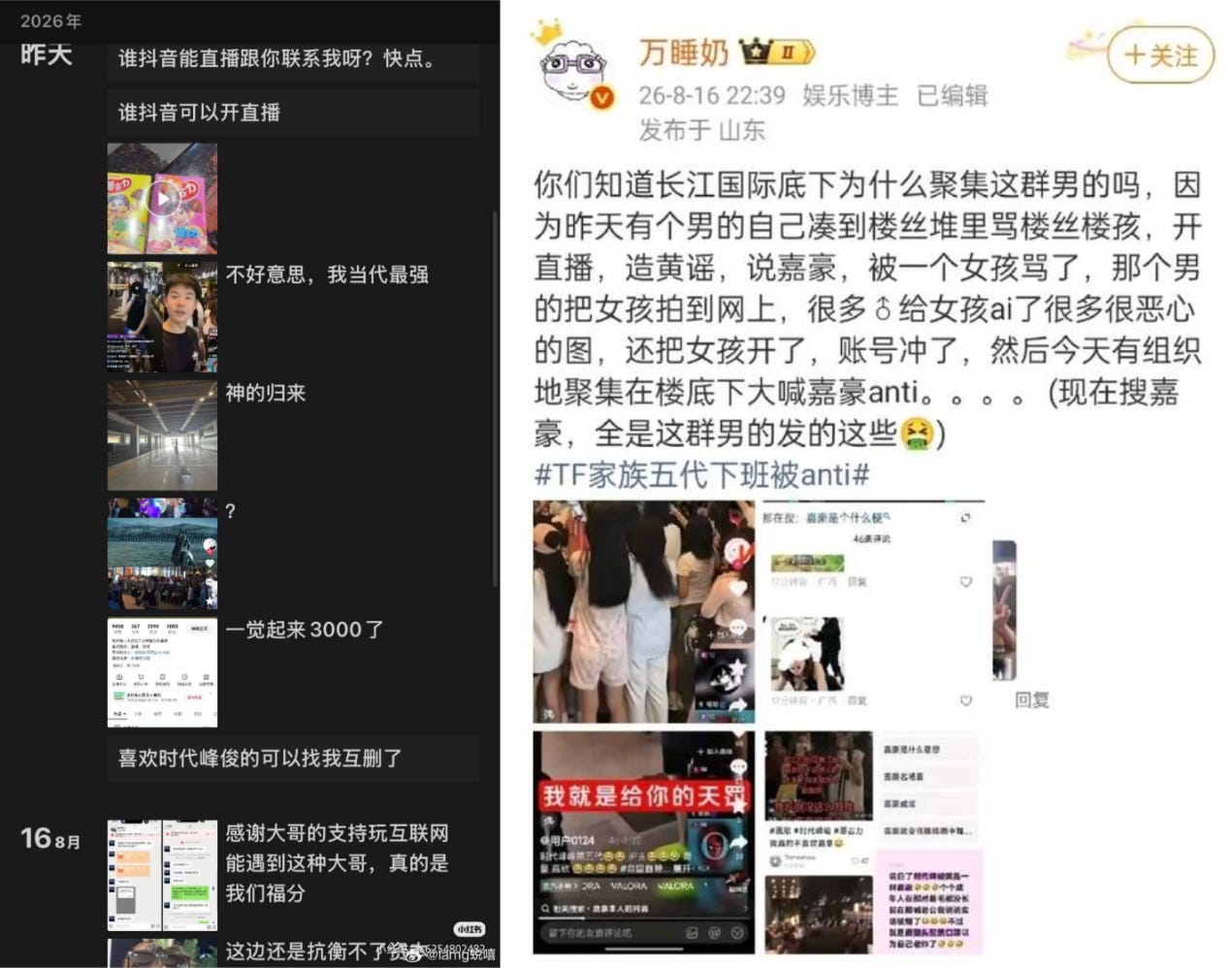
On the 16th, more men gathered “because a brother was being bullied,” massing below the building to scream at fans; when fans complained to the company, Time Fengjun told them they were exaggerating and spreading falsehoods. The 17th was the turning point, more men, a bigger crowd.
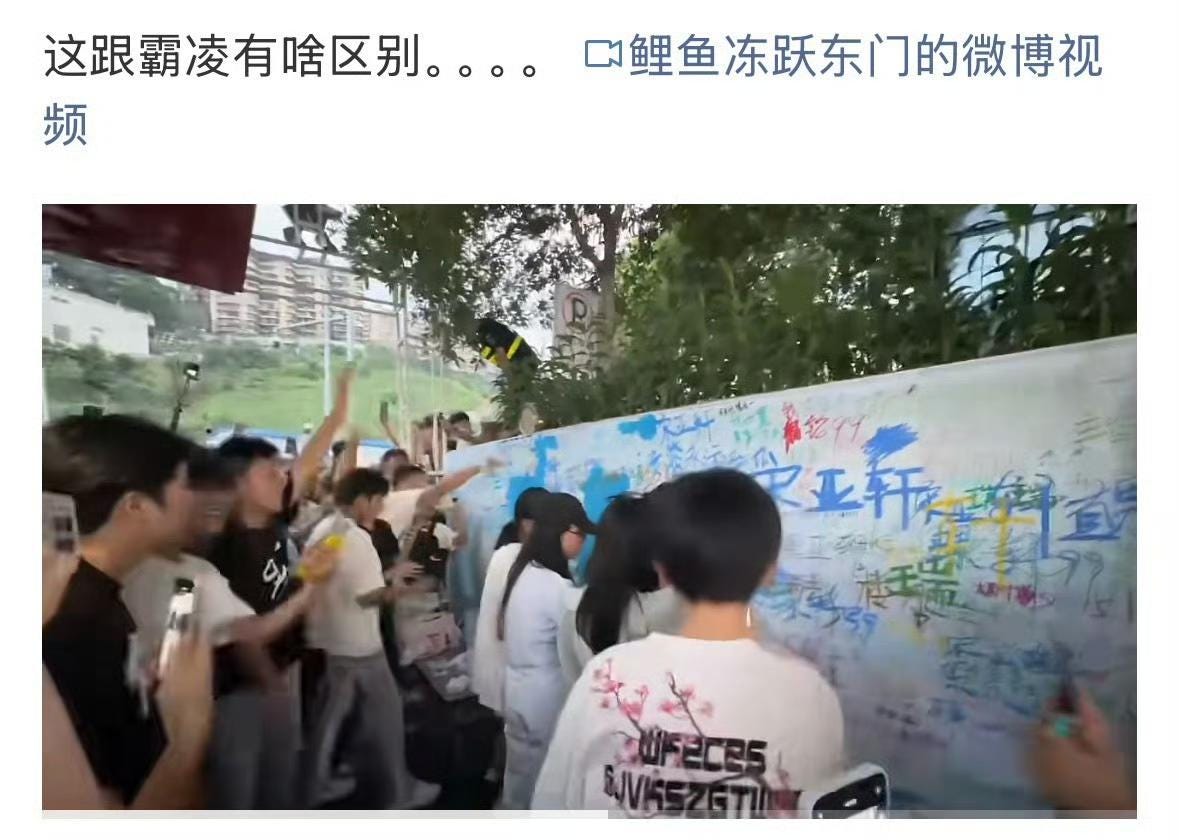
By the 18th it had fully boiled over into a total chaos: the videos everywhere, the men flooded the Chongqing tourism bureau’s account, the company posting a suspension-of-training notice. Fewer fans came that day. More men did, throwing drinks at the women who were there.
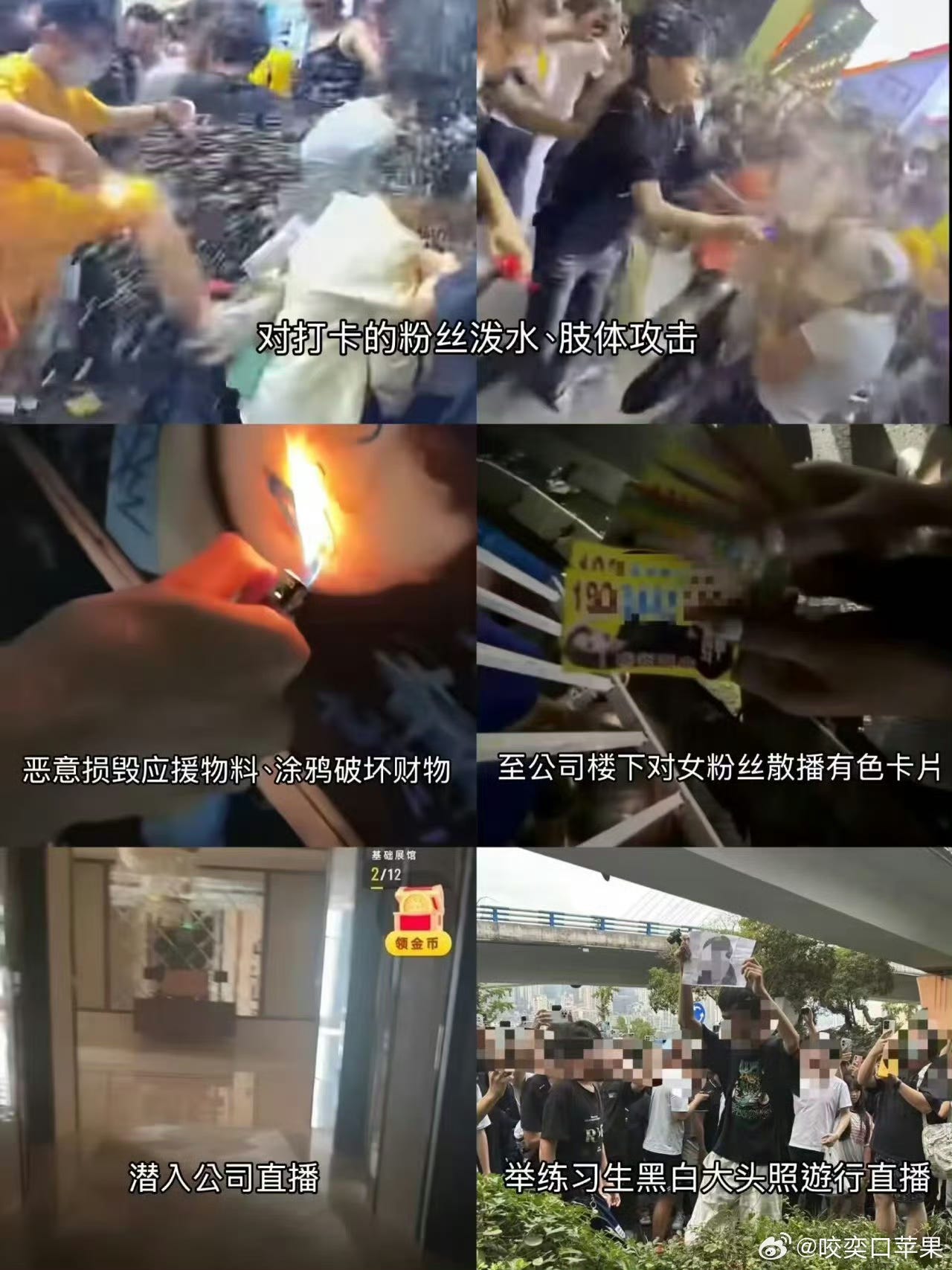
Set the sequence out plainly. At first they came to jeer at the child trainees, live-streaming themselves shouting the slang at boys walking to their vans, blocking the cars, pulling at the doors. Then they turned on the female fans, many of them teenagers themselves, who had come to see the idols. The men surrounded them, mocked them, filmed their faces up close. They threw water. They kicked. A mother and daughter were beaten together.
Fans’ photographs, some of them minors’, were run through AI into fabricated pornography and printed onto cards advertising sex work, then scattered on the pavement where the girls stood. That is the part I keep returning to. You do not print those cards in the heat of an argument. You make them at home, the night before, having already decided what the girls are for.
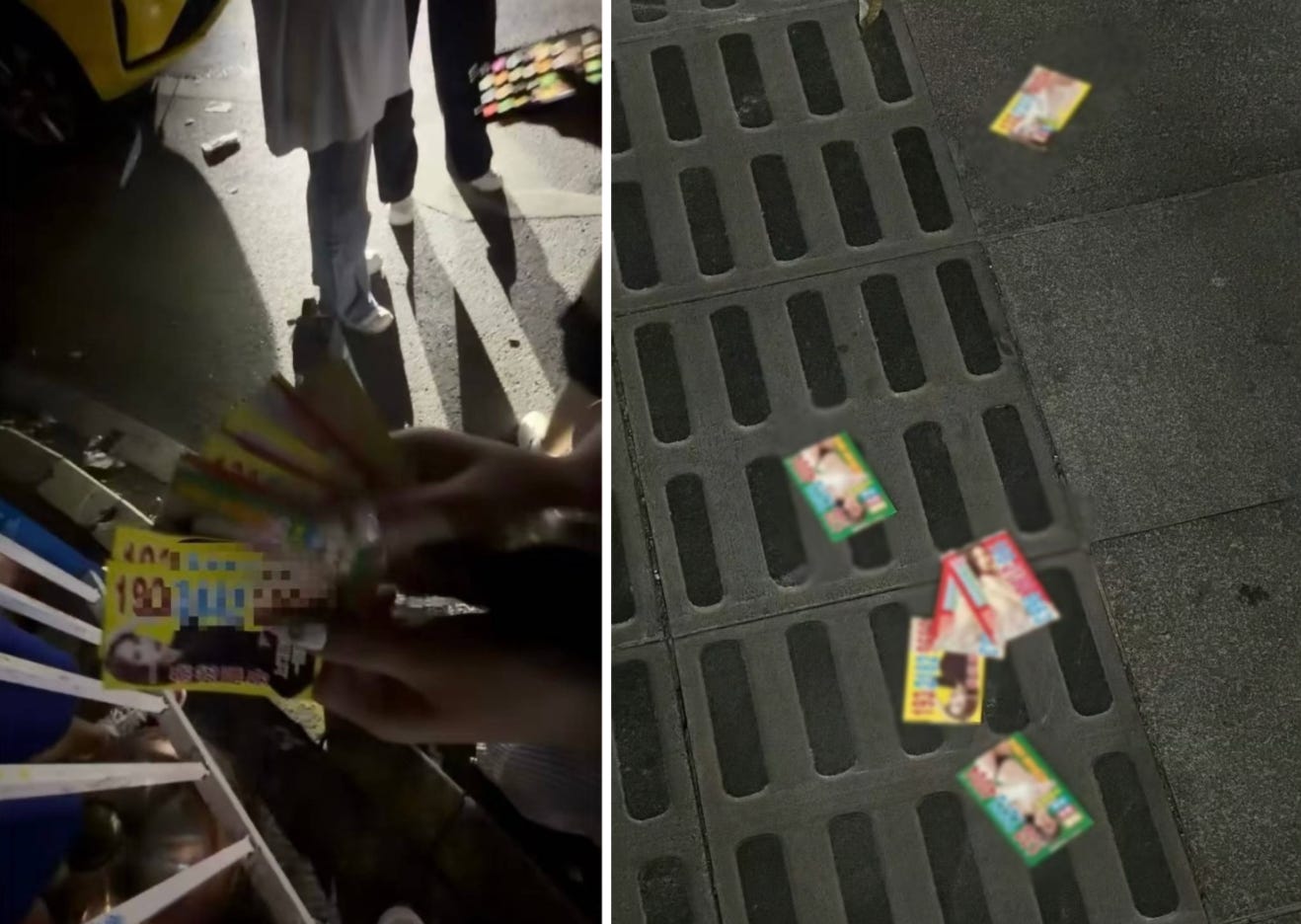
I want to be careful about the spark, because it is actually a real issue and because the argument does not need it. One side says the men started it. The “she threw first” video, which a lot of people have watched, shows a man throwing an object and a woman throwing it back. The cup of water only came after a man had grabbed a girl to take off her mask, and she threw it into the air.
But to take the girls to court over the first cup is wrong. It seems like the mob’s answer was a decision that the girls could have avoided by behaving perfectly. It wasn’t. Nothing a teenage girl does leads to a stack of pre-printed cards with her face on a flyer asking for money.
And note the shape of the men’s own justification. They dressed their assault up as protection: the fans’ love for underage idols was pedophilic, they said, and so the girls had it coming. Yet it was these same men who photoshopped teenage fans onto sex-work flyers and generated pornography of them. Whatever they claimed to be defending, they were the ones sexualizing the children in front of them.
What the authorities did
Then came the official response, which was in its way more chilling than the crowd.
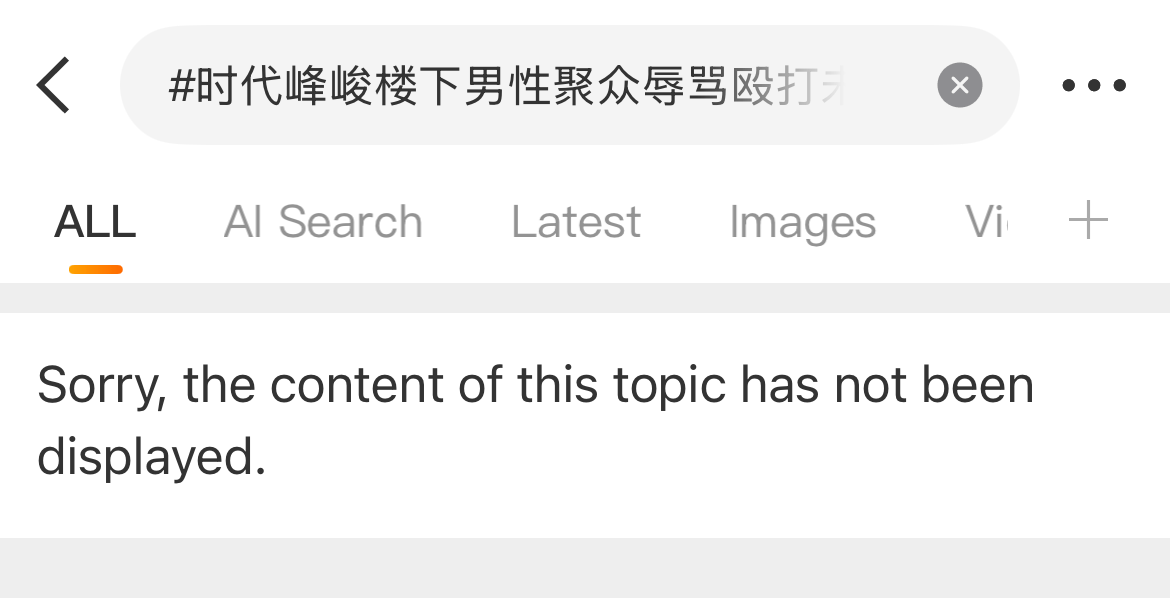
The fans created a hashtag to document what happened to them — a supertopic, in Weibo’s language — naming the thing plainly: men gathering to insult and beat underage trainees and female fans. It is no longer visible.
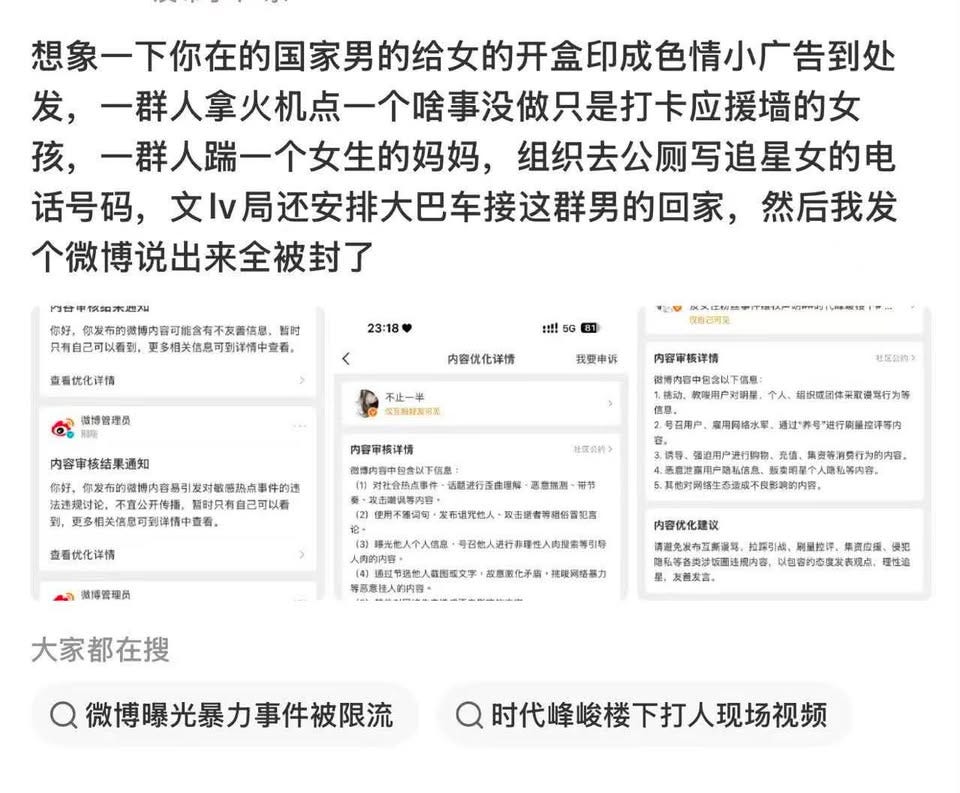
The censorship was not only a matter of things quietly vanishing; you could watch it happen to you. A fan who posted an account of the violence received the platform’s verdict in writing: her post “may contain unfriendly information” and would, for now, be visible only to herself. The listed grounds read like a charge sheet against her — inciting confrontation, organizing crowds, raising money, hiring “water armies” to manipulate traffic. And then the platform’s advice, which is the tell: post in a spirit of tolerance, it counseled, and practice rational fandom. There it is. A campaign in which grown men doxxed teenage girls, printed their faces on solicitation cards, and set fire to a fan wall had been recategorized, by the machinery above it, as a fandom that needed to calm down. The men do not appear in that sentence. Only the girls, who are asked to be more rational and more kind.
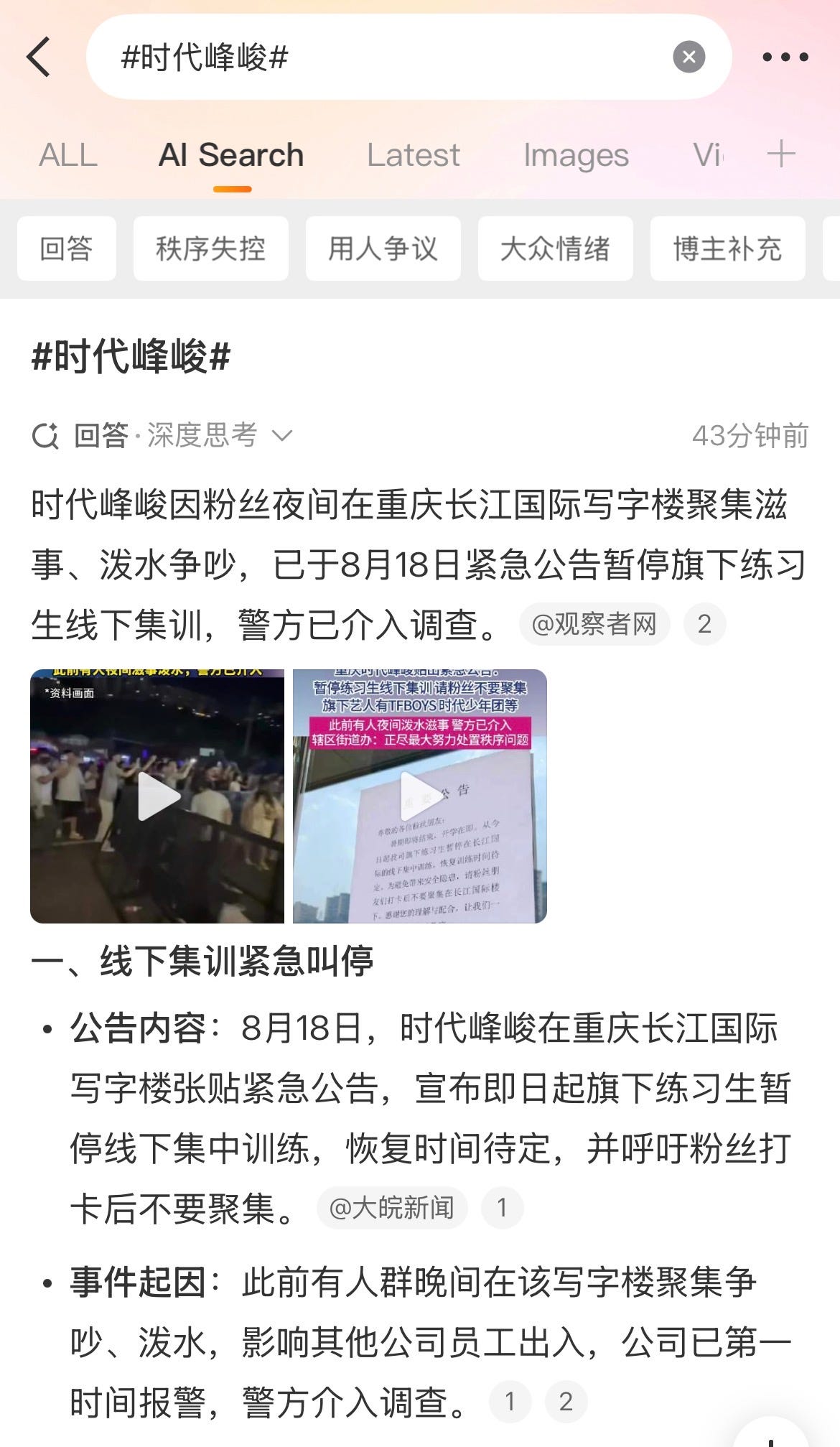
In its AI Search, where Weibo offers an AI-generated summary, the whole episode was laundered into “fans gathered at night and quarreled,” a grammar in which the men simply dissolve and the disturbance becomes something the girls were doing.
The company’s own statement suspended the trainees’ sessions, and said little about the women who were assaulted. And around the edges of the footage: a video of a police officer with his arm around one of the ringleaders, easy and friendly; the report that the Chongqing tourism bureau sent public buses to carry the men away from the scene. The state has not issued a formal account. It did not need to. The account was written in what it chose to erase, and in whose arm was around whose shoulder.
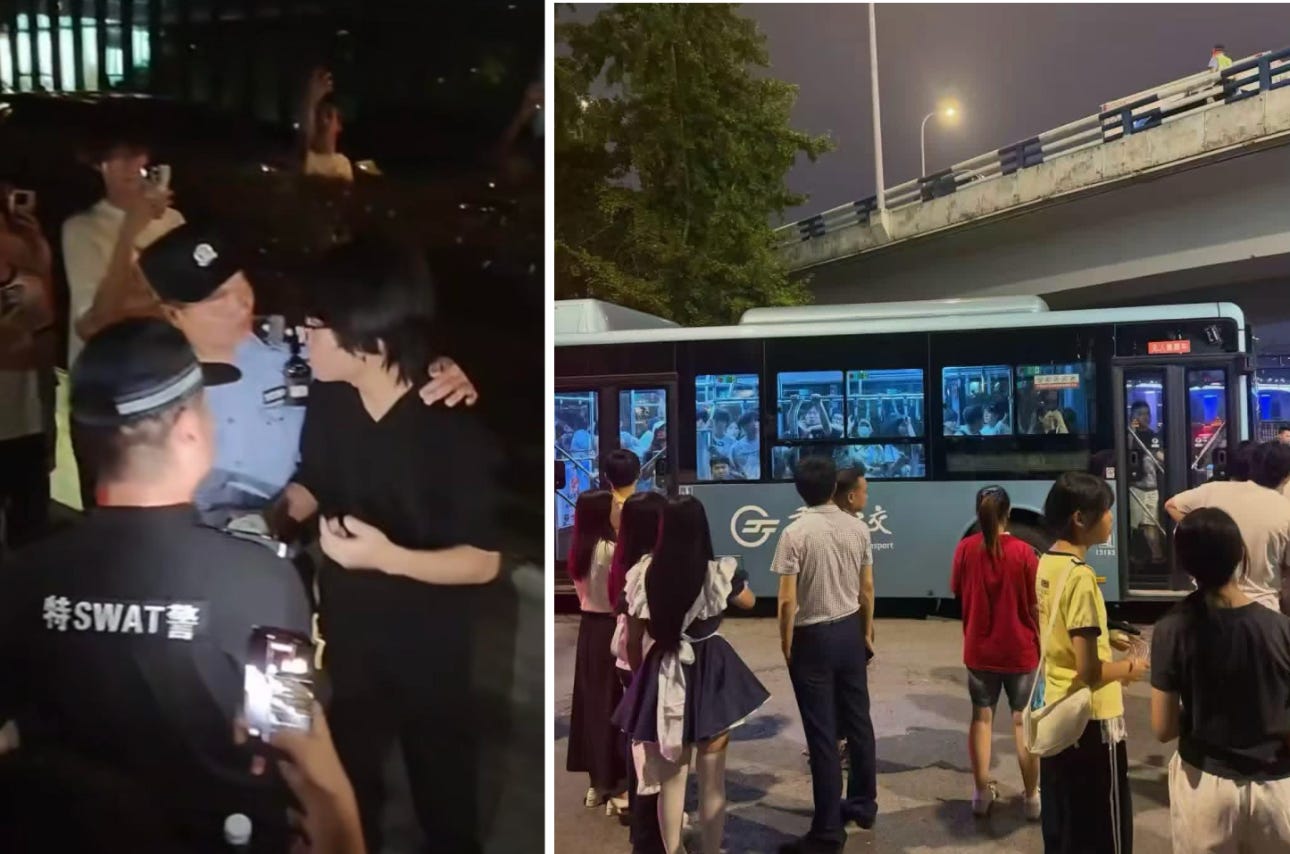
What the men were actually protesting
Underneath all these cruelties there is a single premise, and once you see it the disparate cases stop looking disparate. The premise is that a woman is not a person but a resource — a sexual and reproductive asset that belongs, properly, to a man, or to men, or to the nation as a stock of men. Almost everything else follows from that one idea.
Watch how it surfaces when the “owner” changes. In 2019, Shandong University was found to have paired international students with local “study buddies,” and because some of those students were foreign men and some of the buddies were Chinese women, the internet detonated. The campaign that followed called itself, without irony, “Chinese boys protect Chinese girls.” Its logic was territorial: our women are being taken by foreign men. Men filmed themselves in mock-heroic poses vowing to defend the nation’s girls; the same men trailed actual Shandong women across campus with livestream cameras, shouting slut-shaming abuse at them, until the university had to lock the gates. A Shandong University student, herself one of the women being hounded, named the mechanism exactly: a Chinese woman being possessed does not anger them; a Chinese woman being possessed by a foreign man is what angers them. What was being defended was never the girl. It was the ownership.
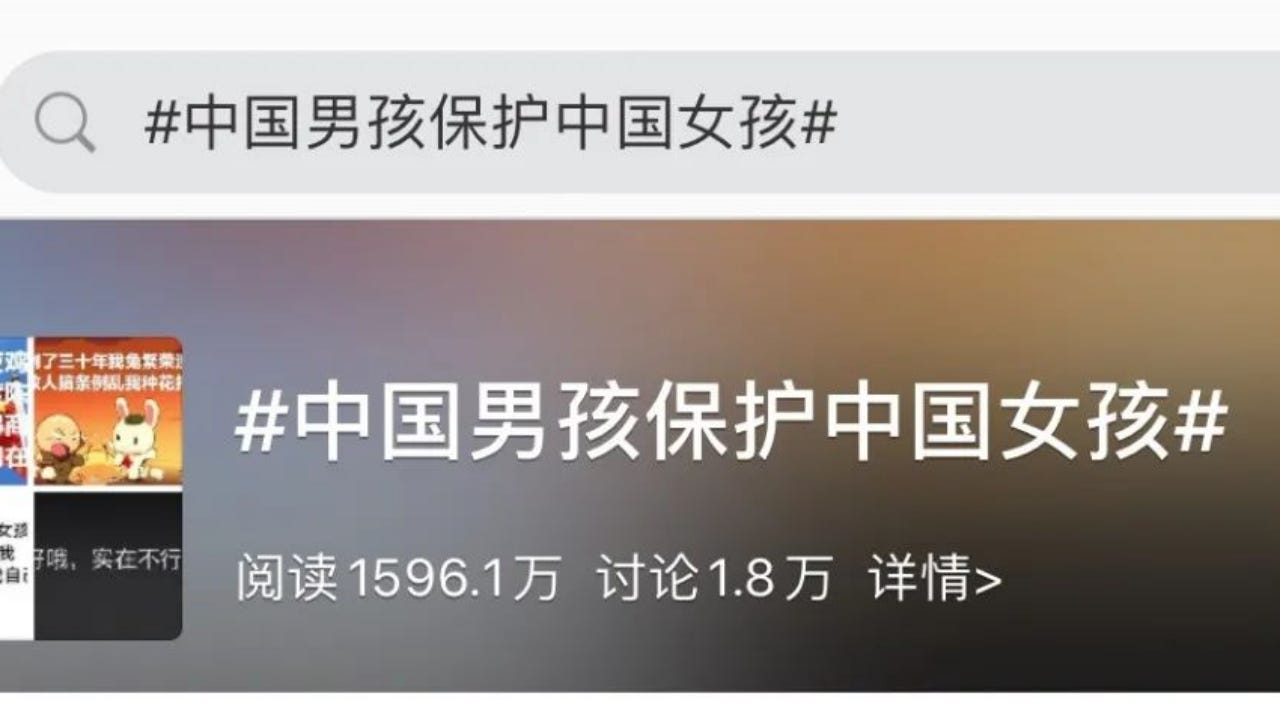
If you hold that sentence next to the others and they rhyme. The men outside Yangtze International were enraged that girls loved idols they judged unworthy, that a sexual-romantic resource they felt entitled to was being “spent” on other men, and their answer was to repossess those girls as public property, photoshopping their faces onto solicitation cards, generating pornography of them, marking them as sexually available to anyone as punishment for not being available to them. The men who buy trafficked, disabled women to bear them children are working the same premise at its most literal: a woman is a thing that can be purchased and used to produce a family, and the law, as we will see, half-agrees. Different scenes, one grammar — she is ours, not her own. The nationalist, the incel, and the buyer are not three problems. They are one belief in three costumes.
And this is why the misogyny and the stereotypes are not decoration on top of the violence; they are its operating system. If a woman is a resource, then her own desires are noise — the Shandong women “didn’t really” want language practice, the fans “don’t really” love music, the wife “doesn’t really” want the divorce. If she is a resource, her stated refusal is not a boundary but a malfunction to be corrected. And if she is a resource, then a man who takes or keeps or kills one has committed, at worst, a property matter, which is very close to what the sentencing language actually says.
This is why the misogyny and stereotypes are not just an extra layer on top of the violence; they are a fundamental part of it. If a woman is seen as a resource, then her own desires don’t matter. The Shandong women “really” didn’t want language practice, the fans “really” don’t love music, the wife “really” doesn’t want the divorce. If she is a person who can be useful, her stated refusal is not a boundary but a problem that needs to be fixed. If she is a resource, then a man who takes, keeps or kills one has committed, at worst, a property crime. This is very close to what the sentencing language actually says.
The state of things
Behind all of this is a situation that will not improve on its present course, and may be the reason the machine runs the way it does.
The sex ratio is badly skewed, the inheritance of a one-child policy laid over a preference for sons — tens of millions of men for whom the promised wife and place do not, arithmetically, exist. Youth unemployment has been high enough that the government stopped publishing the number for a while, then changed how it was counted. The property that a young man was supposed to acquire before anyone would consider him is out of reach. So there is a very large population of underemployed, unmarried, frustrated young men, marinating in spaces that hand them a diagnosis: your life was stolen, and the thief is the feminine man girl prefers to you. That is precisely the syllogism the Chongqing crowd began with, months before the violence: those unworthy boys have money and fame and the love of girls, and I, who deserve it, have none. It is the incel arithmetic exactly, and it does not stay online. It got on scooters and turned up outside a building and put its hands on actual children.
Over the top of this the state has thrown its full weight into marriage and childbirth, because the birth rate is in freefall and a shrinking, aging population frightens the planners more than anything else. It wants the daughters to have daughters. What it has never wanted, with anything like the same urgency, is to make the country safe for them once they are here, and this is where I want to be careful, because the strongest case is not a collage of shocking crimes. Any single crime can be answered with a single sentence and a single verdict. The stronger thing to look at is the paperwork: the law, the sentencing language, the terms of service. Those are not incidents. They are the settings the machine runs on, and they all lean the same way.
Start with the criminal code itself, because a country’s sentencing ranges are the most formal statement it makes about what it will not tolerate. Trafficking a woman or selling her carries a starting sentence of five years. Buying a trafficked woman carries a maximum of three. In law, on paper, the man who purchases a human being is the lighter offender. This is not a rural enforcement gap; it is the same code everywhere. This summer, Chinese-language independent outlets read through thirty-one public verdicts in which men had bought or trafficked mentally disabled women and raped them to produce children. In the overwhelming majority, the rape was never charged at all. A “marriage” wrapper — a bride price, a banquet, the word “wife” — was enough to make the courts write “lived together” instead of “raped,” and to let the buyers testify as witnesses rather than stand as defendants. Prosecutors in one Shanxi case declined to charge a man who had confined and impregnated a woman with no capacity to consent, reasoning that he “subjectively intended to build a family.” A stranger who does this is a rapist; a man who means to keep her is not. That distinction was written by the state’s own prosecutors, and it is the woman-as-property premise made law: acquire her with the forms of ownership, a price and a banquet, and the courts will read the rape as marriage.
Then look at what the law does to the woman who wants out. Since 2021 a thirty-day “cooling-off period(离婚冷静期)” stands between a couple and a divorce, a measure the government adopted, and defends, as a way to hold marriages together and lift the birth rate. In its first year, divorce registrations fell by more than forty percent. The Supreme Court’s own figures show that most divorces are filed by women, and that domestic violence is among the leading reasons. Officials answer that the cooling-off period doesn’t apply to abuse cases, which must go through the courts. However, proving abuse to a Chinese court is its own ordeal: in one study of Beijing divorce judgments, family violence was formally recognized in about six percent. So the design holds a great many women, including battered ones, inside the marriage for the sake of a number the planners care about. And note what the law still declines to say at all: it contains no clear crime of rape within marriage. The silence is itself a ranking.
北海 Northward Seaside is a reader-supported publication. To receive new posts and support my work, consider becoming a free or paid subscriber.Subscribe
The sentencing language tells the same story in a different register. When a man kills his wife or girlfriend or the woman who left him, the verdict very often files it under “a family conflict” or “emotional dispute” — phrases that pull the sentence toward leniency. One Chinese data-journalism team went looking to test the grim TV maxim that “it’s always the husband.” Pulling intimate-partner murder verdicts from the public judgment database, they found that of the killings between partners, 82 percent were men killing women. The asymmetry ran deeper than the count: among the far fewer cases of women killing men, a striking share were women who had been beaten for years and finally struck back — a pattern almost absent on the other side. And the report named the logic without euphemism: the husbands, it wrote, treated wife and children as their possessions, theirs to decide whether to let live.
When Li Yan finally killed her husband after being beaten for years, burned with cigarettes on her face and genitals, and having a finger cut off, the courts that sentenced her to death twice over would not write the word “abuse” in the verdict; they called it a “family dispute.” It took more than a hundred lawyers and scholars petitioning the Supreme Court to “stay the blade,” and nearly three years, before the death sentence became a suspended one.
A man who kills is often “provoked by a family dispute.” A woman who kills the man abusing her must be rescued from the gallows by a national campaign. Even Lhamo — the Tibetan livestreamer whose ex-husband doused her in gasoline and set her alight on camera, and who was, rightly, executed for it — had, while she was still alive and fighting for custody, watched a court hand both her children to that same man, the one with the better income.
None of this needs a viral video, and that is the point of it. But the videos exist too, because the paperwork has a daily texture. A woman gets into an ordinary ride-hail car — the most banal errand there is — and the system around her is built to treat her as a commodity and her safety as an afterthought. When a flight attendant was murdered by a driver in 2018, it came out that the platform had let drivers tag female passengers “pretty,” “nice figure.” Three months later another young woman, nineteen, was raped and killed by a driver who had been reported by a different woman the day before for asking passengers to move to the front seat and steering toward empty roads, a complaint the company sat on. As she was being killed, her friends and the police called the platform for the car’s details and were put off for hours with “privacy” and “we don’t have the authority.” Two deaths were what it took to pull the service. That is the everyday face of it: not a monster in the dark so much as a system that had filed a woman’s life below its own convenience until the cost came due.
And then there are the knives on the street, which I mention last and carefully, because the official word for them is “random.” A jobless man in Nanchang, turned down for a security job and unmarried, trailed three young women leaving work and stabbed the one in the middle — a trainee lawyer — to death. Six years later, in the same city, another jobless man approached two students in traditional dress, and when they brushed him off, stabbed them a dozen times, killing a nineteen-year-old. In both the official finding was mental illness and a “random” choice of target. Perhaps. But it is worth asking why the random knife, again and again, comes down on a young woman. When a society keeps manufacturing desperate, failed, “diagnosed” young men, “random” is the word for the motive; it is not the word for the pattern of the dead. Random is who they are angry at in general. Female is who is on the ground.
Set the whole record beside itself. When the goal is to move a woman toward marriage, the state’s ingenuity is boundless: it will register a wedding inside a subway station. When the question is her safety once she is inside a marriage, a car, a police station, a street, the same state discovers a hundred reasons for restraint. I am not claiming a room where someone drew this up. I don’t need to. The claim is smaller and harder to refute: that whatever the intent, the errors of this system fall, with a consistency that stops looking like chance, in the same direction — a woman’s safety placed behind stability, behind the birth rate, behind a man. And a government nervous about the anger of its men has no urgent reason to correct an error that points that anger away from itself. The girls outside the tower were, on that logic, expendable.
So I did not sleep, and I do not think what I watched was a fandom curiosity that ends when the schools reopen and the crowd goes home. I think it was a preview. Every pressure underneath it is set to intensify, and each of them resolves, on a single street, into the same picture: a crowd of men, and the girls they have decided is to blame.
On social media, in the hours I was awake, I kept seeing women saying the same thing to one another, that they have to leave China, that leaving is the only choice left for them. I left six years ago. I am one of the women who, back then, said something about women’s lives online and was attacked by men until the abuse simply stopped registering, until I was immune to it. I understand what these women are saying, and I agree with them. I think it is the best thing for them.
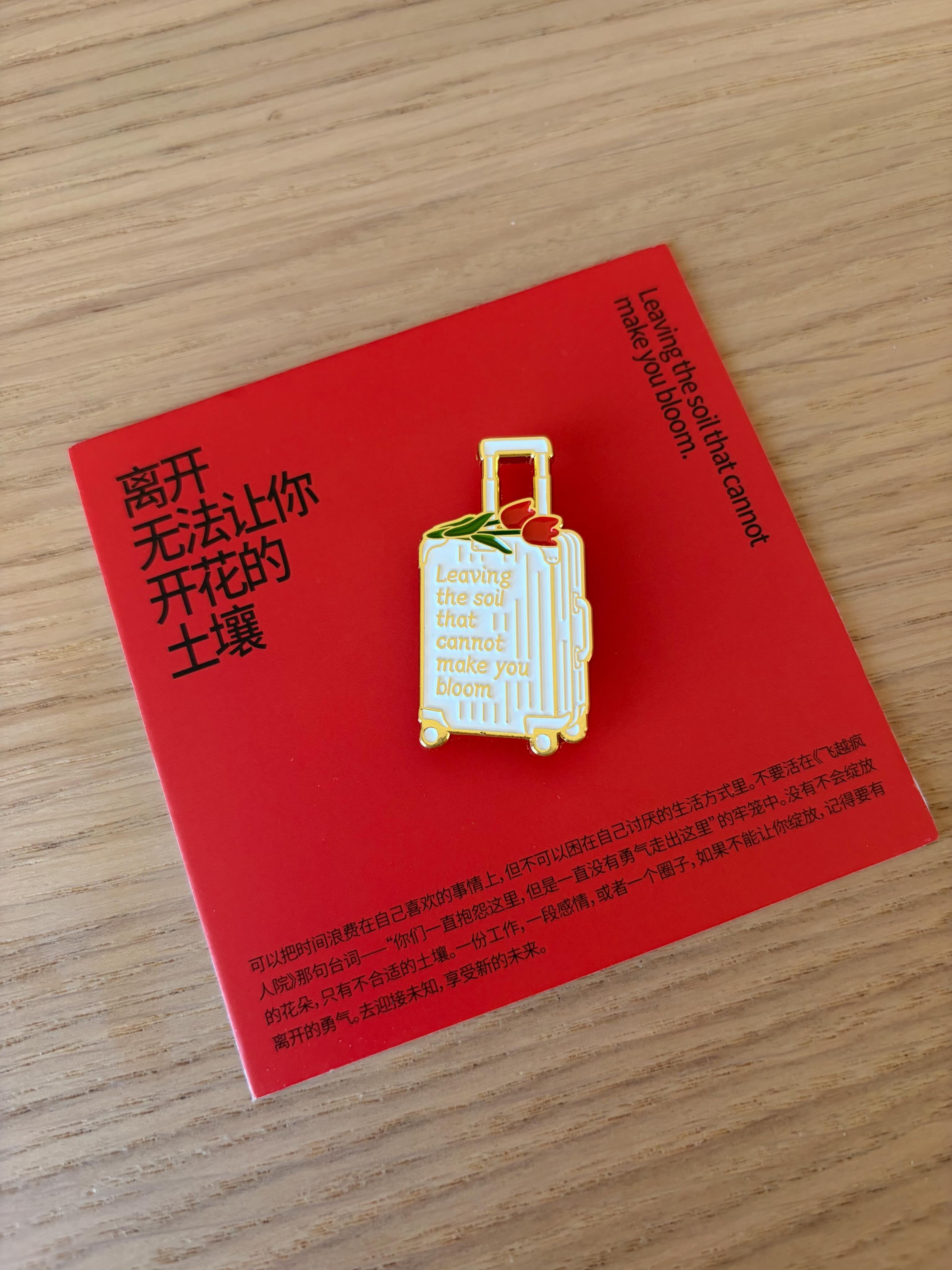
I recently bought a pin. It says, “Leave the soil that won’t make you grow.” That was how I felt when I left six years ago. I hope that for every woman who is still there.
Note on sourcing: the Chongqing events are drawn from fan-compiled timelines.
A special thanks to all the women who kept sending me the screenshots and the videos, so there would be a record.
As of writing, mainland police had issued no formal report; some specific later incidents remain reported rather than independently confirmed, and the precise trigger of the confrontation is disputed by the parties involved. My description of the disputed video reflects my own viewing.
***
This piece was first published at 北海 Northward Seaside. Read the original here. Republished with the author’s permission.
Chu Yang is a journalist from China, now living in Aarhus, Denmark — a small city by the sea where people bike through the rain and leave their babies outside in strollers.
More content from this blog
- The Mortara Case, by Abe Silberstein – 25 October 2023
- “Azerbaijan Has Its Own Version of the Putinist Slogan ‘We Can Do It Again!’”. Interview with Azerbaijani Journalist Bashir Kitachayev – 30 April 2024
- Kharg, Hormuz, and the Boundaries of U.S. Power, by Siyâvash Shahabi – 17 March 2026
- Andrew Tate and the Moral Bankruptcy of Muslim Proselytization, by Rasha Al Aqeedi – 26 January 2023
- ASEAN and Its Member States Must Stand Against the Rising Repression of Transgender and LGBTIQ Communities Across Southeast Asia. Press Release by the ASEAN Civil Society Conference and ASEAN People’s Forum – 16 September 2026
Except where noted otherwise, original writing and translations produced by the Left Renewal Blog Collective are published under a Creative Commons Attribution–NonCommercial–ShareAlike 4.0 licence. Republished and translated material remains subject to the licence and terms of its original publication.