how the 1968 invasion of czechoslovakia destroyed an autonomous movement
If you live outside of the Czech Republic (sorry, I just can’t bring myself to use “Czechia”) or Slovakia, you can get surprisingly far on the left without knowing much about the Prague Spring and August 1968. You might have a vague image of Soviet tanks in Prague and remember the phrase “socialism with a human face,” but usually the story gets filed away as another Cold War anecdote, somewhere between Hungary in 1956 and the fall of the Berlin Wall. But honestly, August 1968 is one of the clearest cases we have of an authoritarian state crushing a leftist movement that was beginning to advocate for determining its own future and holding its own power.
In Czech collective memory and contemporary culture, August 1968 is something that’s always sort of hanging around, even if it’s relegated to being white noise in the background. You can even see that in the film Pelíšky, which for a lot of Czech families is the classic Christmas go-to, although in reality it’s really a bittersweet, semi-dark comedy. It opens up by ridiculing an attempted and comedically failed suicide by a teenage boy which sounds morbid, but I think fits perfectly within the confines of Czech dark humor. I know some people find the film corny or they’re tired of having to watch it every year, but I personally think it can serve as a somewhat useful primer or intro to the basics of Czech mentality. Anyway, the film begins around Christmas 1967 in a Prague house where two families, the Šebeks and the Krauses, live as neighbors. Major Šebek is a loyal army officer and true believer in the communist regime, tries to run his flat like a barracks and gets excited about socialist modernity like the invention of plastic spoons and “unbreakable” cups (the scene is genuinely funny). Mr. Kraus, living upstairs, is a former resistance fighter and bitter anti-communist who keeps predicting that the communists have maybe a year or two left. Their wives mostly try to keep life bearable, while their children are dealing with school, embarrassment, first love, and parents who turn every domestic situation into a referendum on history or culture.
Most of the plot revolves around borderline absurdist domestic chaos and melodrama. Teenage Michal Šebek is painfully in love with his neighbor Jindřiška Krausová, but she’s interested in Elien, the cooler classmate with parents abroad, Western gifts, films, music, and clothes. Around that triangle, the film moves through Christmas visits, family rituals, death, awkward attempts at adult dating, strange pioneer games, and the comic humiliation of fathers trying to command households that are already slipping out of their hands. Then the Warsaw Pact invades near the end of the film. In a tragicomic Christmas film. The shift feels brutal because that’s how the invasion survives in family memory. There wasn’t a tense buildup or expectations of occupation. There was daily life, arguments, weddings, summer, and then an army in the street.
Here‘s a clip of the ending sequence to give you an idea of things.
That’s the level where I think the story has to be held – as a national wound sure, ok, but predominantly as an omnipresent warning that still finds a way to seep into everyday life. Authoritarian politics don’t always arrive saying it hates “socialism” and it doesn’t always arrive with clear warning. Sometimes it arrives saying it alone is allowed to decide what progress is, who counts as a true believer, and which people should be crushed for the benefit of the “correct” system.
The word “tankie” gets thrown around so loosely now that it often means little more than “a leftist I dislike.” When looking at 1968, though, the word becomes almost too literal. Five senior Czechoslovak Communist officials, Vasil Biľak, Drahomír Kolder, Alois Indra, Oldřich Švestka, and Antonín Kapek, secretly wrote to Leonid Brezhnev warning that Czechoslovakia was sliding into “counterrevolution.” They asked the Soviet leadership for “assistance and support by all means at your disposal.” Put more plainly, a group of wormy cowardly tankies saw reform from below threatening their position and invited force from above to save them. The Kremlin already wanted a way in and their letter gave Moscow something it could later wave around as an invitation.
That private letter worked nicely as an addition to the public excuse Soviet and allied leaders had been building for months. The Prague Spring was presented as a security emergency, not as a political argument inside socialism. Press freedom, open debate, and reform inside the Communist Party were treated as proof that capitalism was preparing to return. Czechoslovakia’s borders with West Germany and Austria were described as weak points where spies, saboteurs, and NATO influence could slip in. By July, Warsaw Pact leaders were already arguing that socialism in one country was no longer that country’s business alone. If Moscow decided socialism was in danger, other socialist states had a duty to intervene.
On August 21, the Soviet news agency TASS presented the invasion through exactly that language. According to its statement, unnamed Czechoslovak Party and government figures had asked for urgent help, including military help, against counterrevolutionary forces working with hostile powers. Soviet troops supposedly had no intention of interfering in Czechoslovakia’s internal affairs and would leave as soon as the danger had passed. All of it was absurd – an invasion sold as “concerned assistance”, an occupation sold as “non-interference”, and a popular socialist reform movement recast as a foreign-backed attack.
The problem for Moscow was that the “invitation” didn’t actually exist in any legitimate sense. The five hardliners had written secretly, as cowards tend to do. They had no authority to summon an army on behalf of the government, the Party, or the population. When the Party Presidium met as the invasion began, it condemned the entry of troops by 7 votes to 4. Moscow had expected its allies inside the leadership to carry out a quick internal coup and announce a new “workers’ and peasants’ government.” They failed. Party delegates then evaded the occupying forces and gathered at the ČKD factory in Vysočany for an emergency congress, where they condemned the invasion and elected a reform-minded Central Committee. The congress was later annulled under Soviet pressure, but it still destroyed the claim that Czechoslovak communists had collectively called in the tanks.
So yes, the tankies got the tanks they asked for while everyone else got an occupation they didn’t ask for.
The larger doctrine came after the fact, but the logic was already there. Later in 1968, Brezhnev turned the principle into what became known as the Brezhnev Doctrine. It codified the idea that the sovereignty of a socialist country was conditional. If the Soviet leadership decided that socialism was in danger, intervention could be framed as an international duty. Moscow claimed the right to define socialism, identify its enemies, and overrule the people supposedly living under it. “Counterrevolution” became flexible enough to cover an uncensored newspaper, an independent union, a workers’ council, or a communist who believed working people should have political power. Once the label had been applied, evidence was basically irrelevant.
Tankies and other leftists of the Marxist Leninist persuasion often prefer to just write off the Prague Spring as counterrevolution, and liberals often treat it like everyone was secretly trying to get to peak western capitalism. Neither version is accurate. Alexander Dubček replaced the conservative Antonín Novotný as First Secretary of the party in January 1968. In April, the Party adopted its Action Programme. This was a Communist Party document written inside a socialist state. It celebrated the end of capitalist exploitation, treated the main means of production as social property held by the state and cooperatives, and assumed that Czechoslovakia would remain socialist. There was no agenda of mass privatization, no plan to hand factories back to capitalists, and no campaign to join NATO.
To be fair, the Action Programme was still limited. It kept the leading role of the Communist Party and tried to reform the system from inside. But it also admitted, in the Party’s own language, that centralized bureaucratic rule had produced fear, dishonesty, stagnation, and abuses of power. Its proposed answer included an end to prior censorship, more freedom of speech and association, rehabilitation of people destroyed in the Stalinist purges, stronger legal protections, freer travel, and federal equality between the Czech and Slovak parts of the country. Economic reformers around Ota Šik wanted to loosen rigid central planning, give enterprises more autonomy, and use prices and limited competition to expose waste. Their model was called a “socialist market,” and people can argue about its problems without pretending it was the same thing as the capitalist restoration after 1989.
The point is that reformers were trying to address the fact that the bureaucracy had made itself unaccountable and called it socialism. Some reforms were cautious and technocratic. Some were more democratic. The Action Programme called for trade unions able to defend workers’ interests instead of simply passing down Party orders. It proposed elected bodies inside enterprises, more influence for worker collectives, and managers made accountable for their use of socialist property. Public opinion research from the period also doesn’t necessarily support the idea that most people wanted an immediate return to capitalism. Many people associated socialism with social security and equality, while also wanting rights, dignity, and an end to command from above.
The Prague Spring was therefore an argument within the confines of socialism about authority itself. Reform communists, democratic socialists, market socialists, Marxist humanists, students, trade unionists, liberals, former political prisoners, religious believers, and people with no real label all entered that argument. They did not all want the same future and that’s part of what makes the period feel particularly exciting. For a few months, the official system could be questioned in public, and people outside the senior Party apparatus began acting as though they had the right to shape whatever came next.
Once censorship weakened, newspapers and journals began discussing topics that had been buried for years, like the political sham trials of the 1950s, official corruption, national inequality, culture, religion, and the everyday humiliations produced by the state. Ludvík Vaculík’s June 1968 manifesto is usually shortened to “Two Thousand Words,” but its full title is more representative of what it actually said: “Two Thousand Words that Belong to Workers, Farmers, Officials, Scientists, Artists, and Everybody.” It wasn’t a call to restore capitalism or invite the West in. It said that the Communist Party had once carried real hopes, then traded that public trust for offices, bureaucracy, censorship, and rule by officials who claimed to speak for workers while giving workers almost no say.
The manifesto pushed people to stop waiting for reform to be handed down from above. It also called for public criticism, local civic committees, free speech committees, open local newspapers, pressure on abusive officials to resign, and worker involvement in choosing managers, trade union representatives, and workers’ councils. It also warned against reckless provocation, because Vaculík and the people around him understood that the old forces were looking for an excuse to reverse the process, and that’s exactly why Party conservatives and Moscow hated it. They considered it dangerous that politics were moving out of sequestered offices and committee rooms and into wider society.
There was also a serious Marxist critique happening beneath the more familiar language of liberalization. Karel Kosík and Ivan Sviták, two of the best-known Marxist humanist figures at th etime, had spent years attacking the stale official version of Marxism. They remained materialists and socialists, but they rejected bureaucratic dictatorship, censorship, and the reduction of people to obedient instruments of the state. Their critique attacked a system that treated human beings as objects to be administered. Kosík’s work asked how people could act freely inside structures they had made and then lost control over. In 1968, that was a practical question about the state, the workplace, culture, and daily life.
Around 23:00 on August 20, Soviet-led Warsaw Pact forces consisting of the Soviet Union, the Polish People’s Republic, the People’s Republic of Bulgaria, and the Hungarian People’s Republic crossed the border into Czechoslovakia. Airborne troops seized Prague’s Ruzyně airport so transport aircraft could keep landing and armored columns entered cities from several directions. In the first phase alone, hundreds of thousands of troops, thousands of tanks, and hundreds of aircraft took part, with the occupying force later approaching half a million. They moved to seize the Party leadership, government buildings, television, radio, transport links, and newspapers. By morning, people were waking up to engines, tank tracks grinding over asphalt, soldiers at intersections, and signs and shouted orders in unfamiliar languages.
Czechoslovak leaders had ordered the army to stay in its barracks. A military confrontation with that force would have been suicidal and would have given Moscow exactly the counterrevolutionary war it claimed to be preventing. The absence of a conventional battle saved lives, but it didn’t make the invasion peaceful.
The area around Czechoslovak Radio in Prague became one of the worst scenes. Crowds built barricades and tried to stop troops from taking the building because the broadcasts were one of the few ways to tell the country what was happening.
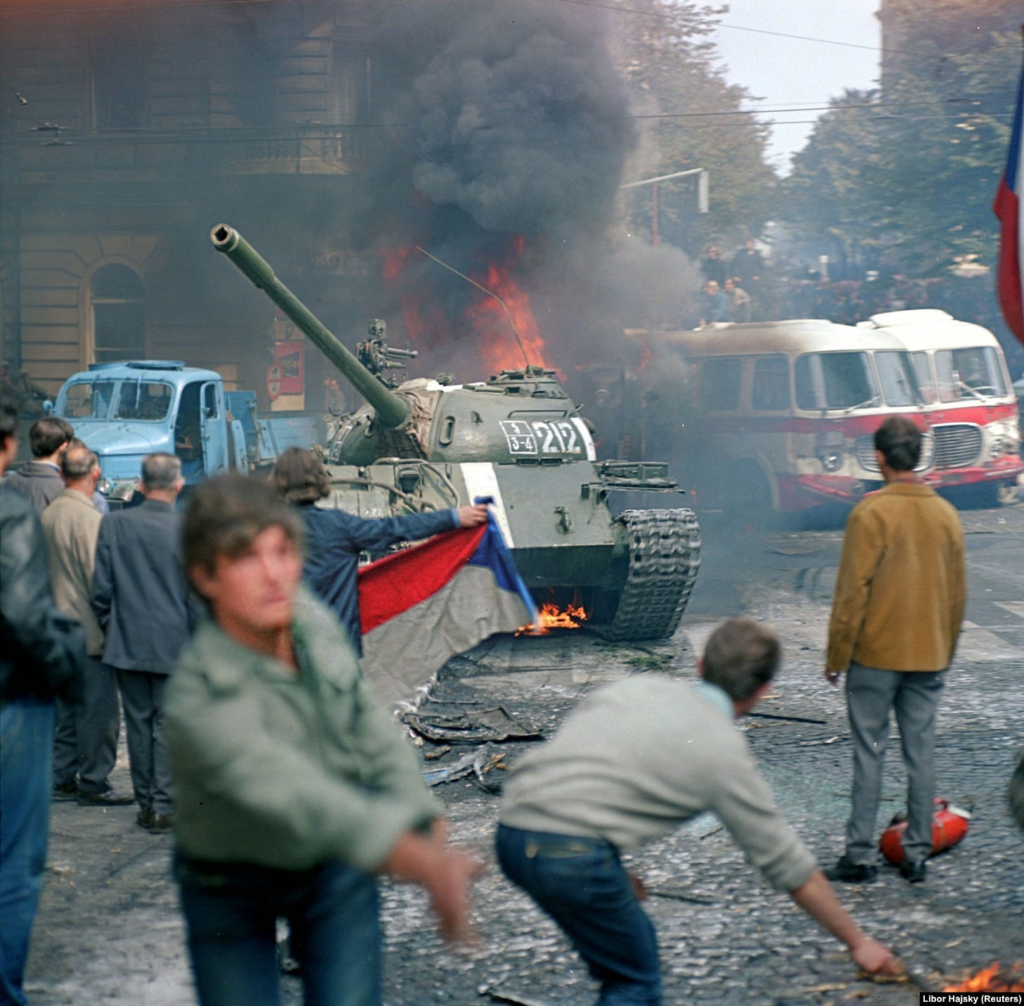
Soviet soldiers fired and military vehicles rammed through people and obstacles. Nearby buildings caught fire. Some victims were shot in the street or while watching from windows. Others were crushed by tanks and trucks or died in fires and traffic collisions caused by the convoys. The violence was spread across the country, including Prague, Liberec, Brno, Bratislava, Košice, and Poprad. Later historical research identified 137 Czechs and Slovaks who died as a result of the invasion by the end of 1968, with around 500 seriously wounded.
Even though there was no formal military resistance to the invasion, people still resisted in the ways available to them. They tore down street signs, painted over place names and house numbers, turned directional signs around, and put up false directions. As a result, convoys got lost while commanders stared at maps that no longer matched the roads. Railway workers intentionally delayed military supplies and printers kept producing leaflets and newspapers. Graffiti appeared everywhere, ridiculing the occupiers and denying that any counterrevolution existed:
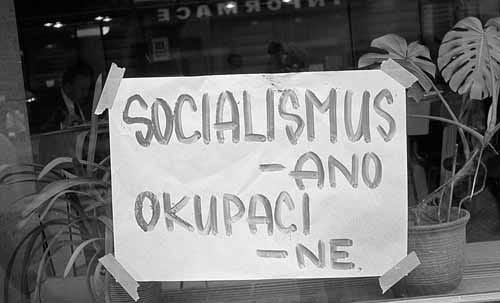
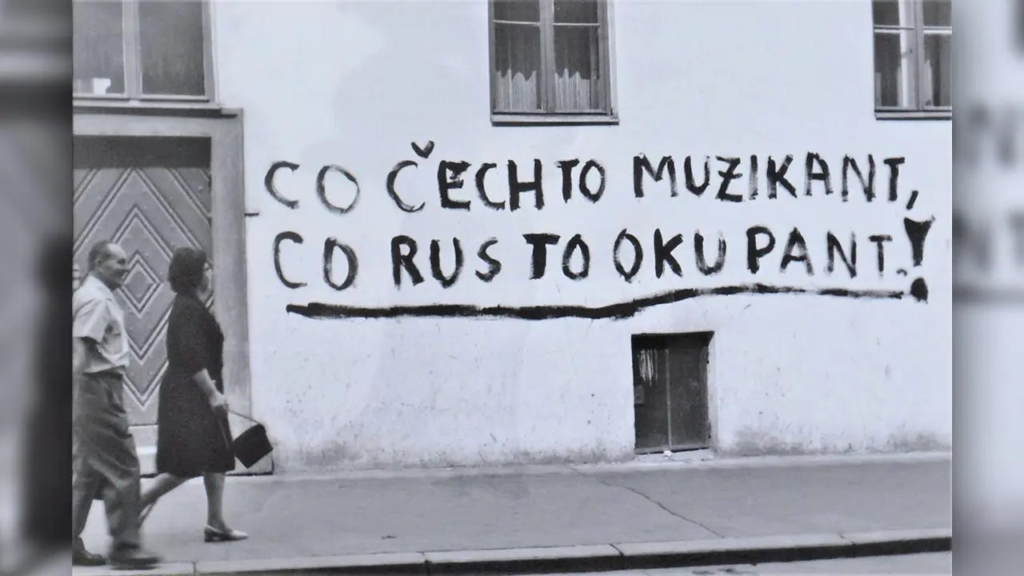
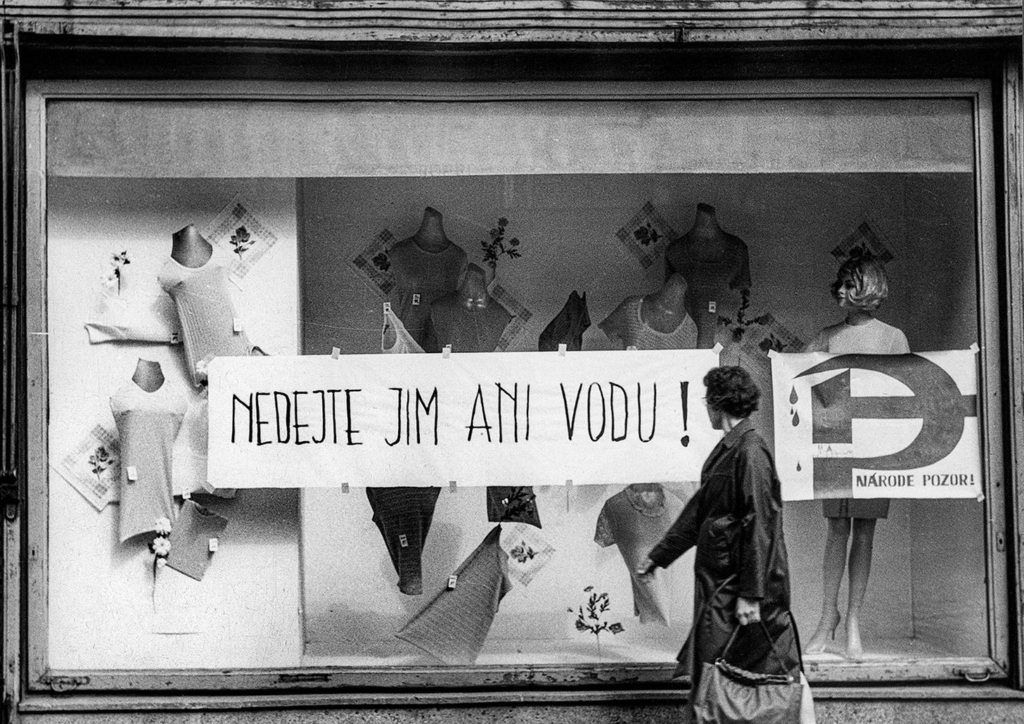
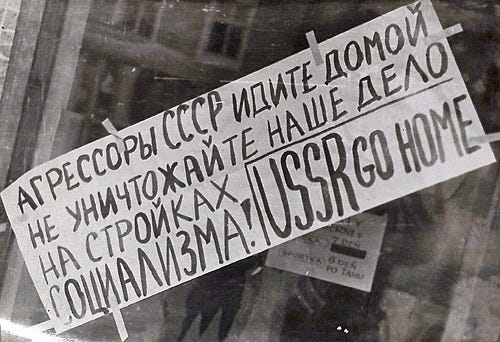
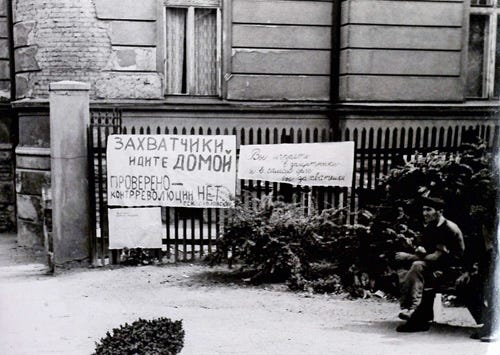
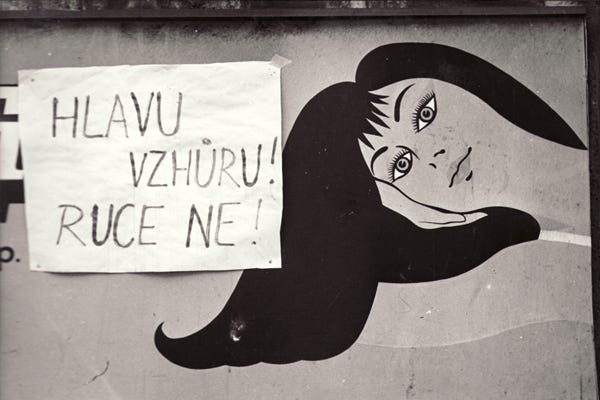
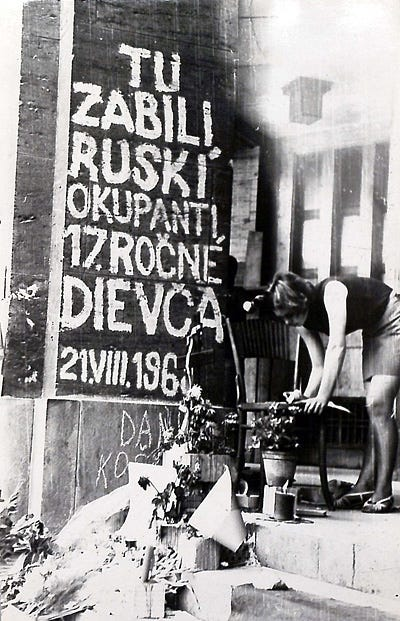
People also walked up to tanks and argued with the soldiers face-to-face. Many of the troops were young conscripts who had been told they were saving Czechoslovakia from fascists or a Western-backed coup. Residents who were capable spoke to them in Russian, showed them newspapers, asked where the alleged counterrevolutionaries were, and tried to make them see all of the many holes in the propagandized narrative they were given. Some soldiers were visibly confused, but that didn’t make the invading army harmless. A confused nineteen-year-old is still a threat when he’s driving a tank or holding a loaded rifle on your street.
Radio became a center of resistance even after troops occupied its main building. Journalists and technicians kept broadcasting from improvised studios and hidden transmitters. They passed on news, appealed for calm, exposed false Soviet claims, and helped people coordinate without offering the occupiers an excuse for even greater violence. For several days, microphones, printing presses, jokes, street signs, arguments, and deliberate noncooperation made a huge military operation politically incoherent.
There’s something very Czech and Slovak about the street-sign resistance in particular. Faced with an enormous mechanized army, people responded by making the country impossible to navigate and then standing beside the lost tanks to explain, with remarkable patience and sarcasm, that nobody had invited them. It was funny, practical, brave, and deadly serious at the same time. While the situation is different and there’s obviously no ongoing invasion, it’s hard not to find a parallel between this and the troll-ish decision that the country made to officially rename the street that the Russian embassy in Prague is located on to Ulice Ukrajinských hrdinů, or the Street of Ukrainian Heroes. Not only do Russian officials have to accept mail addressed to such a street, their embassy is also situated on a square named after the murdered Russian dissident, Boris Nemtsov (náměstí Borise Němcova).
After the invasion, the reform leadership was arrested, flown out of the country, and taken to Moscow. Under extreme pressure, the Czechoslovak delegation accepted the Moscow Protocol, which opened the way to censorship, the rollback of reforms, and a permanent Soviet troop presence. František Kriegel, a communist doctor and veteran of the Spanish Civil War, was the only member of the delegation who refused to sign. The others returned hoping they could preserve some part of the opening or slow the repression, but that hope didn’t last very long.
“Normalization” is one of those obscene bureaucratic words that makes violence sound like little more than mundane office administration. Gustáv Husák replaced Dubček as Party leader in April 1969 and the return of censorship followed. Reformers were expelled from the Party, removed from universities and cultural institutions, pushed out of professions, and forced into menial work. Children could lose educational opportunities because of a parent’s politics and independent organizations disappeared. K 231, the association of former political prisoners, was refused registration and shut down. The workers’ councils were first restricted and eventually banned. Kosík lost his university position and the right to publish. Sviták went into exile. Petr Uhl’s small revolutionary Marxist youth organization was broken up by the secret police, and Uhl spent four years in prison. Dubček himself was demoted, expelled from the Party, and sent off into political obscurity.
The ensuing purges were enormous. Hundreds of thousands of people were expelled from the Party or left it under pressure. Many more were punished informally through jobs, schools, publishing bans, surveillance, and coerced declarations of loyalty. Tens of thousands fled the country. Normalization taught a society that politics belonged back inside controlled institutions, where ordinary people could be watched, managed, and punished if they insisted on speaking.
In January 1969, the student Jan Palach set himself on fire in Wenceslas Square to protest the occupation and the public slide into resignation. His death and the huge funeral that followed are sometimes turned into a purely national martyr story, but that misses what he was responding to.
Palach was reacting to the suffocation of a living political opening. The occupation had begun with tanks, but normalization worked through careers, schools, silence, and the slow lesson that public truth could cost you your future.
The mainstream or more prevalent version of Czech memory can make 1968 sound like a national trauma without any political sentiment. Soviet tanks arrived, Czechs and Slovaks suffered, and the country eventually got rid of occupation after two decades. That’s true of course, but it leaves out important nuance as to what the invasion truly stopped. At the time of invasion society-wide discussions were ongoing about what socialism, democracy, federalism, culture, press freedom, and workers’ power should actually mean.
Liberals and the right alike have often had reasons to skip over that. For liberals, 1968 can become a prehistory of the post-1989 capitalist West, as if every demand for freedom was already pointing toward the market democracy that came later. For the right and nationalists, it can become a cleaner story of an innocent nation attacked by a foreign one, with little room for the communists, democratic socialists, Marxists, trade unionists, and worker activists who were part of the resistance. These readings aren’t identical, but they often both cherry-pick history for a more personally palatable memory.
The party’s role both pre and post 1968 aside, many of the people resisting the invasion were communists. Many wanted democratic socialism, workers’ power, a reformed federation, or a Marxism freed from Stalinist rule. Some wanted liberal democracy, and some simply wanted foreign soldiers out of their streets. Those positions coexisted, argued with each other, and changed over time. The local officials who requested intervention also often get left out of national memory. Soviet domination depended on domestic collaborators, careerists, cowardly bureaucrats, and institutions willing to enforce the settlement. Remembering that doesn’t downplay the imperial nature of the invasion, rather it shows how imperial power embeds itself inside a society.
You can see the same uneasy or inconsistent memory in contemporary Czech politics. The country formally remembers August 1968, as it should. There are anniversary speeches, events, exhibitions, television documentaries, wreaths, solemn statements about occupation, and a general agreement that Soviet tanks in Prague were a national trauma. Then some of the same society turns around and treats Russian power in Ukraine as something to excuse, relativize, or explain away. The anti-system scene, often lumped together under the ugly but sometimes accurate Czech shorthand dezoláti, has absorbed a lot of this contradiction. (Note: The word can be useful as street shorthand, but it becomes lazy and class-blind if it stops people from asking why alienated and angry people are so reachable by pro-Kremlin narratives in the first place.)
The beliefs inside that scene aren’t a monolith and cover a number of topics. They’re more like a pile of resentments and conspiracies that reinforce each other, like the mainstream media is lying, public broadcasters are propaganda, Brussels and Washington control the Czech government, NATO provoked Russia, Ukraine is corrupt or full of Nazis, Ukrainian refugees are being prioritized over Czech citizens, sanctions and aid to Ukraine are why ordinary people are poorer, and Russia is somehow both a victim of Western aggression and a tougher, healthier alternative to liberal democracy. Covid conspiracies, anti-vaccine politics, anti-migrant panic, anti-LGBT resentment, antisemitic hints about global elites, and nostalgia for order under the old regime are also among the types of sentiment you can find in these same spaces. The shared emotional core is usually distrust in the state, experts, public media, the EU, and anyone advocating for a sober look at what Russia continues to do to its neighbors.
The documentary Velký vlastenecký výlet (English title: Change My Mind) is worth mentioning here. The film follows three Czech Putin sympathizers who doubted mainstream reporting about Ukraine as they travel with director Robin Kvapil into the war zone. The idea behind the documentary was to take people who believe the war is being exaggerated, staged, or manipulated by Western and Ukrainian propaganda, and bring them to places like Kharkiv, Kyiv, and the Donbas, where they have to face underground schools, wounded people, destroyed neighborhoods, burials, shelling, and evidence of Russian atrocities.
The documentary is an uncomfortable watch because the evidence doesn’t really work in the simple way people might want it to. Some moments visibly shake the participants, but other moments show them sliding straight back into suspicion, deflection, and conspiratorial self-protection. One of the useful things about the film is that it shows how disinformation isn’t only a problem of missing or poorly conveyed facts. Facts still have to fight through identity, humiliation, grievance, loneliness, and the need to feel like one of the few people who can see through the lie.
The contradiction also shows up around parties and movements such as SPD, PRO, and Stačilo!, which have drawn support while taking anti-NATO, anti-EU, anti-Ukrainian, or openly Russia-friendly positions. Some of these groups use a vague language of “peace,” while others frame blatant pro-Russian sentiment as refusing to be ruled by Brussels or Washington. That framing is uncomfortably familiar. Moscow also claimed to be defending peace, socialism, stability, and legitimate authority in 1968.
The modern Communist Party, KSČM, makes this even messier. Post-1989 Czech law condemns the communist regime as criminal and names the old Communist Party of Czechoslovakia as responsible for the way the country was ruled from 1948 to 1989, including the use of occupying troops after 1968. But that law was treated as a moral and political reckoning, not as an automatic ban on every party using communist symbols or language. So KSČM has continued to operate legally in the democratic system, and in recent years it has worked through and alongside Stačilo!, a project initiated by KSČM and fronted heavily by Kateřina Konečná. Nobody should mistake it for some leftist liberation force hiding inside Czech democracy. In its current Stačilo! vehicle, KSČM is tied to a platform that calls itself left-wing, patriotic, and conservative, foregrounds sovereignty and national interests, wants to stop “uncontrolled migration,” and advertises support for the traditional family which often veers into homophobia. To many Western readers, that mix of hard sovereignty talk, anti-migration politics, traditional-family messaging, and social spending promises would appear more in tune with the right.
And KSČM has a memory problem as well. Its own older statement on 1968 did acknowledge the violent entry of Warsaw Pact troops and the shock it caused, but it also wrapped the invasion in the language of Cold War context, claimed some forces inside Czechoslovakia really did want to overturn the system, and argued that neither Moscow nor the Western powers wanted a successful democratic socialism here. Individual KSČM figures have gone much further. Marta Semelová called the invasion “international assistance,” treated Vasil Biľak as a positive figure, and questioned whether Milada Horáková’s confession was forced. Vojtěch Filip later tried to muddy responsibility for the invasion by stressing the Soviet Politburo’s nationality mix and saying the history of 1968 had been falsified. In 2025, while Stačilo! was trying to present itself as a broader anti-government movement rather than just the old communist brand, Novinky reported that Zdeněk Milata, a Central Bohemian Stačilo! candidate from KSČM, wrote that the armies entering after August 21 had “preserved socialism in the Czechoslovak Socialist Republic.”
If 1968 means anything beyond solemn dramatic statements and museum panels, it should make people suspicious of every politics that asks an invaded country to be reasonable, accept the empire next door, and call surrender “peace.” It should also make people suspicious of parties that treat democratic freedoms as tools to rehabilitate the same authoritarian reflexes those freedoms were supposed to protect society from.
For the authoritarian left, 1968 is inconvenient because it breaks the usual binary of Western capitalism vs. socialist state power. The people who were suppressed can’t honestly be reduced to a capitalist ruling class defending its property. The fact of the matter is that a state calling itself a workers’ state sent tanks into another socialist country and helped a bureaucracy shut those workers down.
If Moscow’s geopolitical control is treated as the same thing as socialism, any independent movement becomes anti-socialist by definition. Workers can demand power, but only until their demand challenges the officials who speak in their name. A factory can be socially owned, but the people inside it can’t decide how it’s run. An invaded population can resist imperial power, but only when the empire carries the wrong flag. By that point socialism has stopped describing a relationship between working people and power.
Many communists understood this at the time. Major Western Communist parties condemned the invasion, and the rupture helped drive the development of Eurocommunism. Romania and Yugoslavia denounced it for their own political reasons. Eight people carried banners into Red Square in Moscow on August 25,1968 including one reading “For your freedom and ours.” The protest was broken up within minutes, and seven participants were beaten and arrested. Left-wing opposition to the invasion existed in Czechoslovakia, across the Soviet bloc, and around the world. Fidel Castro and a small number of loyal pro-Moscow parties defended it, using the familiar argument that state violence was regrettable but necessary to protect socialism from a greater enemy.
There’s no need to turn the Prague Spring into a perfect lost revolution. It was led in part by Party officials, constrained by one-party institutions, and pulled in several directions at once. Its economic reforms mixed workers’ democracy with technocratic and market ideas. Czech and Slovak priorities did not always align and the most radical possibilities appeared late and remained unfinished. But for a few months, people opened questions that official socialism had declared settled about who controls the workplace, what freedom means under socialism, how nations live together without domination, whether a party can represent workers while denying them political power, and whether socialism can survive when truth itself is treated as a threat. And it’s an absolute tragedy that such a movement was destroyed prematurely before we could even see what it was fully capable of achieving.
radical dumpling: screaming into the void about anti-fascism and anti-imperial consistency, from somewhere between east and west.
This article originally appeared on the author’s Substack.
More content from this blog
- Despite Calls for Calm, the Violence in Sweida Shows No Sign of Ending, by Santiago Montag and Hussam Hammoud – 18 July 2025
- Iran’s Fearless Intellectuals, by Naghmeh Sohrabi – 7 March 2026
- Icons and Guns: Inside Russia’s Largest Far-Right Group, by Giovanni Pigni – 5 August 2025
- Inventing the Kurdish Enemy: How States, Nationalism, and Conspiracy Theories Turned a People Into an Enemy, by Jan Ilhan Kizilhan – 17 May 2026
- The Making of Japanese Settler Colonialism. Interview with Sidney Xu Lu – 14 June 2024
Except where noted otherwise, original writing and translations produced by the Left Renewal Blog Collective are published under a Creative Commons Attribution–NonCommercial–ShareAlike 4.0 licence. Republished and translated material remains subject to the licence and terms of its original publication.