The ‘Indigènes de la République’ have helped make visible a racism of the left, one rooted in the pervasive racism consubstantial with French society — but have they become prisoners of the very dynamics they sought to expose? A systematic analysis of the forces bearing down on the most precarious can open up an alternative: a left critique of the invisibilisation of racial and gender questions, one that escapes the far right’s identity politics game and remains grounded in political economy.
From deaths in the Mediterranean to the Baltimore riots to the everyday details of metropolitan life, everything brings us back to the racial question. We feel it necessary to offer a substantive analysis of racism — not merely a reactive response to events as they unfold.
We are witnessing today a simultaneous rise of Islamophobia and antisemitism. This is a double wave, and we must find a way to think about these things together, even as social divisions grow ever sharper and the logic of a war of all against all becomes increasingly uncontrollable. This means refusing the logic of competition between racisms, while also thinking about Islamophobia and antisemitism in all their specificity — and doing so within the broader context of rising social violence, hardening class segmentation, and the effects of structural racism (in housing, employment, and so on). Things are getting harder and harder for the poorest, for those already most precarious: the racialised, women.
The January attacks confronted the left head-on with its denial of racism. The left — which had made a speciality of denouncing victimisation and refusing to acknowledge racism as a massive structural phenomenon. The obsession of institutional feminists with the headscarf exposed the racism of a left clinging to an abstract and aggressive universalism.
This is why we were enthusiastic about the enormous work that has helped render visible this republican, left-wing racism — work to which the Parti des Indigènes de la République (PIR) has contributed since 2004. Many have worked to undermine this respectable racism [1] — a racism for which the indigenous are not truly equals, and which, though it does not justify itself against the racialised, draws its arguments from the great values supposedly meant to emancipate them. A whole history of the condescension and paternalism of the French left remains to be written, notably concerning the way class discourse has been used to keep hierarchies firmly in place within the workers’ movement itself.
Nevertheless, we believe the PIR has drifted. Riding the hardening of identity politics, it now proposes a systematically cultural — even ethnicising — reading of social phenomena. This has led it to adopt dangerous positions on antisemitism, gender and homosexuality. It essentialises the famous “social indigènes,” the subalterns it claims to represent. It is as if the racialised proletarians who suffer racism most violently were being instrumentalised in a political strategy played out essentially within the arena of the white left and fashionable radical intellectuals.
For us — descendants of Algerian Muslims and Jews — to mount a critique of the PIR, just as to mount one of the Left, is a matter of self-defence. We believe we have nothing to gain from a political operation that subsumes all questions under that of race. For us, not only questions of racism but also questions of political economy and gender relations are on the agenda.
the political economy of Islamophobia
Anyone who takes the RER from the Gare du Nord in the morning knows that those who look Arab, Black or Roma face constant pressure. Stop-and-frisk, police “misconduct”, relocation to ever more distant suburbs — the racialised are subjected to geographical, social and symbolic segregation. This total racism — to use Frantz Fanon’s term, consubstantial with French society — begins as early as secondary school tracking, the search for an internship, a first job, and extends to every dimension of existence. In its many manifestations, it stretches from the streets of wealthy neighbourhoods where racialised men are turned away from nightclubs, to the edges of the seas where those who dare to cross borders are allowed to drown with complicit indifference.
In France, Islamophobia — anti-Muslim racism — is to be understood not simply as a secular opposition to religion, but as a racism directed at everyone who appears Black or Arab, particularly when their presence is visible in public space, whether women wearing headscarves or young men hanging around on street corners. The January attacks only sharpened this process of stigmatisation. From attacks on mosques to assaults on women wearing headscarves, to the summoning to police stations of eight-year-old children who had not been vocal enough in saying “Je suis Charlie,” it has become virtually impossible to speak politically if you have an Arab face without having to justify yourself as not being an Islamist.
This is not a matter of mere discrimination or prejudice. Islamophobia refers to a more central question: the racial question. This functions as an assignment to a particular place in the division of labour for certain categories of the population, on the basis of their origin and the colour of their skin. One only needs to observe a building site to see that the heavy work is generally done by Black workers, the more technical work by Arab workers, and that the foremen are white. [2] Racism is the regime of material exploitation that has organised European capitalist development.
Capitalism sets capitals in competition with one another, but also workers themselves on the market. This competition takes the form of a process of “naturalisation” that enables a specific devaluation of labour-power. Certain socio-historical characteristics of the immigrant workforce — qualifications, displacement, specialisation — are “essentialised”: they become extended, they “stick to the skin.” And this allows employers to drive down the price of labour.
But this process is not reducible to a simple “racial bonus” on exploitation. It is a “total social phenomenon.” We can therefore argue that racialisation is a dynamic essential to capitalism — which constantly needs more labour-power and simultaneously produces that labour-power as “surplus,” always in excess. [3]
the inadequacy of the “colonial” framework
This racism marks European metropolitan space in both material and symbolic ways. Nevertheless, the strictly decolonial reading proposed by the PIR prevents us from understanding current dynamics, in which this racism exists only in connection with capitalist development on a global scale. In this sense, colonial history is behind us, even if it leaves traces. The West — that is, the historic centres of capitalist accumulation now threatened by crisis — perpetuates, through the “war on terror,” the continuation of a structuring of exploitation on a global scale: wars for access to natural resources (oil, “strategic” minerals, and so on). But what is also at stake is the intensification of exploitation across all class segments, beginning with the most fragile. This process of impoverishment and marginalisation ends up engulfing subjects who are not Black, Arab, or descendants of the colonised. In the 2005 riots, it was not only Black and Arab young people, but also vast swathes of the “native-born proletariat” affected by generalised impoverishment. Whatever Fox News may have claimed, these were not ethnic confrontations. Young rioters from immigrant backgrounds were represented in exact proportion to their share of the population in the neighbourhoods that rebelled — no more, no less. [4]
the racial question in social struggles
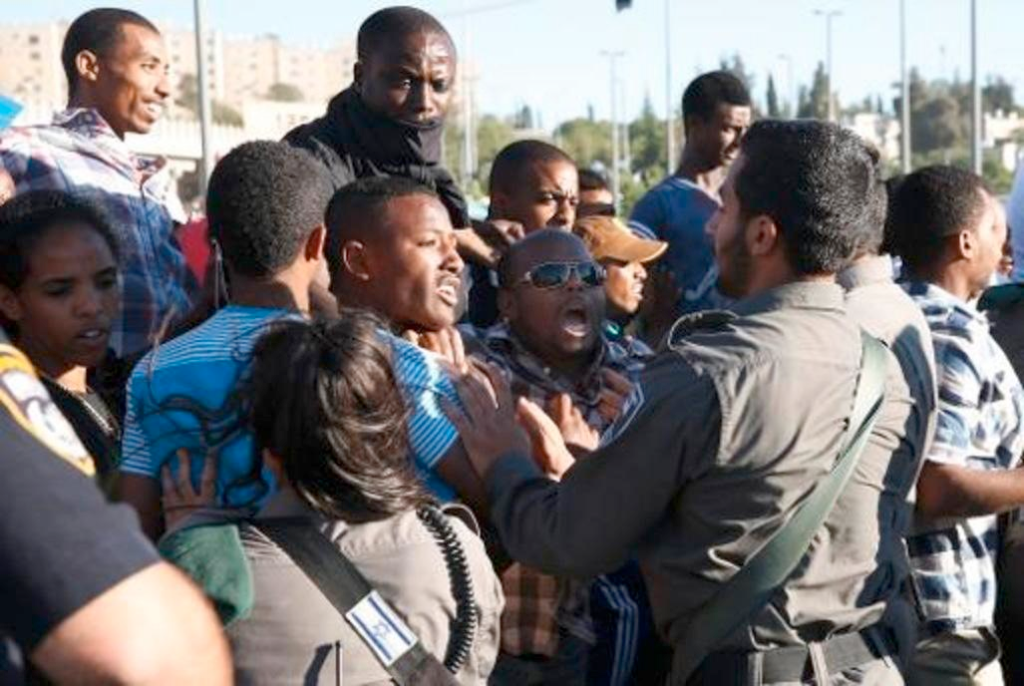
Often, the racial question in social struggles arises as simply immanent to them, rather than in an ethnicising way. If certain struggles are massively racialised, it is because proletarians are assigned to that place in the division of labour. North African mothers organise collectively to obtain social housing; hotel chambermaids at the Park Hyatt go on strike after the rape of a Guinean woman by a fabulously wealthy Saudi man; Chadian asylum seekers occupy a building to live in.
When undocumented Chinese workers in the nail bars of Strasbourg-Saint-Denis collectively demand their wages, go on strike and then run the salon to build the strike fund, they can be joined by Ivorian hairdressers. Despite racial, wage and cultural segmentation, racialised proletarians find themselves together in their struggle. The racial question is central, notably because the question of wages is immediately tied to that of papers — but it does not arise in a strictly identitarian and intra-communal way. Even if the struggle does not immediately produce unity across all class segments. When struggle intensifies, segmentations become less and less significant — provided the lowest segment is taken into account: it was the most isolated and marginalised undocumented women who went on strike here, joined by other migrant women and, after a small victory, by other salons in the neighbourhood. [5] When a struggle is defeated or ends, segmentations harden and everyone returns to their place.
The racialisation we endure is therefore not independent of class divisions. It does not disappear simply because political militants deny it in their discourse. On the contrary, it is thereby reproduced, and we risk deepening further the incomprehension between the different social groups that are brought into contact and sometimes into alliance in struggle. It is precisely because separations and social contradictions are permanent that the emergence of struggles is inevitable. The encounter between the exploited becomes possible — and is itself a stake in the struggle. An encounter between all those who, while exploited in common, are not exploited equally.
the critique of political economy: a “beur” thing?
To conceive of race as a social construction implies being able to think of the other social relations — gender and class — as equally socially constructed. Thinking about systemic racism must make it possible to articulate race and gender, race and class. The field of thought that refuses to treat as natural all the categories produced by this mode of production — property, labour, money — is, to use an old word, that of “the critique of political economy.”
And this is precisely what PIR discourse systematically evacuates. It is as if the “social indigènes” could only escape their subaltern position by doubling down on the racialisation of their place within capital. As if young people from colonial immigrant backgrounds did not have the right — they too — to question the organisation of labour, the ownership of the means of production, exploitation… in short, everything that, barely thirty years ago, defined the divide between left and right. As if all these questions were simply a matter for “intellectuals,” for French people, or worse — the supreme insult — a “beur” thing.
To speak of structural racism without ever identifying the causes of racism is to leave the door ajar for all manner of “anti-system” thinking. Only a firm position on the mechanisms of this “system” allows one to keep a cool head in the great identity game played by the far right.
the antisemitic wave
The murders of Jews in recent years — in Toulouse, Brussels, Paris, Copenhagen — are only the visible tip of the iceberg. In Créteil, in autumn 2014, a couple is burgled: “they’re Jewish, so they’ll have money” — this legitimises the target and the rape of a young woman in front of her husband. The “outbursts” of media personalities extend well beyond the far right. One student union representative explains that it was the Jews — supposedly very numerous at his university — who prevented him from being elected. On the Paris Métro, a lumpen-proletarian from Eastern Europe insults a religious old Jewish man: “Juifff! Shit! Juifff! Crap!”… A bagel delivery man is attacked because he works for the Jews-who-have-money…
We are witnessing a significant resurgence of the old idea that Jews embody money, the system, that they are an occult power. The theoretical substrate of European antisemitism as it sedimented at the end of the nineteenth century is being mobilised. A certain idea of the nation, of a Christian West founded on white racial supremacy from which Jews are excluded. Certain politicians launder themselves by claiming that Maghrebis are spearheading the resurgence of antisemitism. The desecration of Jewish graves in Alsace by “native-born French” (as Hollande put it) was a reminder that antisemitism is not confined to Maghrebis and Black people living in suburban social housing. In French society, antisemitism circulates across different social classes and different cultural spheres. There is also a globalisation of the circulation of this ideology — one need only think of the antisemitic commentary provoked by Dominique Ouattara, the wife of the current Ivorian president, who is of Jewish origin.
The potentially “popular,” anti-hegemonic content of antisemitism has always been the key to its success. “Jews are teacher’s pets”; “Jews run the world.” On this basis, antisemitism can still function as a political operator, redrawing alliances — typically that of a Dieudonné, who comes from the left and from antiracism, bringing part of his audience together with Soral.

structural antisemitism
Modern antisemitism has a systematic dimension. It explains a threatening world that has rapidly become too complex. Bound up with conspiracism, it presents itself as the interpretive key to all the violence and meaninglessness that underlies the dynamics of a social order with no purpose beyond its own reproduction. This apparently delirious explanation of the world has very real effects. The identification of Jews with money, with an abstract and threatening power, endures. In moments of social crisis, it returns in force — even on the left.
The German school of Wertkritik [6] attempts to understand this tendential link between certain forms of anti-capitalist critique and antisemitism. The categories that govern capitalist social relations — money, labour, the commodity — have a double face, what Marx characterises as “fetishism.” A concrete face, which appears to us immediately and shapes our sensory world: the use of the commodity, the content of labour whether manual or intellectual, the lived time of holidays bought on credit… And an abstract face, which operates as the dynamic of the capitalist system — that is, value — but which also makes this famous “system” conceivable. Mediated by value, capitalist social relations remain class relations, founded on exploitation, violently unequal — but they no longer take the form of direct relations between persons. The social violence of capital is indeed exercised upon the exploited, the dispossessed, but its dynamic, by the very logic of this mode of production, contains an abstract dimension.
A whole tradition of anti-capitalism fails to grasp this double dimension of capitalist social relations — at once concrete and abstract. It often naturalises the concrete and concentrates its critique on abstraction: against finance, in favour of the “real economy” or industry, without seeing that the production of consumer goods, the simple exchange of a baguette for money, is also governed by abstractions. Abstraction is therefore attributed to a parasitic dimension, a surplus of the system.
It is with this abstract dimension that Jews are identified: with an occult, impalpable force, with money. Inflated, mythified, biologised, certain of their socio-historical characteristics — their economic activities linked primarily to the sphere of circulation, and their presence across a very wide geographical area — have been the lever for this identification. Thus antisemitism operates typically as a personification of the abstract domination of capital.
In this sense, the Jewish question is both a specific and a central one for the history of European capitalism. It is not a matter of making it an “absolute” question, a “beyond history.” [7] If this type of structural racism has been visited preferentially upon Jews, this racialisation of socio-historical traits can be applied to other populations. Today, for example, in South-East Asia, racism against Chinese people takes on characteristics similar to that directed at Jews (the double figure of money and power).
We must therefore take the full measure of this structural antisemitism, of its historical importance and of the mechanisms of a phantasmagorical figure more alive than ever — not in order to construct this particular racism as exceptional at the expense of all others, but to understand why antisemitism is pernicious and powerful. It leaves capitalism intact by attacking only the phantasmagorical personifications of this social form. To deconstruct antisemitism is to be able to see it where it is found, where it is expressed, and also to work to undo the identification of Jews with money and power.
denouncing “philosemitism” – a disguised antisemitism
The text by Houria Bouteldja calling, in the name of antiracism, for people to march “against state philosemitism” gives us serious cause for concern. [8]
When Segré used the term a few years ago, [9] he was drawing attention to those ideologues who, in the guise of defending Jews, propose a defence of white people, of the West. He was not saying that the French state and reactionary intellectuals were actually philosemitic — still less the white left. Now, “philosemitism” is no longer an antiphrasis, but designates Jews as responsible for constructing an identitarian order. Antisemitism would then be understood as a reaction to state philosemitism — to the role Jews supposedly play as allies of the racist republican state. To struggle against antisemitism would be to struggle against philosemitism. Dialectical subtlety aside, we find here the old idea that Jews, connected to power, are pulling the strings — a figure founded on a reading of colonial history that sets Jews against Arabs and vice versa.
a rereading of the history of Jews in Algeria
The comparison of Jews with the Senegalese Tirailleurs who committed massacres in southern Morocco implies that Jews massacred Muslims or directly participated in colonial repression. It is true that Algerian Jews occupied an ambiguous position with respect to independence. Attached to France — having been naturalised since 1870, and having thereby gained an improvement in their living standards and degree of cultural assimilation — their ancient and recent history nonetheless distinguished them from European settlers too, and they were the target of antisemitism: from settlers, and from the Vichy state.
To hold today that the Shoah concerns only Jews and Europeans — while antisemitism in Algeria is is inseparable from this history — and to forget the minority but significant figures of (communist) Jews engaged in the struggle for independence: this is a choice, a particular way of reading history. Politically, in 1956 at the Soummam congress, [10] the FLN envisaged making precisely the opposite choice, offering an alliance to the Jewish minority, calling on it to express solidarity with the national liberation struggle and promising it “its share of happiness in an independent Algeria”…
politicising antisemitism
This politicisation by the PIR plays out in a to-and-fro between a conference in Oslo for the cream of the global intelligentsia and a demonstration in Barbès.
For this political legitimisation of antisemitism to be acceptable, it must distinguish itself from historical antisemitism. It becomes the “anti-Jewish resentment” of today’s wretched of the earth. Maghrebi, “sympathetic,” authentically ours… It emanates from the fantasy of a pure popular Maghrebi culture that disregards fifty years of history. Like all cultural processes, antisemitic prejudices are hybrid — including among the oppressed. To construct a pure subaltern culture is a theoretical model that falls squarely within what Edward Said has called orientalism. This construction of a radical alterity is first and foremost an act of cultural domination, whether one endows this absolute Other with positive or negative traits.
Now, if we stop reading antisemitism as an ethno-cultural problem, we see that the antisemitic Maghrebis who radicalise politically do not go to the PIR but straight to Soral. By seeking to embody popular Maghrebi antisemitism, one does nothing but ride the wave and the confusion of the left — courting the white left by replaying its historic tactics of minimising racism.
the identification of Jews with Israel
Only a minority of Jews in France are directly connected to the State of Israel. However, a de facto link exists, because Israel represented a “solution to the Jewish national question” after the extermination of European Jews and had taken in a large proportion of Jews from the Middle East and North Africa. A recent state, founded through violence, Israel perpetuates the dispossession of Palestinian populations that Zionism entailed as a national solution to antisemitic violence. Accordingly, we criticize the abuses in Gaza, in the territories, and the accelerating settlement expansion in the West Bank and East Jerusalem.
But the identification of Jews with Israel operates more broadly. There is Netanyahu’s political racket after the Charlie Hebdo attacks — inviting French Jews to make aliyah, in reality inviting them to go and live in the West Bank as foot soldiers of the far right, because Israeli society, in crisis, at war, has nothing to offer. In mirror image, the conflation operates among anti-Zionists. Israel embodies all the world’s problems. But this anti-Zionism is not a critique of a state, its functioning, its nationalist ideology, its violence — it is not a call for international solidarity with the populations victimised by that state (at minimum as a matter of self-defence). A coherent international solidarity would require prioritisation: beginning with the imperialism of one’s own state, and not treating this as an exotic question. It would require not reacting first and foremost to the presence of Netanyahu and Lieberman at the “Je suis Charlie” marches. Israel is cast as the West’s pet, the sole agent of global imperialism, blamed for everything that happens to Arabs—and others—such as the repression of social movements, etc.
The result is that today the political field of anti-Zionism has been shifting steadily to the right. The anti-Zionist left has the greatest difficulty in disentangling the conflation of Jews and Israel within this pathogenic political space — pathogenic for Jews, but also for proletarians in France, racialised or not, who have nothing to gain from this singular fixation on the Palestinian question, fed by nostalgics of pan-Arabism and French leftists.

an anti-system “quenelle” to restore virility
When asked to give her view on what motivated the January 2015 attacks, Houria Bouteldja explains that indigenous males had been driven “mad” by white people’s denial of their virility. Yet according to her, “the residents of the banlieues do not wish to politicise their sexuality.” Likewise, in her contribution to the colloquium “Penser l’émancipation,” she offered an essentialised description of the virility of Arab-Muslim boys, congratulating Soral in passing for offering them a programme for the restoration of a virility damaged by colonialism and racism. To discuss the marchers of the 1980s, she showed us the bodies of hypersexualised indigenous males “delivering the first blows to the white and immaculate Republic” (as if the Republic were not represented by men). She noted in passing that these Arab boys lacked enlightened judgement. Then she sketched the figure of Dieudonné brandishing his quenelle, but “intellectually poorly equipped because he doesn’t have the right software.” Finally, to justify this antisemitic gesture, she mobilised her affect as a woman, declaring her love for Dieudonné: “I love him because he has done something important in terms of dignity, indigenous pride, Black pride: he has refused to be a house negro. Even if he doesn’t have the right political software in his head, he has an attitude of resistance. And I will add that, much more than the nature of his allies, what indigenous people see is this. A man who stands tall.” [11]
On the one hand, this representation of the “Arab boy” is no different from that constructed by white, republican feminists who invoke secularism in exclusionary ways — as intrinsically, culturally, almost biologically, virile and sexist. [12] On the other hand, this essentialisation of Arab-Muslims leaves no room for any other identification among the indigènes. Here, in a nutshell, are the limitations of the PIR programme, sketched out in the notion of a “domestic internationalism” [13] — a racial supremacy that in fact cancels out every other articulation: race and class, race and gender, race and sexuality. According to this logic, an indigenous woman cannot develop tools of struggle and demands based on her present situation, her gender, her sexuality. She must refer eternally to her post-colonial position; her models of emancipation belong only to the past. If she takes it upon herself to defend other causes, or to articulate — just as an example — race and gender, it is because she has adopted the agenda of the whites. [14]
feminism: a luxury for women indigènes?
We recognise ourselves in the refusal of the injunctions of white feminism, which defines the terms of emancipation according to norms fabricated by the dominant for the subaltern and which function to the benefit of the dominant. But for Houria Bouteldja, feminism is a luxury that women indigènes cannot aspire to. On this subject she declares: “The indigenous man is not the principal enemy. A radical critique of indigenous patriarchy is a luxury.” [15] It is not a priority cause compared to white racism, police violence and discrimination. Women indigènes are therefore unable to denounce sexism and patriarchy — which would be merely oppressions among others — without betraying the men of their community. Moreover, they are said to be financially dependent on the men of their communities, which would further reduce their room for manoeuvre.
Yet questions of economic survival are the daily reality for women in working-class neighbourhoods. In Seine-Saint-Denis, the poorest department of Île-de-France, women occupy the parental role in 89.9% of single-parent families — in a general context of a sharp increase in the number of such families (INSEE and Efgip figures). Men have abandoned the family unit, and women find themselves alone raising children and ensuring the family’s survival. It is indeed they who are the pillars of the poorest households. The unravelling of the nuclear family, the “disappearance” of men, does not entail the disappearance of patriarchy: violence perpetrated against women, the structure of the labour market and the family — for example, a divorced woman remains under the tutelage of her ex-husband, notably regarding the children’s upbringing. But this does not authorise Bouteldja to so readily evacuate all feminist aspiration for these women.
endogamous marriage
In singing the praises of endogamous marriage, [16] Bouteldja proceeds as if a white person’s converting to Islam were equivalent to abandoning their privileges and dominant position. Here again, it is a matter of essentialised religion overlaid onto race, as if the two were intrinsically linked. We do not deny that mixed marriages are also marriages between dominant and dominated, but presenting conversion as a social class purifier and advocating for racial non-mixing makes our blood run cold.
This amounts on occasion to condoning arranged marriages imposed on women who are not consulted about the choice of a spouse, and to stifling domestic and intra-communal violence against women. And here, we would like someone to take an interest in the desires of indigène women too, and in the consequences of their denial of autonomy and the frustrations engendered by this communal model. We can see clearly that this subject risks once again falling through the cracks, so as not to divide the community. Once again, women are asked to sacrifice themselves for the group. If the question of domestic and intra-communal violence is used to stigmatise racialised men, if Arab machismo is instrumentalised to absolve that of white men, this is no reason to cultivate omertà among ourselves.
It is true that communal bonds crystallise a need for material solidarity in a context of crisis, pauperisation and cuts to social provision. To identify these phenomena of mutual aid with a simple identitarian retreat is to deny what may in fact be a survival strategy for the poorest. For the community takes on part of the reproductive work — caring for the sick, visiting those in prison, and so on. But structurally, cooking, bringing people together, putting young children to sleep, caring for one’s elderly mother — all this is devolved to women. To idealise communal bonds is therefore to compound the invisibilisation of women’s work within the family and the community.
One might also analyse the Manif pour tous as a retreat into the family sphere and an increasingly violent relegation of women to the private sphere in the context of a generalised struggle for survival. But for white women in Seine-Saint-Denis, one speaks of a return to values, whereas for racialised women one speaks of communitarianism.
We therefore maintain that it is impossible to understand the current context of generalised pauperisation and crisis while bypassing the racial question and a feminist perspective. Because women are assigned to the sphere of reproduction, every moment of crisis implies for them a drastic increase in workload, and intensified violence. Everything connected to consumption becomes more expensive, more time-consuming to obtain, and it is women who partly bear the cost of welfare cuts — in money and in time: if one must queue for three hours at the benefits office, it will be the part-time working woman who does so. Domestic labour increases, and with it the violent reassignment of women to their feminine roles — which have nothing natural about them.
Only a genuinely materialist reading of the racial question — not a merely moral one like that of the left, or a political one like that of the PIR — allows us to articulate the different forms of racism with one another, to refuse to set the victims of racism in competition, and to make the connection with the woman question in the current context.
This reading moreover offers the possibility of escaping a dichotomous vision of these questions. On one side, there is a denial of Islamophobia at the very heart of government — a denial long prepared within the antiracist left. On the other, a part of the field of social criticism systematically underestimates the question of antisemitism. Between the government, the antiracist left and the PIR, the field has narrowed and we are short of air.
To break out of this impasse, we must both acknowledge what is happening now and bring out of the shadows the violence endured in the past. In this sense, the battle for memorial recognition is essential work — but it takes on meaning only if it is effectively connected to social struggles.
The Indigènes de la République’s reading of the racial question seems to us ultimately rather weak, because it is systematically detached from questions of political economy. In this sense, the PIR remains prisoner of the issues of the left — whether white or not.
We believe on the contrary that a class reading of racism must be maintained, even if historically class relations have been used to render racial and gender questions invisible. While a decolonial reading also helps us understand dynamics that are still current, this model today serves to construct a homogeneous subject — as was previously done with class. Thus race subsumes all other questions, becoming the sole paradigm for designating the oppressions connected to capitalist domination. But the point is not to establish a hierarchy between class struggle and racial struggle — rather, it is to grasp the entanglement of the class question and the racial question. It is not possible to think class without thinking race, and vice versa.
What has just happened in Baltimore demonstrates this once again: “Today, there is no legitimate black leadership. If anything the ascension of a handful of blacks into positions of power has demonstrated the structural impossibility of finding a place for the majority of blacks in America. A black mayor, a black police chief, a black president, and Baltimore still burns.” [17]
Notes
[1] See Sylvie Tissot and Pierre Tevanian, Dictionnaire de la lepénisation des esprits, Paris, L’Esprit frappeur, 2002, on the deconstruction of republican racism; Abdelmalek Sayad, “Le Mode de génération des générations immigrées,” in Migrants-formation no. 98, September 1994; Jean-Pierre Vernant, “Le PCF et la question algérienne,” Entre mythe et politique, Seuil, 1996. We cannot resist reproducing this quotation, cited by Saïd Bouamama, which shows the deep colonial imprint at the origin of the resolution adopted unanimously at the inter-federal congress of North Africa of the Communist Party in September 1922: “The emancipation of the indigenous people of Algeria can only be the consequence of the revolution in France (…). Direct communist propaganda among the indigenous Algerians is currently useless and dangerous. It is useless because the indigenous people have not yet reached an intellectual and moral level that would allow them to access communist conceptions. (…) It is dangerous (…) because it would provoke the resignation of our groups.” In Bouamama, “Les fondements historiques et idéologiques du racisme respectable de la gauche française,” 4 March 2015. https://bouamamas.wordpress.com.
[2] See Nicolas Jounin, Chantier interdit au public. Enquête parmi les travailleurs du bâtiment, La Découverte, 2008.
[3] See Karl Marx, Capital, Book I, Chapter XXIII, “The General Law of Capitalist Accumulation,” and more specifically the relation of Irish workers to English workers within the framework of a hardening of the industrial reserve army.
[4] According to the report of the Direction Centrale des Renseignements Généraux (DCRG), 23.11.05, published by Le Parisien, 7.12.05.
[5] See the Combahee River Collective declaration, 1979, on the revolutionary potential of the struggle of Black lesbians — the most dominated segment (gender, race, class).
[6] While adopting its reading of structural antisemitism, we are highly critical of the pro-Israel positions of certain of its representatives, and of the way it evacuates class struggle.
[7] See Enzo Traverso, La violence nazie, une généalogie européenne, La Fabrique, 2002.
[8] The PIR leaflet entitled “No to state racism(s), no to state philosemitism!” was distributed at the demonstration of 21 March 2015. http://indigenes-republique.fr/non-aux-racismes-detat-non-au-philosemitisme-detat.
[9] Ivan Segré, La réaction philosémite, ou La trahison des clercs, Éditions Lignes, 2009.
[10] August 1956, an important moment in the political structuring of the FLN.
[11] “Au-delà de vous: Avec vous, Contre vous. Dieudonné au prisme de la gauche blanche ou comment penser l’internationalisme domestique?“, published 25 February 2014 by Houria Bouteldja on the PIR website.
[12] See Nacera Guénif Souilamas & Éric Macé, Les féministes et le garçon arabe, éd. de l’Aube, 2004, and Isabelle Clair, “Le pédé, la pute et l’ordre hétérosexuel,” Agora Débats Jeunesse, 2012/1 no. 60, pp. 67–78.
[13] To summarise the theory developed by Sadri Khiari of the PIR in the notion of the “Domestic Internationale”: the replacement, in the French context, of the class struggle “with a domestic internationalism in which the racial question, in all its dimensions, would be central. In a word, a decolonial internationalism.” See http://indigenes-republique.fr/internationalisme-decolonial-antiracisme-et-anticapitalisme.
[14] Cf. Malika Amaouche, “Les gouines of colors sont-elles des indigènes comme les autres?”, p. 159.
[15] See “Méditations d’une femme indigène quelques mois après l’affaire DSK: Pierre, Djemila, Dominique…et Mohamed,” published 8 March 2012 by Houria Bouteldja on the PIR website.
[16] See the interview with Houria Bouteldja in Vacarme no. 71, spring 2015, pp. 44–69.
[17] “A Statement from a Comrade and Baltimore Native About the Uprising There“.
Malika Amaouche, Yasmine Kateb and Léa Nicolas-Teboul are feminists involved in various organisations.
The French original of this article was first published in Vacarme 2015/3 N° 72. This English translation, by Daniel Mang, was first published on the Left Renewal Blog.
More content from this blog
- Davyd Chychkan, 1986-2025
- Why “Neutral” Anti-Imperialism Keeps Losing, by Siyâvash Shahabi – 1 March 2026
- Name-calling in Myanmar: on people, by Andrew Selth – 28 February 2025
- Against Political Purity: A Reply to Eli Machover, by David Feldman, Ben Gidley, Brendan McGeever – 11 July 2025
- Executions After War: The Islamic Republic Settles Accounts with Protesters, by Zamaneh Media – 7 May 2026
Except where noted otherwise, original writing and translations produced by the Left Renewal Blog Collective are published under a Creative Commons Attribution–NonCommercial–ShareAlike 4.0 licence. Republished and translated material remains subject to the licence and terms of its original publication.