Toward the Divine State
From the beginning, anarchists suspected that Iran’s revolution might end not in freedom, but in clerical rule. Today, with the benefit of hindsight, the religious character of the revolution appears obvious. But during 1978 and early 1979, events in Iran remained fluid and uncertain. Anarchists nevertheless sensed the danger early. Long hostile to clerical authority and the quiet tyranny of piety, they viewed theocratic politics as inherently hostile to human emancipation.
Amid the protests of late 1978, the French anarchist and former missionary Marie-Madeleine Hermet noticed that revolutionary energy among the poor and illiterate masses was increasingly expressed in religious terms. More troubling still was what she described as a “cult of personality surrounding Ayatollah Khomeini,” which gave the anti-Shah uprising the “air of a crusade.” [1]
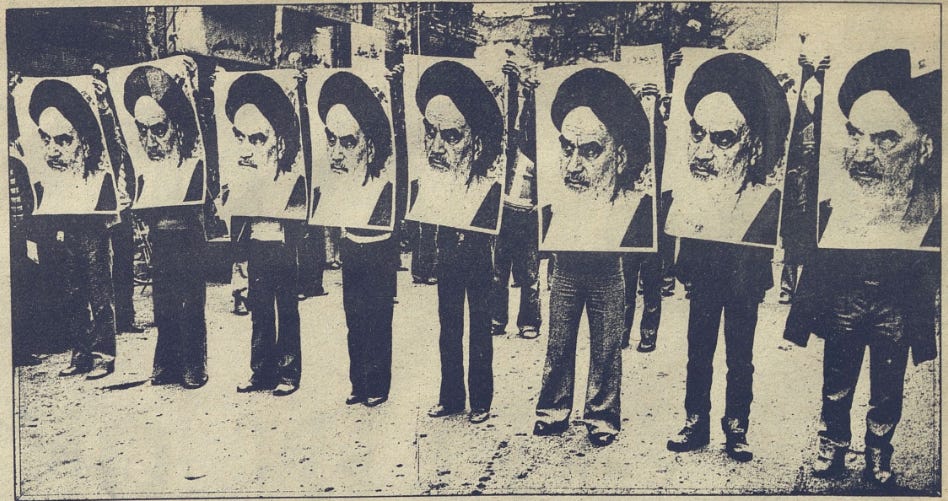
Even if Shiite modernists collaborated with Marxist-leaning intellectuals toward something resembling “Islamic socialism,” Hermet doubted such a synthesis would be viable. An alliance between the mullahs and Marxists, she believed, would prove deeply “unsettling.” [2]
Drawing on history, Hermet reminded readers that revolutions often end not in liberation, but in restored order. She sharpened the point with a striking image: “The Crusaders were well-armed ‘soldiers’ when they entered Jerusalem. So it may well be a Muslim army, with red battalions, that will restore order in Iran!” [3]
Other libertarian writers worried less about Khomeini as an individual than about the clerical machinery surrounding him. Shahin, writing in Freedom, warned that religious power flowed through a vast network of mullahs and mosques that shaped everyday life. “It’s the bigotry of hundreds of minor officials which would be the problem,” wrote Shahin, “Think of priests in Ireland.” [4]
Not all anarchist observers were equally alarmed in the early months of 1979. Writing in January, Alain Sauvage argued that although Islam tended “to dull and regiment the masses,” Shiism might still allow a more positive political evolution. Besides, he asked, “how could one imagine a regime worse than that of the Shah of Iran?” [5]
After February 11, 1979, however, the direction of the revolution became harder to ignore. The Shah’s regime collapsed, Khomeini took power, and the institutional foundations of the Islamic Republic rapidly took shape. The Islamic Revolutionary Guards were established in May, and by June, Khomeini was denouncing liberals and leftists alike as counter-revolutionaries hostile to Islam.
To many libertarian commentators, the revolution now seemed to be confirming their worst suspicions. Religion had become the central mechanism of domination. Hermet declared the events in Iran a “retrograde revolution,” the opposite of genuine emancipatory. [6] The Italian paper Rivista Anarchica argued that Islamic authority was even more entrenched than political dictatorship because it was “rooted in people’s consciousness for millennia.” [7]
In July 1979, the German anarchist paper Freie Presse reported on the criminalization of homosexuality under the new regime and condemned revolutionary courts carrying out executions for sexual or moral offenses. [8] One form of domination, the paper argued, had simply given way to another. Drawing comparisons to Nazi Germany and Castro’s Cuba—where “deviants” were sent to forced-labor camps—it concluded bitterly: “In Persia, the imperial plague has been driven out by religious cholera.” [9]
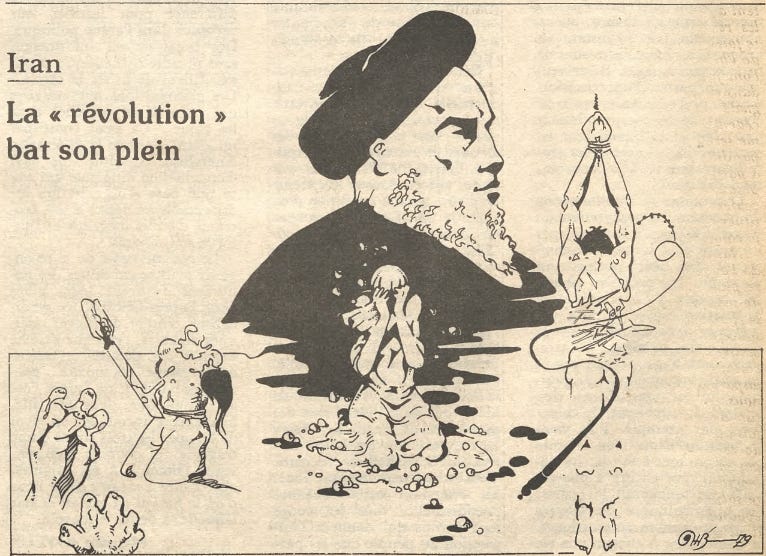
By late 1979, Iranian anarchist exile and translator Rahsepar was confirming many of the earlier libertarian fears. Writing in Le Monde Libertaire, he argued that the uprising of 1978 had emerged not from political parties, but from the people “under the influence of religion.” These religious forces, he wrote, “succeeded in channeling the anger of the masses into their own structures. They had 3,000 study circles and 180,000 mullahs.” Rahsepar also confirmed severe repression against homosexuals and dissidents. The religious organization was merging completely with the structure of the state, creating a system in which laws could neither be challenged nor changed. [10]
The Left’s Illusions
If anarchists distrusted clerical rule, they were no less wary of a revolutionary Left eager to take over the state. The uprising of 1978 and early 1979 brought together Marxist intellectuals, guerrilla organizations, and, as one German anarchist paper sneered, “dogmatic communists of the Moscow school.” [11] To anarchists, these groups represented the authoritarian Left: movements that claimed to speak for the people while trying to centralize power in their own hands.
This fear ran through much of the libertarian response to the Iranian Revolution. Writing in November 1978, Marie-Madeleine Hermet worried that both the “sword and the censer” might fall into “feverish and bloodthirsty hand,” whether those of “ayatollahs, of Marxists (Leninist or otherwise), of Stalinists or Trotskyists, of Maoists.” [12] The danger, in her eyes, was not simply one ideology replacing another, but the recurring spectacle of revolutionary elites claiming the right to rule in the name of liberation.
For more than a century, anarchists had defined themselves against what they regarded as the authoritarian Left. They cared less about the traditional divide between Left and Right than about the divide between libertarian and authoritarian politics: between decentralization and centralized power. The German anarchist Rudolf Rocker warned in 1947 that the modern “extreme left” had embraced “a new absolutism” far more expansive than the monarchies of the past. [13]
To many anarchists, Iran revealed how badly the Left could misread a revolution. Maurice Joyeux saw nothing surprising in Khomeini’s rise to power. What puzzled him instead was the shock of the Left itself. “What is less understandable,” he wrote, “is the disapproving astonishment of men of the Left and far Left” confronted with a pattern that had repeated itself for two centuries: one ruling faction overthrowing another with the support of ordinary people, only to establish a new form of domination.
In Joyeux’s view, parts of the Left were helping to deceive the masses while reproducing the very power structures they claimed to oppose. What he called a “catch-all Marxist leftism” had become an exhausted and coercive ideology that “pushes peoples into hopeless struggles where they will find only new masters.” [14]
Others saw the same pattern repeating across the twentieth century. Writing in Rivista Anarchica, Fausta B. pointed to the recurring illusion of “revolution” in Russia, Cuba, China, and Portugal. Echoing Joyeux, the author wondered how the Left could repeatedly lose “its capacity for understanding, analysis, and objectivity?” [15]
For many anarchists, the events of 1979 fit a pattern visible since the French Revolution itself: ordinary people overthrowing one system of domination only to fall under another. Whether clothed in nationalism, Marxism, or religion, movements claiming absolute truth and centralized authority tended to produce new ruling classes. The tragedy of Iran, in their eyes, was not simply that a revolution had failed, but that so many on the Left had once again mistaken power for liberation. The problem was not only who held power, but how power itself was exercised.
Notes
[1] Hermet, “Les Troubles en Iran: Révolution, Islam et socialisme,” Le Monde Libertaire (Paris), Sep 14, 1978.
[2] Ibid.
[3] Hermet, “Révolution, oui ! Croisade, non!” Le Monde Libertaire (Paris), Nov 16, 1978.
[4] Shahin in Freedom, Feb 10, 1979.
[5] Sauvage, “Un peuple en marche, mais vers quoi?” Le Monde Libertaire (Paris), Jan 4, 1979.
[6] Hermet, “Une révolution rétrograde,” Le Monde Libertaire (Paris), Feb 15, 1979.
[7] Fausta B., “Se Komeini Fosse Una Donna,” Rivista Anarchica (Milan), April 1979. #3
[8] These reports are documented by the Iran Human Rights Documentation Center.
[9] “Todesurteil gegen Homosexuelle,” Freie Presse (Wetzlar), July 14, 1979. #1,2.
[10] Rahsepar, “Iran d’hier a aujourd’hui,” Le Monde Libertaire (Paris), Nov 22, 1979; see also “Crisis in Iran” Fifth Estate, Dec 4, 1979.
[11] “Es lebe der Tyrannenmord,” Schwarze Gockler, Sep 1978.
[12] Hermet, “Révolution, oui ! Croisade, non!” Le Monde Libertaire (Paris), Nov 16, 1978. #4,5.
[13] Rocker, Zur Betrachtung der Lage in Deutschland : d. Möglichkeiten e. freiheitl. Bewegung (New York; London; Stockholm, 1947), 9.
[14] Joyeux. “En Iran, face à la réaction religieuse, ce sont les femmes qui portent l’espoir des peuples arabes abrutis par l’Islam!” Le Monde Libertaire (Paris), Mar 22, 1979. #4.
[15] Fausta B., “Se Komeini Fosse Una Donna,” Rivista Anarchica (Milan), April 1979. #1.
Tom Goyens is a Professor of History at Salisbury University, Maryland, USA. His research and writing focus on the American and transatlantic anarchist movement in the 19th and 20th centuries.
This article was first published on Anarchistories. You can read part 1 here and part 3 here.
More content from this blog
- Bangladesh’s Women Have Lost before the Country Has Even Voted, by Navine Murshid – 9 February 2026
- Asian Values Remain the Go-to Defence of Illiberalism, by Mark R Thompson – 25 May 2025
- Campists React to Iran Protests With Usual Dehumanization of Non-Western Struggles, by Brian Hioe – 19 January 2026
- Despite Claim to be Leftists, Signatories of Counterpunch Letter Glowingly Praise an Authoritarian Theocracy, by Brian Hioe – 12 May 2026
- War with Iran Is Sparking an Antisemitic Chain Reaction, by Jonathan Jacoby – 21 March 2026
Except where noted otherwise, original writing and translations produced by the Left Renewal Blog Collective are published under a Creative Commons Attribution–NonCommercial–ShareAlike 4.0 licence. Republished and translated material remains subject to the licence and terms of its original publication.