Eight weeks into Trump’s war with Iran, the origins of the Islamic Republic are worth revisiting. The regime now confronting Washington was born in the upheaval of 1979, when the Shah’s pro-Western monarchy collapsed and Ayatollah Khomeini seized the revolutionary moment. But the Iranian Revolution was no unified uprising. The anti-Shah movement brought together a volatile mix of factions: secular nationalists, pro-Soviet Communists, Marxist guerrillas, religious left-wing militants, and Islamic fundamentalists. By 1980, Khomeini had outmaneuvered his rivals and consolidated a regime that has endured ever since.
How did anarchists interpret these dramatic events as they unfolded amid violent direct action and repression, propaganda, and ruthless power politics? These were hardly new phenomena. Anarchists had been analyzing such features of radical upheaval since the French Revolution. But was Iran different?
To explore that question, I returned to the archives and examined some twenty articles published in the European anarchist press at the time. Their writers pieced together events largely from Western media reports and, on occasion, from correspondents inside Iran itself. What follows is not a comprehensive study, but rather a thematic snapshot of the libertarian [1] response to one of the late twentieth century’s defining revolutions—an event that, forty-seven years later, has once again returned to the headlines.
Shared Struggle Against Domination
Demonstrations against the Shah’s regime spread across Iran throughout 1978 and were met with escalating violence. One of the regime’s most feared instruments was SAVAK, the secret police, notorious for torture and assassination. In January, several thousand people protested in the religious center of Qom, where security forces killed several demonstrators.
By September, the Shah had declared martial law. Soon afterward came further bloodshed at Jaleh Square in Tehran. The most shocking event of the year was the torching of the Cinema Rex in Abadan on August 19, which killed between 370 and 470 people. Though widely blamed at the time on SAVAK, the attack was later traced to Islamist militants targeting what they saw as Western decadence.
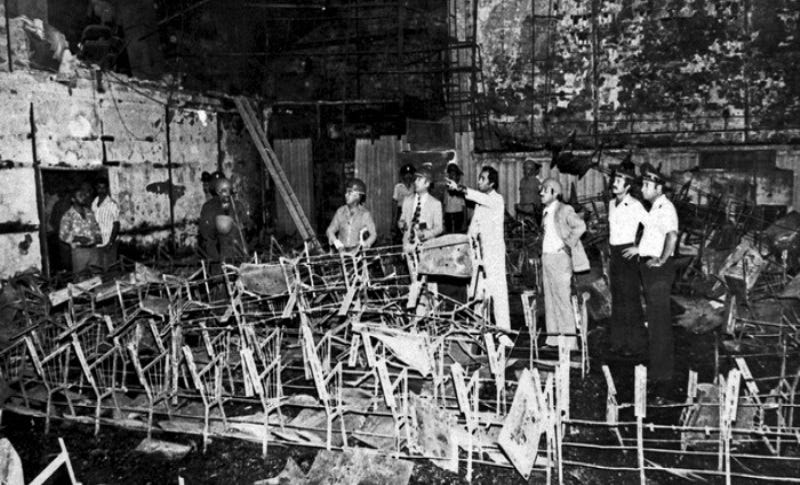
The anarchist press unequivocally condemned the Shah and welcomed the broad struggle against domination. In the wake of the summer violence, the West German anarchist paper Der Schwarze Gockler [The Black Rooster] emphasized the temporary unity of Iran’s diverse opposition—ethnic, religious, and political groups joined in common resistance.
The paper also interpreted the Abadan cinema fire—wrongly, as it turned out—as a likely regime operation, insisting that “the only ones capable of such barbarity are always those in power.” The claim reflected a familiar anarchist distrust of official narratives. In the same article, titled “Long Live Tyrannicide,” the destruction of banks, party offices, and state buildings was praised as a rational response to oppression. [2]
Enthusiasm for popular revolt was tempered by anxiety that one form of domination might simply replace another, a theme to which we will return. In September 1978, for example, the French anarchist Marie-Madeleine Hermet published the first of several thoughtful reflections in Le Monde Libertaire. A former Catholic missionary turned atheist libertarian, Hermet approached events in Iran with caution rather than celebration.
“Is it a mass movement?” she asked, or merely “an outburst of religious fanaticism?” While acknowledging the courage of the crowds and the legitimacy of their grievances, she doubted whether the revolt was truly emancipatory. Widespread illiteracy, she argued, made many people “even more unconditionally devoted to religious leaders than to political ones.” What troubled her most was the possibility of “a revolution of a religious type…” [3]
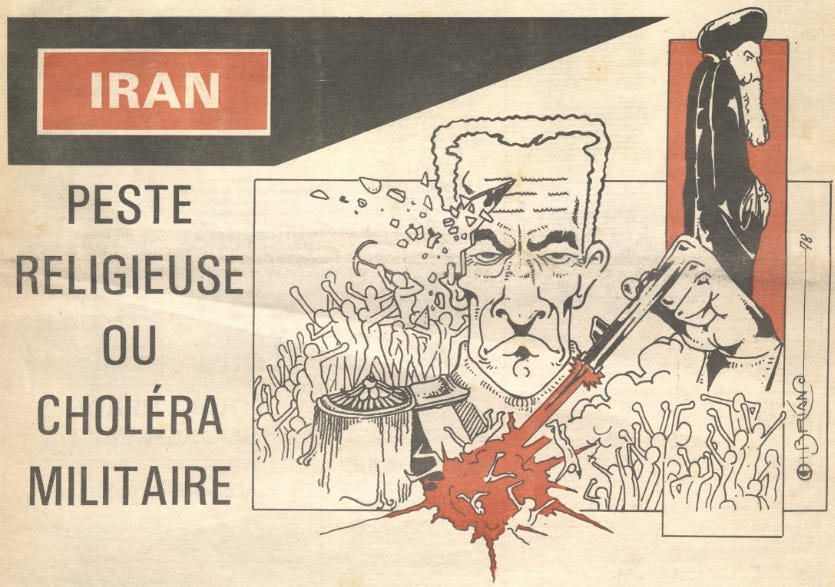
By January 1979, the French anarchist Alain Sauvage also questioned where the revolt was heading. The rebellion was broad and powerful, he argued, but united only negatively—against the Shah. Such unity was tactical and temporary, and “cannot fail to break apart as soon as a new regime takes power in Tehran.” [4]
Writing in London’s Freedom, Shahin likewise admired the uprising while fearing its outcome. Yet he insisted that one achievement could not be denied: the “self-activity” of ordinary people who had, “by their own will, brought down a system.” [5]
Anti-Imperialism
For anarchist commentators, the Iranian Revolution could not be understood solely as a domestic revolt against the Shah. It unfolded within a larger system of imperial power, Cold War rivalry, capitalist dependency, and strategic control. Yet these writers differed on whether the revolution might break this system or merely exchange one form of domination for another. Far from being merely “anti-American,” the libertarian press offered a multi-layered critique of empire.
The Shah was rarely seen as an autonomous ruler but as a client sustained by Western power. According to Der schwarze Glockler, the United States was the real “power behind the throne.” [6] Hermet, writing in 1978, offered a broader geopolitical reading. She stressed Iran’s oil wealth, strategic Cold War location, and the involvement not only of the United States, but also Britain, the Soviet Union, China, and West Germany. “It thus appears,” she concluded, “that the Shah’s dictatorship rests on economic and strategic considerations.” Domestic despotism and foreign domination are intertwined. [7]
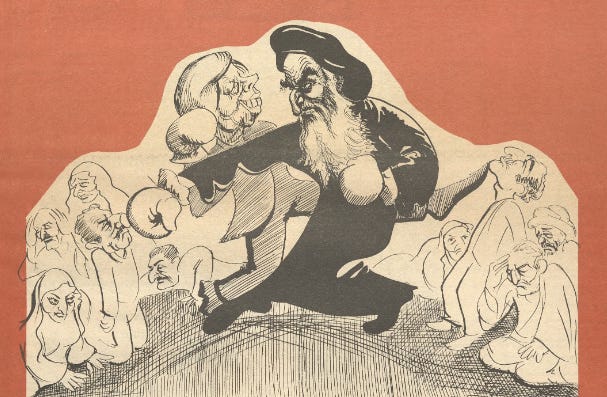
If the Shah was a client ruler, Iran itself appeared as a geopolitical prize. Several commentators saw the superpowers treating Iran less as a people than as strategic territory. Alain Sauvage argued that, for Washington, Iran served as a bastion against Soviet influence in the Middle East. Once the Shah’s regime began to crumble, the central question became how to preserve that alignment.
Sauvage suspected that the United States was less interested in saving the monarch than in managing succession. Khomeini, he warned, might prove an acceptable replacement if he remained capable of interpreting religious rule in ways that did not “hinder the development of capitalism and consumer society.” [8]
Yet empire was not understood as exclusively Anglo-American. Anarchists often universalized domination rather than moralizing only against the West. In March 1979, one month after Khomeini consolidated power, the celebrated French anarchist writer Maurice Joyeux (1910-1991) published a polemical essay arguing that the “sham revolutionaries” invoking Islam were helping to strengthen “the spiritual imperialism of the Muslim world.” What the world was witnessing, he wrote, was the “classic interplay of imperialisms.” [9]
A similar dual critique of imperialism and religious domination appeared in the Detroit anarchist journal Fifth Estate in December 1979. The ongoing hostage crisis, it argued, was being used to inflame nationalism and xenophobia. “We spit on the American flag and the Iranian flag, on all flags.” Yet the journal was equally hostile to the new regime, describing Islam as containing the psychological elements needed to mobilize the population “around a program of self-sacrifice and submission.” [10]
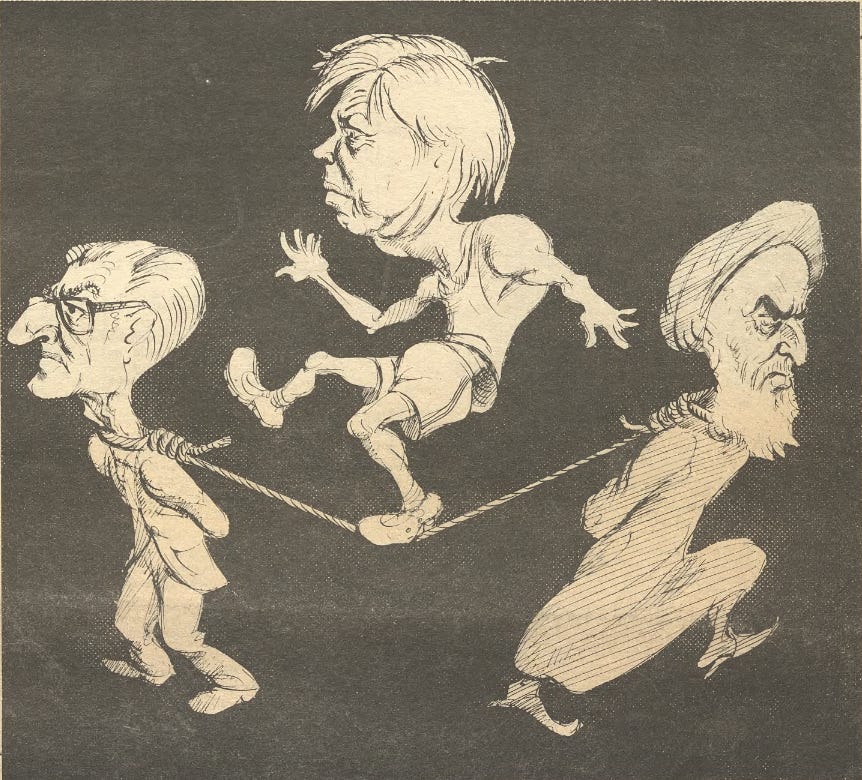
Not all libertarian anti-imperialism took the same form. Whereas Maurice Joyeux portrayed Iran as a battleground of rival imperialisms—Western, Marxist, and Islamic—leaving little room for revolutionary hope, the Spanish anarcho-syndicalist paper Solidaridad Obrera approached events through the lens of the struggle for social and economic autonomy. Contrasting Henry Kissinger’s call for an American military presence with Abolhassan Bani-Sadr’s plea for an economy that “produces for itself,” the paper briefly entertained the possibility that Shiism might support decentralized forms of social organization. Even here, however, the central question remained whether genuine self-management could emerge from a movement already captured by new authorities. [11]
Against the New Masters
If anti-imperialism led anarchists to examine the foreign forces surrounding Iran, anti-authoritarianism shaped how they judged the revolution itself. For these writers, the central question was never simply whether the Shah would fall, but what kind of power would replace him. Their answer was stark: unless hierarchy itself was dismantled, revolution would merely change uniforms. Domination, not just a particular regime, is the root problem.
Writing in November 1978, Marie-Madeleine Hermet sharpened this classic anarchist critique by turning from state to ideology itself: not only rulers, but doctrines. She feared that the Iranian Revolution might harden into a crusade in which “the New Bibles being brandished are, alongside the Judaic and the Christian, the Qur’an, Capital, Mein Kampf, and the Little Red Book.” [12] Sacred texts and secular dogmas alike, she suggested, demanded obedience rather than freedom.
A few months later, in February 1979, with Khomeini ascendant, Hermet believed events were confirming her fears. What did Iranians truly hope for, she asked? If they sought individual autonomy, equality, and freedom of thought and action, disappointment surely awaited them. Hopefully, they did not wish “to pass from the condition of slaves of the Shah to that of slaves of Allah and of a religious potentate.” Deeply sensitive to what she saw as the stultifying effects of revealed religion, she ended with a severe warning: “as long as a book, even if it be the Qur’an, decides for people, those people can never claim to have come of age.” [13]
By April, after the revolutionary government began executing supporters of the old order, the earlier warnings about a fresh authoritarianism seemed vindicated. “The case of Iran allowed for no revolutionary hopes of any kind from the outset,” wrote Fausta B. in the Italian anarchist paper Rivista Anarchica. The mass movement against the Shah, the author argued, had drawn much of its strength from the religion embodied by Khomeini. “But was all this not foreseeable?” Fausta B. asked, “Was it not known that the struggle served to replace one power with another—one even more terrible because it has been rooted in people’s consciousness for millennia?” [14]
On December 3, 1979, a new constitution making Khomeini the Supreme Leader of Iran was approved by an official 98%, though large sections of the population boycotted the referendum. An editorial in Le Monde Libertaire argued that beneath the language of faith lay a familiar struggle for power among competing elites, especially within the clergy. In the East as in the West, the paper observed, “all clericalisms conceal, beneath the verses of faith, the ambitions of a caste.” By then, the revolutionary mystique had faded, revealing ordinary power politics beneath sacred language. [15]
By the end of 1979, many libertarian observers concluded that Iran had not abolished authority but sanctified it. They distrusted any institution claiming sacred or ideological authority over human beings. The language of faith, they argued, concealed an old drama: rival elites competing for command while ordinary people remained subjects.
Notes
[1] The term ‘libertarian’ refers to the common European meaning of anti-authoritarian socialism, not the American meaning of free market, minimal government ideology.
[2] “Es lebe der Tyrannenmord,” Der schwarze Gockler (Karlsruhe), Sep 1978.
[3] Hermet, “Les troubles en Iran: Révolution, Islam et socialisme,” Le Monde Libertaire (Paris), Sep 14, 1978.
[4] Sauvage, “Un peuple en march, mais vers quoi?” Le Monde Libertaire (Paris), Jan 4, 1979.
[5] Freedom, Feb 10, 1979.
[6] “Es lebe der Tyrannenmord.”
[7] Hermet, “Les troubles en Iran.”
[8] Sauvage, “Un peuple en march, mais vers quoi?”
[9] Joyeux, “En Iran, face à la réaction religieuse, ce sont les femmes qui portent l’espoir des peuples arabes abrutis par l’Islam!” Le Monde Libertaire (Paris), Mar 22, 1979.
[10] “Crisis in Iran—None for Me, Thanks,” Fifth Estate, Dec 4, 1979.
[11] “La cara oculta del Irán,” Solidaridad Obrera (Barcelona), Apr 20, 1979.
[12] Hermet, “Révolution, Oui! Croisade, Non!” Le Monde Libertaire (Paris), Nov 16, 1978.
[13] Hermet, “Une révolution rétrograde,” Le Monde Libertaire (Paris), Feb 15, 1979.
[14] Fausta B., “Se Komeini Fosse Una Donna,” Rivista Anarchica (Milan), April 1979.
[15] “Iran: La Corde Raide,” Le Monde Libertaire (Paris), Dec 13, 1979.
Tom Goyens is a Professor of History at Salisbury University, Maryland, USA. His research and writing focus on the American and transatlantic anarchist movement in the 19th and 20th centuries.
This article was first published on Anarchistories. You can read part 2 here and part 3 here.
More content from this blog
- Revolutionary Roads and Marxism Today. Interview with Kevin Anderson – 9 July 2025
- Sixty Years on From the 1965 Indonesian Genocide – 30 September 2025
- Understanding how Middle Eastern Populations Experience the Human Rights Framework in Practice, 75 Years after the Universal Declaration of Human Rights. Interview with Shadi Mokhtari – 8 December 2023
- Israel: A settler-colonial state? A clarification, by Ralph Leonard – 22 November 2023
- Against the Hierarchy of Lives — a Call for an Internationalism from Below, by Roud Collective – 25 August 2026
Except where noted otherwise, original writing and translations produced by the Left Renewal Blog Collective are published under a Creative Commons Attribution–NonCommercial–ShareAlike 4.0 licence. Republished and translated material remains subject to the licence and terms of its original publication.