A recognizable habit has metastasized across some segments of Western academic discourse and most of the terminally online Marxist-Leninist political culture: rather than examining conflicts through historically grounded analysis or the material conditions of the people involved in them, politics is sorted into a rigid binary and left there. On one side sits the Western imperial bloc and on the other, whoever happens to be considered the rival of the Western imperial bloc, a category that requires remarkably little scrutiny to qualify for. Russia, whose oligarchs park their money in London and Zurich, whose economy is threaded through the same Western financial architecture its advocates claim to oppose, which supplies more refined fuel to Israel than any other nation on earth and whose passport holders constitute the third largest foreign ethnic group serving in the IDF, has nonetheless become the designated standard-bearer of the anti-Western camp. Clearly, the binary is not derived from material analysis. What matters is not what a state actually does, whom it arms, how it treats its own people, or where its money goes. What matters is the posture: the right speeches at the UN, the right rhetoric about American hegemony, the correct vibes of opposition. The camp is assigned by aesthetics, then defended as science.
Nobody has embraced this more than the campist influencer class: ideological grifters who convert other people’s wars, prisons, occupations, deportations, and grief into political content, then label the product “anti-imperial solidarity” and call it organizing. Flattering lighting, the carefully practiced explainer voice, and that unmistakable look of someone who has just discovered the “true” enlightened nature of the world and regards your failure to do the same as a character flaw they want to help you eradicate with weaponized conviction, which is to say, the exact expression American televangelists have been aiming at television cameras for decades. They are, in every meaningful sense, bystanders who have mistaken their distance for objectivity: countries never visited, languages never learned, conflicts experienced exclusively as content, the analytical frameworks largely self-assembled from other people’s certainties and presented, with considerable nerve, as expertise. They are not historians. They are not regional specialists. They can barely read the “sources” they crop and refer to. What they are is very online, very confident, and surrounded by an audience trained to mistake confidence for competence and avoid asking questions, because the algorithm rewards certainty and punishes nuance.
Part of the appeal is aesthetic. The whole performance is calibrated to project severity, principle, and a studied, unsentimental hardness. They sneer at “moralism”, by which they mean the suggestion that actual human beings experiencing actual harm might constitute a meaningful data point, because cruelty reads as sophistication and empathy is for liberals. They cast themselves as hardened revolutionaries, clear-eyed enough to stomach ugly truths for the sake of the larger cause. To complete the bit, they borrow a vocabulary of false gravitas: “material conditions,” “dialectics,” “critical support,” “manufacturing consent,” “the imperial core.” These phrases have the benefit of sounding weighty to people who haven’t heard them before and conveniently vague and moldable to everyone who has.
the gospel of the binary
None of this is to say that American foreign policy sits beyond criticism. Of course it doesn’t, and a serious accounting of US hegemony and interventionism is necessary. But the problem isn’t the criticism, it’s that it only ever runs in one direction. At the center of all of this is a childish binary: America bad, therefore America’s enemies good, or at the very minimum defensible and complicated. If a Western-aligned state bombs civilians, that’s imperialism. If Russia bombs those same civilians in that same building, there’s “important context.” If a US-backed government disappears people, it’s authoritarianism. If an anti-US government does it, then raising the subject becomes poorly timed, suspiciously framed, or possibly foreign-funded. The framework cannot handle the mundane fact that two states can be monstrous simultaneously, because that would require going off-script.
The formula never changes. Find a state you feel opposes the US, inflate it into a revolutionary symbol, reframe any local resistance as a color revolution or CIA operation, bury atrocities under “nuance,” or simply call them fabrications, accuse anyone who objects of parroting Western propaganda, and and call the process “understanding dialectics.”
Under this system, imperialism becomes something only the US and its allies are physically capable of practicing. Authoritarianism becomes “discipline.” Propaganda becomes “counter-hegemonic media.” Dissidents become “foreign assets.” Independent workers’ movements become “destabilization campaigns.” Every ugly reality gets fed through the machine until it comes out clean, defensible, and ready to regurgitate.
Their favorite move is definitional gatekeeping. Imperialism, they explain, only counts if it clears a very specific theoretical checklist derived from Lenin over a century ago, and when a state inconveniently clears that checklist anyway, the checklist gets quietly amended or contorted. A definition of imperialism that cannot identify empire when it’s standing on someone’s neck is nothing more than an alibi. But that’s the whole point – an alibi is exactly what it’s designed to be.
Then comes “materialism,” a word doing an enormous amount of unpaid labor in this ecosystem. It signals that the speaker, unlike the naive moralist weeping over mere mass death, has grasped the deeper structural forces operating beneath visible suffering. What it carefully excludes is the most material thing of all: the bodies under rubble, the family that just learned their home no longer exists, or the working class losing their livelihoods. None of that makes the cut.
The person delivering this hardened-realist analysis is, of course, (most often) doing so from a comfortable bedroom many thousands of kilometers from the nearest front line, with no skin in the game and no consequences to bear. Someone else’s city gets bombed. Someone else’s son dies at the front. Someone else’s language or culture is erased by decree. Someone else’s relatives disappear into a prison that the commentator will never once have cause to worry about. Their “materialism” costs them precisely nothing.
Real material conditions include prison cells, checkpoints, bomb shelters, forced passports, dead relatives, stolen homes, banned languages, destroyed hospitals, conscription notices, and the specific experience of having your suffering declared geopolitically inconvenient by someone who has never once been forced to live with inconvenience.
What the campist left cannot do is begin with the person. A person’s testimony of suffering that confirms the theory is evidence. Testimony that complicates it is propaganda: selective, suspiciously timed, and almost certainly funded from somewhere unfriendly. If the victim names the wrong empire, the victim becomes suspect. What disappears is exactly what this analysis claimed to illuminate: the concrete material conditions under which people actually live.
ukraine, eastern europe and selective victimhood
The campist response to Ukraine has been particularly illuminating and revolting.
Since February 2022, Russia has engaged in a highly visible, well-documented campaign of terror against a sovereign Ukraine. Russian forces have struck a children’s theatre in Mariupol where civilians sheltering inside had written “дети” (children) on the ground outside in letters large enough to be visible from the air. In the same city, they bombed a functioning maternity hospital with patients in active labor inside (making its one of the 1,350+ documented attacks on Ukrainian healthcare facilities), then claimed the building had been seized by militants. They have fired cluster munitions into the Kramatorsk train station as civilians queued to evacuate, killing over 58 people. They have hit a shopping center in Kremenchuk on a Monday afternoon. They have dropped missiles on a nine-story residential block in Dnipro, killing 46 people including children. They struck a café and grocery store in the village of Hroza during a memorial gathering, killing 59 people in a village of roughly 300. They have left mass graves in Izyum with evidence of systematic torture.
They destroyed the Nova Kakhovka dam, flooding downstream communities, killing civillians and animals, displacing tens of thousands, and triggering an ecological catastrophe across the Dnipro delta. After Russian forces withdrew from Bucha, investigators found bound civilians shot at close range in residential streets alongside documented sexual violence against occupied residents, including children and the elderly. After the liberation of Kherson, they found detention sites used to torture and disappear civilians, and continue a policy of terror conducting “human safaris” (intentional targeting with drones) against civilian residents.
They have conducted the forced deportation of Ukrainian children on a scale that prompted the International Criminal Court to issue arrest warrants for Vladimir Putin and his Commissioner for Children’s Rights. They have methodically targeted Ukrainian power infrastructure across consecutive winters, leaving civilian populations without heat or electricity in temperatures well below freezing, not as a side effect of military operations but as the stated strategy.
And then Ukrainian drones finally reached Moscow.
And suddenly, the campist left have opinions. Suddenly rules of engagement matter. Suddenly civilian proximity to a target is a meaningful moral consideration. Suddenly the psychological experience of living under aerial bombardment is worth exploring in detail and at length.
Strange how that works. Bucha didn’t move them. Mariupol didn’t garner concern. 59 people killed at a village memorial was ignored. What has prompted this sudden outpouring of humanitarian sentiment is drone disruption at a scale not remotely comparable to what Ukraine has endured, in a city none of them live in, targeting a government none of them are at risk from. And the reason is transparently not empathy. It’s that they still, despite all evidence to the contrary, regard Russia as some kind of functional counterweight to US hegemony, which makes its airports and oil fields more sacred than Ukrainian hospitals or residential blocks.
These same dynamics show up in every serious discussion of Eastern Europe. When people from the region describe life caught between two forms of power, with Western military structures and neoliberal economics on one side and Russian revanchist nationalism on the other, they are typically informed that this perspective reflects a failure of anti-imperialist clarity.
Acknowledging that NATO exists as an instrument of American geopolitical power and that Russia is simultaneously an imperial aggressor is treated as some kind of ideological system error. Ukrainians resisting invasion become proxies. Belarusians opposing dictatorship become color revolution pawns. Czechs, Poles, Balts, Georgians, Crimean Tatars, and Chechens are classified as unreliable narrators of their own experience. The only Eastern Europeans whose testimony counts are the tokenized handful willing to reproduce the approved script, preferably in fluent English, aimed at a Western audience positioned to appropriately validate it.
It assumes that the people actually living with the consequences of empire cannot be trusted to describe those consequences, while distant commentators living in the imperial core, with no personal stake and limited regional knowledge, mistake detachment for objectivity and present themselves as the adults in the room.
The same logic appears in attempts to minimize Soviet and Eastern Bloc repression by suggesting it was primarily directed at intellectuals and bourgeois elements. A real “they were asking for it” narrative. But the historical record shows that surveillance, forced labor, deportation, and political violence operated at vast scale against workers, peasants, and ethnic minorities as well. Entire villages were uprooted through collectivization. Populations were transferred. Languages and cultures were systematically suppressed. This was not a targeted administrative inconvenience solely for the professional class. It was enormous, and it was deliberate.
Eastern Europe is admitted into the campist worldview on specific conditions: when its suffering can be attributed to NATO expansion, Western neoliberalism, or American hypocrisy. When it points instead toward Soviet domination, Russian imperialism, forced assimilation, and decades under Moscow’s boot, those histories become awkward and “problematic.” Acknowledging both simultaneously draws accusations of nationalism, Russophobia, or false consciousness, whichever lands first. The implication running beneath all of this is that people who actually lived under these systems are too close, too emotional, too compromised to analyze them correctly, while outside third-party observers working from self-invented purity test frameworks retain superior clarity.
And when Russian tanks arrive, historically and today, accompanied by forced passports, abducted children, banned languages, and ruined cities, the response is reliably the same: but there’s nuance.
iran and the liberal mirror
Current debates about Iran reveal the same pathology from a different angle, with the added complication of a liberal mirror image performing its own version of identical failures, just slightly different branding.
Because the Islamic Republic occupies a position of strategic opposition to the United States and its regional allies, significant parts of the international left approach Iran almost entirely as a geopolitical variable. Criticism of the regime’s internal repression gets treated with suspicion, downplayed, or quietly discarded when it appears to align with Western human rights narratives.
What this removes from view is the actual reality of Iranian society. Over the past several decades, Iran has seen repeated waves of protest from workers, students, women, and ethnic minorities. The Jin, Jiyan, Azadî uprising following the death of Mahsa Amini in 2022 exposed the depth of popular opposition to the Islamic Republic’s political order. Protesters articulated grievances spanning economic inequality, gender repression, and political authoritarianism. For many of the people taking to the streets at serious personal risk, the most immediate source of domination was the Iranian state itself.
Recognizing this demands no amnesia about sanctions or the history of Western intervention in the region. In fact, you can’t just gloss over those points at all. But it still requires accepting that multiple forms of domination can coexist simultaneously, and that those carrying the greatest weight are always ordinary people. Bombs falling on Iran do not transform the regime into a progressive force. Online performances of solidarity with the state offer no protection to those living beneath US or Israeli bombs. Political prisoners, striking workers, dissident journalists, and women disappear from the analysis, replaced by the geopolitical positioning of the government that represses them.
Liberal foreign policy discourse performs its own version of the same error, with more palatable aesthetics and arguably worse self-awareness. Authoritarian regimes become problems to be solved through external pressure, whether diplomatic, economic, or military, operating on a persistent assumption that Western power functions as a corrective force in world affairs. History has not been especially cooperative with this assumption, but it persists.
This became particularly visible in the enthusiasm with which some welcomed Israeli and American strikes on Iranian targets, as though the most effective expression of solidarity with people living under a theocracy is, to put it plainly, bombing them. Those voices might now sit with what that enthusiasm actually produced. Trump signed a “ceasefire agreement” that changed the situation on the ground in no meaningful way, while Israel has continued striking Lebanon without serious interruption or consequence. The architecture of regional destabilization that was cheered as liberation has resolved with the Iranian population bearing costs that have nothing to do with their liberation. The contradiction was always harder to ignore than it appeared: many of the same voices that correctly emphasized the human costs of imperial aggression in Ukraine showed minimal interest in the bombing of a girls school or how strikes on Iran contributed to rising oil prices that directly benefited the Russian economy and helped finance the war they claimed to oppose. It was never a coherent position, and recent events have simply made that more difficult to overlook.
History provides remarkably little reason to believe that third-party military intervention reliably produces democratic transformation. Campaigns conducted in the language of liberation, like those in Iraq and Libya. have produced prolonged instability, humanitarian catastrophe, and the collapse of functioning institutions.
Campist anti-imperialism and liberal interventionism are two reflections of the same analytical failure. One reflexively defends states that oppose Western power. The other reflexively trusts Western power to resolve crises abroad. Both subordinate local populations to larger geopolitical narratives and both turn human beings into supporting characters in someone else’s ideological fantasy.
gatekeeping palestine
There is a particular irony lodged at the center of campist engagement with Palestine that rarely gets examined: a movement that claims Palestinian liberation as one of its central moral commitments has constructed a framework that actively drives away potential allies for that cause because their own oppression is ideologically inconvenient.
The claim, stated or implied with remarkable consistency, is that it’s simply impossible to hold genuine solidarity with Palestinians while also naming Russia as an aggressor. It uses a familiar simplified pattern: Russia opposes Western hegemony (while it materially supports Israel), opposing Western hegemony is the correct anti-imperialist position, therefore criticizing Russia is, at minimum, suspicious, and at worst a form of serving Western imperial interests. Anyone unwilling to accept this framework is swatted away.
The immediate effect falls heaviest on Eastern Europeans. Those who have their own reasons to name Russian imperialism as a lived reality are told that doing so disqualifies them from coalition and solidarity. They’re welcome to join, but only if they’re willing to classify their own experience of occupation, forced assimilation, and imperial violence as exaggerated, irrelevant, or the fault of NATO expansion.
What gets systematically disregarded is the evidence of what Eastern Europeans who do support Palestinian liberation have actually done. Ukrainian civil society organizations have signed open letters of solidarity with the Palestinian people. Ukrainian activists have organized street demonstrations calling for solidarity with Palestinians while their own cities are under bombardment. Others have fundraised for humanitarian aid to Gaza. Ukrainians recently joined the Sumud flotilla, boarding a boat to break a blockade while their homeland remains under one. None of this is invisible, but it is simply inconvenient, because acknowledging it would require updating a framework that has already arrogantly decided what Eastern Europeans believe.
And it’s worth asking plainly: how does any of this help Palestinians? The framework is US-centric to its core, less a theory of liberation than a purity testing mechanism. Attitude toward NATO functions as the master key, unlocking or revoking all other solidarities regardless of what someone actually believes, organizes for, or risks. Calling Russia an imperial aggressor will not cause the global south to implode, will not rehabilitate the US, and will not retroactively justify a single cruise missile fired in the wrong direction. What it might do is allow more people, those with living memory of occupation and dispossession or those who understand imperial violence from the receiving end, into rooms where they could be genuinely useful.
But the campist left did not invent this dynamic alone. Part of what sustains it is the behavior of highly visible pro-Ukraine advocates who have made Israeli genocide apologia a feature of their public presence. When a commentator with hundreds of thousands of followers, like Frank Peter Wilde, describes the absence of pro-Palestine activists as one of his favorite things about Ukraine, or characterizes Palestinians as being held as a deposit to blackmail democratic, liberal values, he is not simply expressing a personal position.
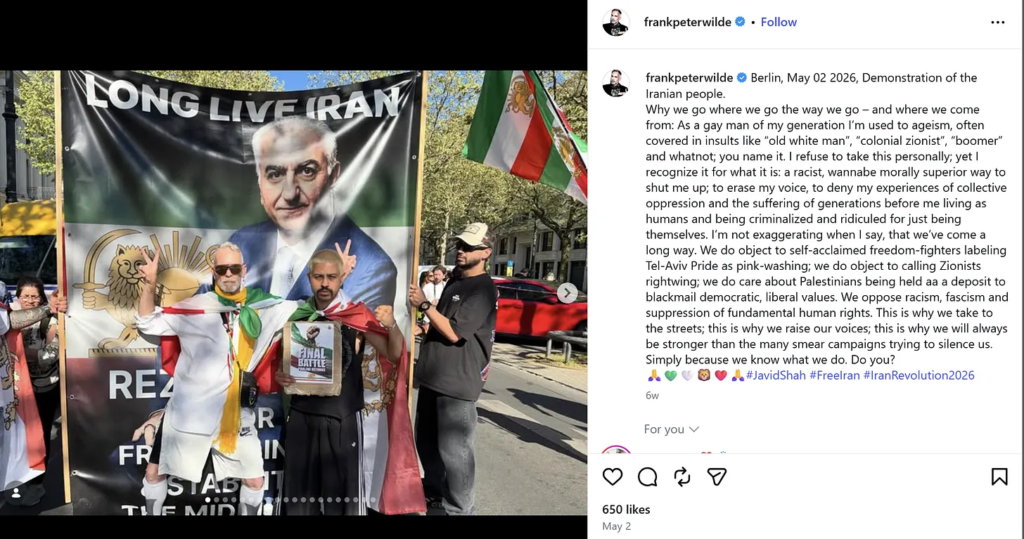
He becomes the face of a demographic that he doesn’t actually belong to, but who the algorithm decided he represents, and he hands the campist left exactly the shorthand it needs to avoid engaging with what Ukrainian civil society has actually done on Palestine.
None of this is difficult to understand. A politics that begins with the geopolitical positioning of states and works backward to the people inside them is not a politics of liberation.
What the campist framework has actually produced is a remarkable record of failure. It has not weakened American hegemony. It has not advanced Palestinian liberation. It has not built internationalist coalitions or meaningfully supported working-class movements in the countries it claims to champion. What it has done is provide a sophisticated-sounding rationale for why the testimony of people under occupation, bombardment, or dictatorship should be discounted whenever it arrives inconveniently.
The liberal interventionist mirror image deserves no softer assessment. Expressing solidarity with populations under authoritarian rule through the mechanism most likely to kill them is not a coherent politics either, and the recent record in Iraq, Libya, and now Iran offers no serious reason to revisit that conclusion.
Both tendencies share the same essential feature: the people most affected are the last ones consulted and the first ones written out. The campist does it with theoretical vocabulary. The liberal does it with the language of humanitarian concern. The result, for the people on the ground, is functionally identical.
radical dumpling: screaming into the void about anti-fascism and anti-imperial consistency, from somewhere between east and west.
This article originally appeared on the author’s Substack.
More content from this blog
- New Documentary ‘Double Minority’ Tackles Women’s Political Exclusion in Nigeria, by Oluwakemi Adelagun – 11 July 2025
- Degrowth, Marx and the Future of the Left. Interview with Kohei Saito – 12 July 2026
- Does “Conservative Leftism” Have a Future?, by Chris Maisano – 11 September 2025
- Fuck Leftist Westplaining, by Zosia Brom – 4 March 2022
- Earthquake in Afghanistan: When Customs Kill More Than the Quake, by S N Tripathy – 6 September 2025
Except where noted otherwise, original writing and translations produced by the Left Renewal Blog Collective are published under a Creative Commons Attribution–NonCommercial–ShareAlike 4.0 licence. Republished and translated material remains subject to the licence and terms of its original publication.