Trilingual Hong Kong newspapers from the 1940s, a patriotic Japanese business man, and Imperial Appropriation of Decolonial Discourse
Note: This article was originally written and published in Chinese at 裂隙 Fuite as 《雨夜与灯火:大东亚叙事下的日占香港》. 裂隙 Fuite is a new WeChat ‘Official Account’ (公众号) co-operated by four Chinese students of the humanities across the Pacific including myself, two at Duke Durham and two at Duke Kunshan University. The translation was assisted by an LLM (specifically Gemma-4-31b) – the translated version is not exactly the same as the original at places, and this is partially intentional.
Introduction
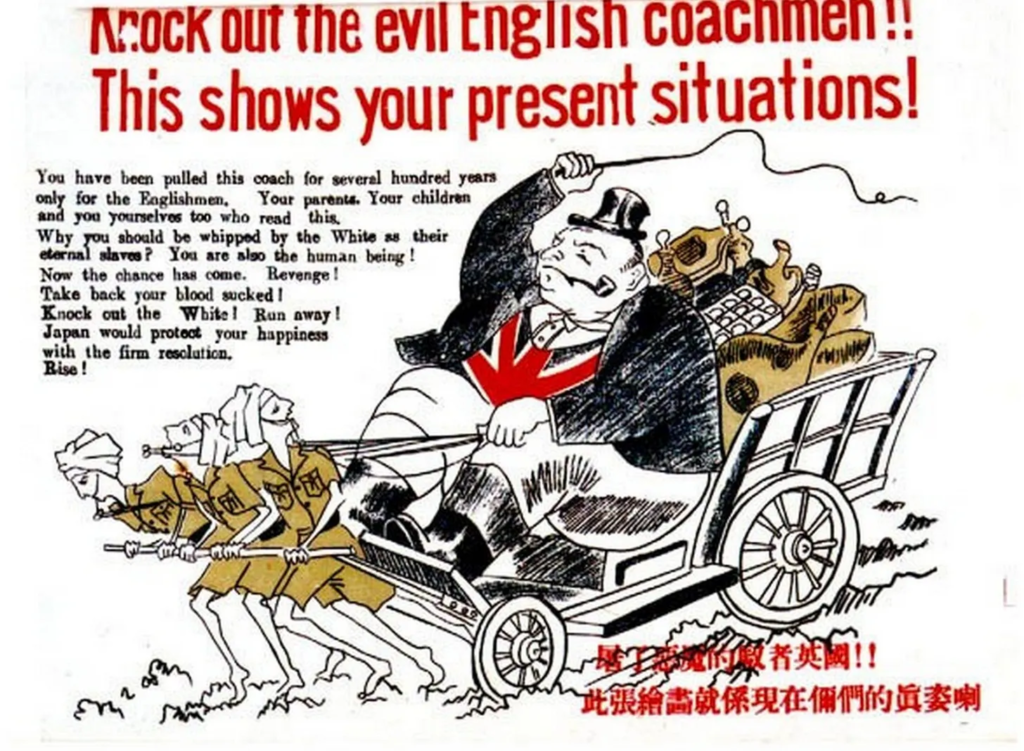
When we discuss the history of Hong Kong, we often first think of the era of British rule and the Special Administrative Region following the 1997 handover. Yet, there is a conspicuous gap in the British narrative during World War II: those “three years and eight months” following “Black Christmas” in 1941, when Hong Kong fell and became a Japanese “occupied territory.”
For the British, this humiliating chapter of history is difficult to recount; for China, Hong Kong was not the “main battlefield” of the War of Resistance as we typically remember it. However, as a site where the conflicts of China, Britain, and Japan converged, Hong Kong offers us a glimpse into how a sophisticated narrative machine operates: how it packages aggression as “liberation,” justifies occupation with “co-prosperity,” and quietly sets silence apart from resistance.
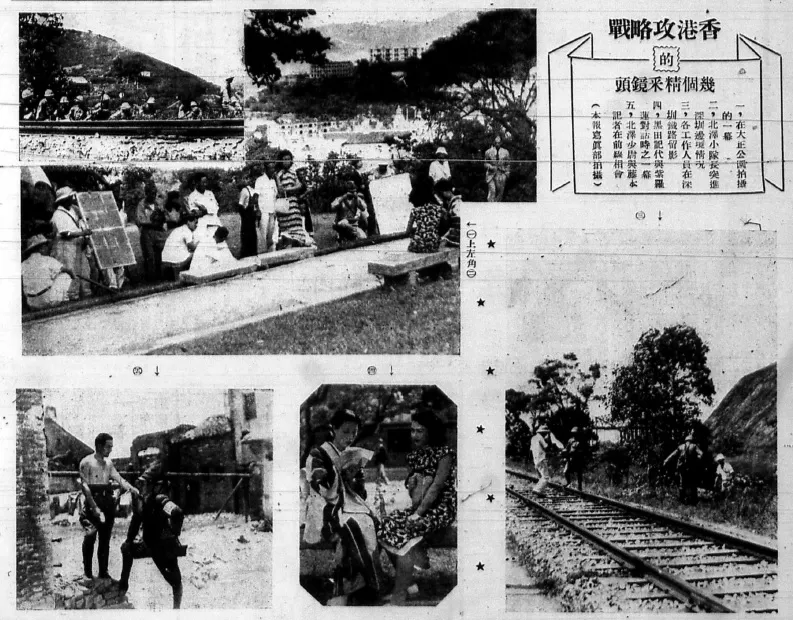
In attempting to piece together the narrative landscape of Japanese-occupied Hong Kong in 1942, my gaze eventually fell upon a newly compiled collection of documents. The old articles from the Hong Kong Daily, reports from industrial magazines, and scholarly essays cited in this text are all drawn from Crossing Eurasia: Translations and Selections of Anti-Japanese War Literary Materials from Hong Kong Periodicals (Chung Hwa Book Company (Hong Kong), 2024), compiled and translated by Professor Kwong Ho Yee of the Chinese Department at the Chinese University of Hong Kong.
Published nearly eighty years after the Second World War, this anthology gathers fragments scattered across colonial archives, occupation-era newspapers, and private letters, placing them back into the living context where the discourse of the “Greater East Asia Co-Prosperity Sphere” was generated. It allows texts that were once buried by the flames of war or simplified by the narratives of victory to speak once more.
The following text is a series of slices, slowly unfolded from these archives that span Eurasia.
I. Returning to Port on a Rainy Night: From “Hellfire” to “Testimony”
June 15, 1942. Hong Kong.
Amidst a torrential downpour, an official ship belonging to the “Imperial Army Comfort Delegation” slowly entered Kowloon Harbor. On board was Okamoto Isotaro, a businessman who had long supplied the Japanese army in South China and served as the “General Director of the Guangdong Collaborative Agency.”
This was not his first visit to the city, but it was his first return since Hong Kong had fallen and been incorporated into the “Imperial Land of the Great Japanese Empire.” To understand his state of mind at this moment, one must turn back the clock five years to a panicked retreat that he still remembers with “utter heartbreak.”
After the Marco Polo Bridge Incident of 1937, full-scale war broke out between China and Japan. Over two hundred Japanese expatriates in South China were forced to abandon businesses and assets they had spent years building. They boarded the evacuation ship *Tangshan Maru* in tears, drifting for a night in the lower reaches of the Pearl River before arriving in Hong Kong. Okamoto clearly remembered his appearance upon stepping onto the streets of Hong Kong: head wrapped in bandages, shirt drenched in sweat, shorts wrinkled and messy, his body burning with a 39-degree fever, so wretched that “even tears would not flow.” More etched into his memory were the looks of the Chinese people stopping to watch him: in his eyes, “every single one seemed to hold contempt and a sneer.”
Yet, he wrote in his recollections that he “could not hate” the local Chinese. The people he truly detested were the British and Americans. When he witnessed a Briton or an American, dressed in a dashing white suit, striding “with gallant poise” while arm-in-arm with a woman in thin clothing, a sudden surge of rage rose in his chest. That “feeling of sudden heat” remained vivid in his memory years later. “Just you wait!” he vowed in his heart. He called these Westerners “blue-eyed magicians,” admitting that having lived in Guangdong for years, he knew their methods “deserved to be despised”; at that moment, his hatred for them “had never been higher.”
The wretchedness was caused by the West, and the humiliation was brewed by the West; even the “sneering” eyes of the Chinese were ultimately attributed by him to Western colonial rule over the city. Thus, the colonized people of Hong Kong were quietly transformed from “others” who looked coldly upon his misery into “compatriots” who shared the same humiliation—provided, of course, that they also hated the British and Americans.
On this rainy night five years later, the man who once suffered a persistent fever and silent tears returned. This time, he stayed in a hotel specially reserved by the Governor-General’s Office of Japanese-occupied Hong Kong, overlooking the night view of a city returned to “Imperial Land.” As the rain cleared and stars emerged, the lights of ten thousand homes “magnificently reappeared before his eyes.” He wept and wrote:
”Ah, the lights of Hong Kong! Until December 25th of last year, they were the hellfire where aggression, exploitation, deception, intrigue, debauchery, and sin intertwined; now, they have become a shining testimony to peace, friendship, grace, liberation, co-prosperity, and righteousness.”
The lights illuminated not only the city’s skyline but also the symbolic coordinates of Hong Kong within the “Great East Asia War” in Okamoto’s heart.
He further wrote: For over a century, Hong Kong had been Britain’s “suction cup for exploiting Shina” (Note: “Shina” is the original (derogatory for ‘China’) term used in historical documents from the Japanese occupation period and is retained here); now, it had become the “breast that nurtures a New China” for the Imperial Nation. The same port, the same facilities—the “vampire” of yesterday had transformed into a matrix to nourish the “people of Southwest Shina, who had long been misled by Westernization and American oppression and suffered greatly.”
In his simple yet resolute vision of “Greater East Asianism,” Japan should fully utilize this natural harbor and its complete infrastructure to comprehensively “inject” the “Imperial Way” into South China across three dimensions: economic, cultural, and ideological.
This was not a mere whim of emotion. As early as 1940, he had written in a Japanese industrial magazine praising the “prosperity” of Japanese-occupied Guangdong, titled The Prosperous State of the Emerging Guangdong.
As a “military supplier”, his business map always synchronized with the tread of military boots: wherever the occupied zones expanded, his market extended. Therefore, when he spoke of how Hong Kong, as the “gateway to Southwest Shina,” was becoming “increasingly prosperous” and emphasized that this was the “duty of local imperial subjects,” words like “prosperity,” “friendship,” and “liberation” were not empty slogans to him: they were business—a vast market awaiting development in the eyes of a military contractor.
Okamoto was not a hypocritical opportunist. He sincerely believed that Japan was the liberator, destined to “liberate” the people of South China completely from Western “delusions.” In this self-validating narrative, the “sneering” eyes from five years ago finally found a place: they had simply been blinded by the British and Americans; now that “Greater East Asia” had returned, they would finally realize who their “own people” truly were.
II. Who Represents the True “East”?
So, what exactly did “liberation” mean?
The answer comes from another man—one possessed of a scholar’s coolness rather than a merchant’s tears.
Among the same old articles in the Hong Kong Daily is a piece signed by Kanda Kiichiro titled British Colonial Cultural Policy. Kanda was a professor at Taipei Imperial University, and by 1944, he held the additional title of “Director of the Hong Kong Library.” After the Japanese government took over the collections of Hong Kong University, they also took over the library donated by the Chinese businessman Fung Ping-shan, renaming it the “Governor-General’s Library of the Hong Kong Occupied Territory,” with Kanda serving as its director.
Throughout his article, Kanda critiques the British. He claims the British used skyscrapers and roads to flaunt material civilization, leaving the Chinese “dazzled and bewildered”; he argues that British cultural policy aimed to “turn local Chinese into British colonial subjects,” teaching them only utilitarian English and cultivating “industrialists in a vulgar sense,” while providing no immersion in true “spiritual culture.” He even cites how English literature depends on cross-cultural roots in Greek, Latin, French, and Italian to prove that Hong Kong University under British rule fundamentally failed to understand the essence of culture.
These criticisms were not entirely without merit. Colonial universities generally prioritized technology over the humanities, focused on English proficiency, and ignored local and Chinese history and literature. Many Chinese scholars conducted similar self-examinations after the war.
However, Kanda immediately follows this by writing: Hong Kong will henceforth become “a great center of Greater East Asia,” and in terms of culture, there must be “the birth of a new culture.” What was this new culture? It was an “Eastern ethic” centered on Confucianism and the “elegant and poignant literature of China,” shaking hands and collaborating with the “pure and genuine spiritual culture of the Imperial Nation,” thereby “giving birth to a truly grand and healthy Eastern spiritual culture.”
Kanda wanted to strip Chinese culture from its own historical context and weave it into a so-called “Eastern” framework with the Imperial Nation as its spiritual core. What he praised was a depoliticized, classical, and submissive China: Confucianism, Han poetry, and poignant sentiment. As for the modern China engaged in the War of Resistance, it was entirely outside his field of vision. In this narrative, Chinese culture was not the subject, but rather a raw material used to fill the spiritual depth of the Japanese Empire.
But the essence of this narrative is most exposed not by Kanda’s arguments, but by a “permit” found in another article.
III. Judicial extraterritoriality and “friendship”
This “permit” belonged to an elderly woman named He Ruiting.
He Ruiting was the sister of the prominent Hong Kong figure Sir Robert Ho Tung. She married an industrialist in 1892 and had three sons and one daughter, living a “happy life with everything she could desire.”
But one thing always displeased her: Hong Kong, with its deepening British color, was slowly losing the “inherent tones of Shina.” New European furniture was fine, but it always felt out of place; her children became Christians upon reaching adulthood. An indescribable sense of oppression grew daily.
Thus, in 1905, she converted to the teachings of a monk from the Japanese Higashi Hongan-ji temple preaching in Wan Chai, becoming a devout believer.
For the next thirty-eight years, she kept her believer’s license—given to her upon conversion—closely hidden, never showing it to any family member.
Until one year-end after the fall of Hong Kong, ignoring the warnings of close relatives, she returned to her residence on Pok Fu Lam Road, only to find that Japanese soldiers had occupied it for “strategic convenience.” The soldiers would not let her enter; due to the language barrier, they mistook her for a thief or spy and raised their pistols and swords.
At that moment, this old woman, “with a bravery entirely unlike that of an elderly woman,” bowed, took a silk pouch from her handbag, unfolded the paper she had hidden for thirty-eight years, and handed it to the soldiers. After reading it, the soldiers’ expressions suddenly softened, and one said:
“You are a believer of Hongan-ji; you are on Japan’s side. Very well, you may enter.”
No one questioned the legitimacy of the gun. That the soldiers occupied her house and treated her as a thief was trivial; the only question that mattered, the only one requiring an answer, was: Which side are you on?
The title given to this report in the article was Living by Faith.
The license stated that this Buddhist sect “is based on encouraging people to do good and has compassion and love at its heart,” and that all followers “should, according to treaty, be appropriately protected by the government as part of a unified global administration.”
This phrase “according to treaty… appropriately protected” is the exact language of extraterritoriality: a believer gains “protection” from a foreign power by joining a faith, thereby partially escaping local jurisdiction. This structure of convert—protection—treaty was precisely the colonial apparatus established by Western Christian missions in China.
A sharp paradox thus emerges: Greater East Asianism shouted for the expulsion of Europe and America to restore Asian authenticity, yet the legal technology it relied upon to operate was a replica of the very Western colonial mechanisms it claimed to eradicate. The shell was Asian, but the skeleton was colonial. The so-called “liberation” used the tools left behind by the colonizers; the so-called “friendship” was granted through licenses of extraterritoriality.
What, then, of those who refused this “liberation” and refused to take such a license?
For them, the Greater East Asia narrative donned a different face.
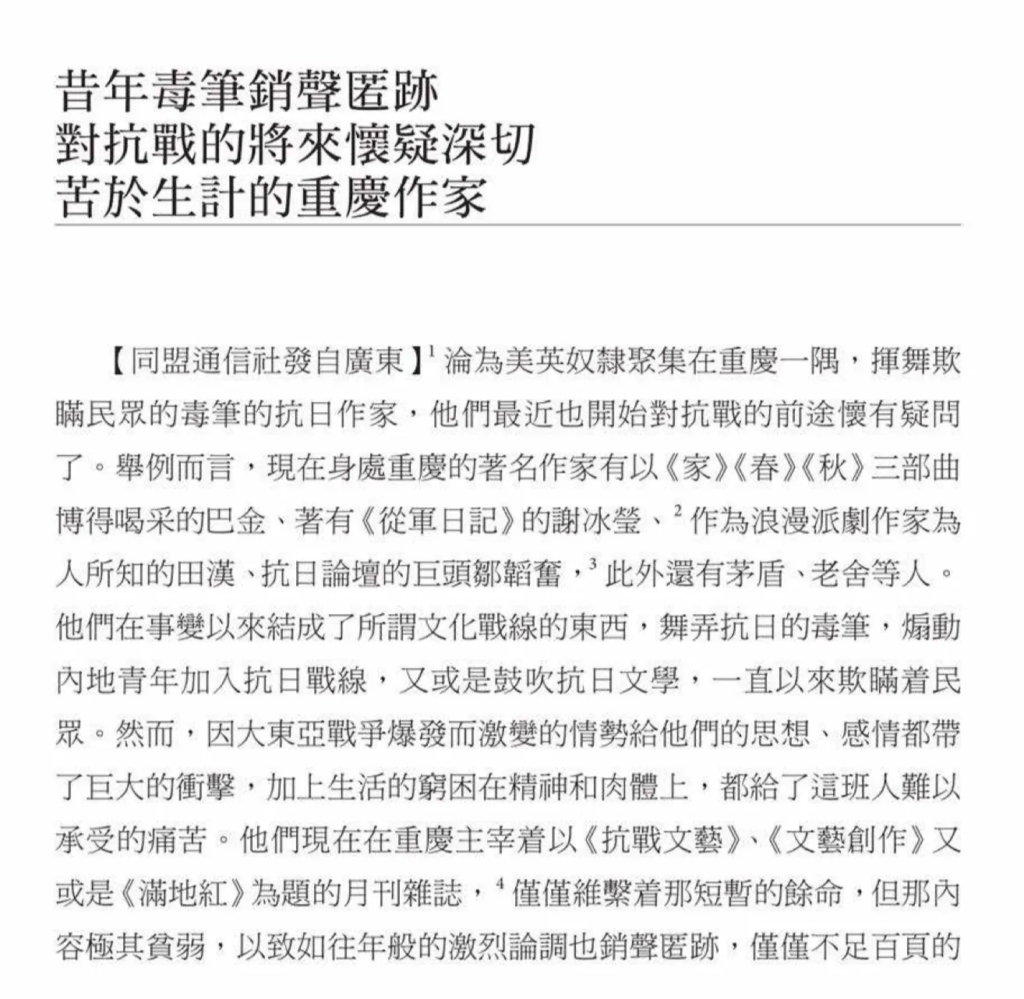
In the same batch of old articles is a dispatch from the “Domoe News Agency” sent from Guangdong. The Domoe News Agency was Japan’s national news agency, positioning itself as the propaganda organ of militarist Japan. This dispatch reported on Chinese writers far away in the rear at Chongqing—Ba Jin, Tian Han, Mao Dun, Lao She, Xie Bingying, and Zou Taofen.
It claimed they had “become slaves of the Americans and British,” “wielding poisonous pens to deceive the masses,” and added that they were now suffering for their livelihoods and their thoughts were wavering, with their publications becoming thinner and their tones heavier, noting that “the fierce rhetoric of previous years has vanished.”
The hardships of the Chongqing writers—the thinning journals, the destitute lives, the somber tones—were all sufferings caused by this very war of aggression, yet they were read by this dispatch as “evidence of the bankruptcy of the War of Resistance line.” The perpetrator pointed to the wounds he himself had inflicted on the victim and said: “Look, he cannot hold on.”
The article cited a lament by Ba Jin, roughly stating that while the spirit is higher than matter, a writer cannot write on an empty stomach—rewriting this honest complaint about livelihood into a “confession” of “deep doubt about the future of the resistance.”
Conclusion: Rewards, Takeovers, and Encirclement
For those who had already submitted, the narrative was an offering: molding He Ruiting into a touching model of faith to reward her obedience. For cultural heritage that could be co-opted, the narrative was a takeover: using scholars like Kanda to declare what constituted “orthodox Oriental culture” and monopolizing the power to rearrange it.
For those who refused to bow, the narrative was an encirclement: depicting persisting writers as desperate, self-doubting, and on the verge of collapse to dismantle their symbolic power. Binding these three strategies together was the emotional playbook of people like Okamoto: first depicting the Empire as the victim, then making the conquest seem like a homecoming, a nurturing, a liberation.
Reward the obedient, take over the heritage, encircle the resistors. Three lines pointing toward a single project: redefining who is qualified to represent “China” and the “East.” And the answer always passed through Japan.
The city’s lights remained on; the silence of the streets—where “not even a puppy” could be seen—felt like a prosperity as before; all of this was treated as proof of successful governance. But the lights being on does not mean the people inside the houses are free; silence may simply be the result of a curfew. Okamoto said the lights of Hong Kong changed from “hellfire” to “righteousness,” but not a single lamp had been replaced. The city had not changed, nor had the power structure; the city had simply changed masters.
Under the guise of “liberating you from old colonialism and old delusions,” Greater East Asianism monopolized the power to rename everything: to rename what is friendship and what is crime; who is a compatriot and who is an enemy; which culture is worth promoting and which voices must be silenced.
It would sincerely believe itself to be the liberator, just as Okamoto sincerely wept. It would rename the same set of lights, ask you to look up and admire them, and insist that the light had never been so bright.
Okamoto said he would “forever and ever gaze upon the beautiful night of Hong Kong.”
Reading these old articles, I too am gazing. I am only not quite sure if we are seeing the same lights.
Diego Ge was born and raised in Shanghai. He studies political science and international comparative studies at Duke University in the US.
This article first appeared on positions – a personal blog on politics, migration, change.
More content from this blog
- Antisemitism Is Exploding on the Right but the Jewish Establishment Is Focused on the Left, by Jay Michaelson – 16 March 2026
- Kazakhstan and Russia’s Neo-Imperialism, by Dmitry Mazorenko – 29 October 2025
- The Global Right Ascendance Will Leave Israel in the Wreckage, by David Schraub – 10 April 2025
- The Political Economy of China. Interview with Ho-fung Hung – 24 May 2026
- How the Nations of Eastern Europe Tried to Civilize Each Other. A Conversation with Polish Historian Ela Kwiecińska – 15 October 2024
Except where noted otherwise, original writing and translations produced by the Left Renewal Blog Collective are published under a Creative Commons Attribution–NonCommercial–ShareAlike 4.0 licence. Republished and translated material remains subject to the licence and terms of its original publication.