From Tempest
Increasingly, understanding the inter-imperialist competition between the United States and China is becoming essential to understanding the dynamics of the modern capitalist system. With the goal of broadening our understanding of the dynamics at play, Ashley Smith, along with co-authors Eli Friedman, Kevin Lin, and Rosa Liu, have published China in Global Capitalism: Building International Solidarity Against Imperial Rivalry, out now from Haymarket Books. Thomas Hummel recently sat down with Ashley Smith to chat about some of the book’s central themes and to explore the practical implications of the rise of China for socialists and activists fighting for a better and more just world today.
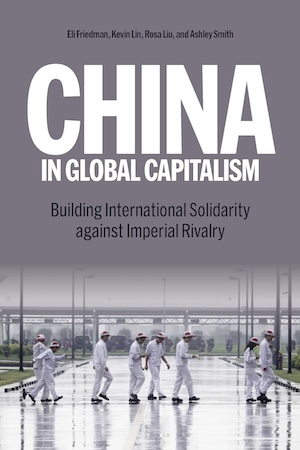
Thomas Hummel: First of all, congratulations on getting this book out. The book covers several key themes: the rise of capitalism in China, class struggle, China’s place in the new world of inter-imperialist rivalry and crisis, and the possibilities for international working-class solidarity. Why do you think this book is so important at this moment in world politics?
Ashley Smith: I believe the starting point for any discussion of world politics today is the state of global capitalism, which I think is in its greatest period of crisis since the 1970s, and possibly since the 1930s. While it’s not on the scale of the Great Depression, since the Great Recession, we’ve been in what David McNally has referred to as “a long global slump.” Michael Roberts calls it a “long depression.” This crisis is interwoven with other systemic crises, the most obvious being the climate crisis, the migration crisis—which stems from the Great Recession, climate change, and other large-scale issues—and the rising levels of interstate conflict, inter-imperial rivalry, and war. These factors are driving millions of people to move across the globe.
First and foremost, China is a capitalist state that oversees a capitalist economy. Its state and private corporations are thoroughly integrated into the world system.
On top of this, we’re seeing the return of pandemics. COVID-19 is just one of many to come, given the world’s increasing integration and the zoonotic spillover of diseases from animals to humans. This is happening with growing regularity. So, we are dealing with multiple, overlapping crises of global capitalism that are creating unprecedented struggles from below in nearly every state around the world. Over the past 15 years, we’ve seen massive uprisings of people across the globe.
At the same time, these crises have intensified inter-imperial rivalries and interstate conflicts, leading to an increasing number of wars, both between states and within states in the form of civil wars. There are thus two axes of conflict in the world: one between capitalist states, and the other between those states and the workers, peoples, and nations they exploit and oppress.
Our epoch’s central inter-imperial conflict is between the United States and China. This conflict is the top priority for both the U.S. and Chinese states, and it’s leading them to produce symmetrically opposed policies—economic, political, and military—as their rivalry intensifies and plays out globally.
At the same time, both the U.S. and China are experiencing growing struggles from below, as oppressed and exploited people become fed up with their own ruling classes. In this conjuncture, the Left is really being put to the test. The challenge is whether we can oppose both these powers and the inter-imperial rivalry they are locked in while also supporting and building solidarity with the struggles from below in both countries.
This book was written in that spirit: as an attempt to offer an alternative of anti-imperialist internationalism and solidarity from below against the escalating inter-imperial rivalry between the U.S. and China.
TH: Many on the Left consider China and its so-called “socialist” system to be an alternative to the American-dominated world system. Can you speak a little bit about why you believe this is not true?
AS: I think you have to start by understanding why people would be looking for an alternative to the U.S., because as we know, it has been the hegemonic imperialist power in the 20th and 21st centuries. It has the largest economy, the largest military force, with 800 bases around the world, the most developed set of imperial alliance structures, and it’s the main enemy of liberation struggles in almost every part of the world. So, it’s completely understandable that people repulsed by U.S. imperialism would seek some kind of alternative—some state that stands up to the U.S. and offers an alternative to its vicious capitalist and imperialist policies.
More content from this blog
- Who Are Sudan’s Islamists?, by Alex Thurston – 30 March 2026
- Year Three of the War [in Sudan] in One Word: Drones, by Kiri Rupiah – 18 April 2026
- Mandarin Hegemony: The Past and Future of Linguistic Hierarchies in China, by Gina Anne Tam – 18 April 2024
- Confusions Between Far-Right and Left Discourse Are Spreading Internationally, by Philippe Corcuff – 2 May 2026
- Sudan War: A Counter-Revolution Against the Corporeal and the Imaginative, by Lina Dohia – 10 April 2024
Except where noted otherwise, original writing and translations produced by the Left Renewal Blog Collective are published under a Creative Commons Attribution–NonCommercial–ShareAlike 4.0 licence. Republished and translated material remains subject to the licence and terms of its original publication.