This piece is a response to the wider debates continually raging around identity politics and class. It tackles the writing of Adolph Reed Jr., not because he’s the worst example identity politics critique, but because he’s one of the best.
Adolph Reed Jr.’s critique of identity politics is rooted in an analysis of US capitalism’s response to and co-option of black liberation movements in the ‘70s as a method of demobilisation. He has made extensive investigation into the relationships between race and class, and that ways that a ‘race first’ politics has been used to mediate class struggle in the US.
However by ignoring the class content and revolutionary politics of participants in the ‘60s black liberation movements, Reed ends up at a rejection of revolutionary class struggle as such, in favour of color-blind class representation by union leadership and socialist politicians.
Note: when people talk about ‘identity politics’ they can mean anything from the promotion of individual women and black politicians within the Democratic party, trans bathroom access laws, accountability for sexual abuse, intersectionality, or urban insurrections against police violence. Rather than attempt to limit the definition or use multiple alternatives such as ‘liberal representational identity politics’ vs. ‘communist praxis informed by intersectionality’, this piece will mostly follow Reed in using identity politics to mean one or all of these things at different times, and rely on concrete historical and current examples to delineate.
Reed has been writing critical appraisals of the role of identity politics in American politics for decades. His associate Cedric Johnson’s Revolutionaries to Race Leaders documents the process whereby the radical black movements of the ‘60s were co-opted and demobilised in the ‘70s, leading to a shift by many towards the election of black representatives to local and state governments. John Clegg in the Brooklyn Rail [1] discussed the role of black representation in Baltimore via Johnson’s work, in the form of both black police and black local politicians in quelling the protests that followed the police killing of Freddie Gray.
However, Reed goes further than pointing out the importance of the black political class in managing the black working class. Rather, he locates the origins of the black political class in the black liberation struggle itself:
Although black life as a whole has not improved considerably beyond the elimination of racial segregation, in the 1970s certain strata within the black community have actually benefited. This development is a direct outcome of the 1960s activism: of the interplay of the “movement” and the integrative logic of administrative capitalism. And this “gains of the sixties” interpretation cannot spell out what “satisfaction” is because it is itself the ideology of precisely those strata which have benefited from the events of the 1960s within the black community.[2]
Reed’s examination of this process has led him to reject anti-racist politics as such.[3] Instead he argues that class is responsible for maintaining existing racial inequality: hundreds of years of slavery, decades of Jim Crow, redlining etc. have led to a highly racialised US working class. With the advent of ‘color-blind’ policies in the ‘60s and the neo-liberalism’s stripping away of the welfare state and job security in the ‘70s, it is now class that predominantly maintains those racial class divisions by its own logic rather than legalised discrimination:
I’m increasingly convinced that a likely reason is that the race line is itself a class line, one that is entirely consistent with the neoliberal redefinition of equality and democracy. It reflects the social position of those positioned to benefit from the view that the market is a just, effective, or even acceptable system for rewarding talent and virtue and punishing their opposites and that, therefore, removal of “artificial” impediments to its functioning like race and gender will make it even more efficient and just.[4]
With Obama presiding over increased deportations of immigrants, the militarisation of police forces and the tear gassing and rubber bullets fired in Ferguson and Baltimore, that critique of black representation in electoral politics as improving anything for the black working class remains relevant. The Democratic Party machine and liberal commentariat has often met any policy criticism of Cory Booker and Kemala Harris this year with accusations of racism (the figure of the ‘racist, sexist, Bernie bro’ or ‘alt-left’), even when those criticisms come from black social democrats or communists. So, we can see that this strategy of capital continues, and it has picked up charter schools advocate and Campaign Zero founder Deray McKesson along the way, running for Baltimore Mayor in 2016 and endorsing HIllary Clinton for president. This hasn’t only been limited to the Democratic party either, former Black Panther Party leader Eldridge Cleaver made a senate bid as a Republican in 1986.[5]
Reed is not only critical of the black liberation movement, he’s critical of a politics of identity in general:
The Civil Rights and Black Power movements prefigured the coming of this new age; the feminist photocopy of the black road to nowhere was its farcical re-run.[6]
As I’ve read more of Reed’s work over the past year or so, and seen the way it’s been deployed in discussions about ‘identity politics’, I’ve noticed significant flaws in both his historical narrative and in the solutions he proposes to overcome the limitations of ‘neo-liberal identity politics’. This is coupled with a dismissal of those he criticises as ‘anti-Marxist’, while his own work is peppered with references to the Frankfurt School and Marcuse.
In crafting an historical narrative from black power to ‘Black Faces in High Places’, Reed does not engage with those elements of the ‘60s movements who were resolutely opposed to such a conclusion and recognised the risks at the time.
Fred Hampton was leader of the Black Panthers in Illinois, and was instrumental in organising the Rainbow Coalition, which included amongst others the Young Patriots and the Young Lords. The intent was to unify struggles based on identity along class lines.
Hampton was assassinated by the Chicago Police force in 1969, but while he was only 21 when he died, he was already very clear that black liberation was tied to the abolition of capitalism:
We don’t think you fight fire with fire best ; we think you fight fire with water best. We’re going to fight racism not with racism, but we’re going to fight with solidarity. We say we’re not going to fight capitalism with black capitalism, but we’re going to fight it with socialism. We’re stood up and said we’re not going to fight reactionary pigs and reactionary state’s attorneys like this and reactionary state’s attorneys like Hanrahan with any other reactions on our part. We’re going to fight their reactions with all of us people getting together and having an international proletarian revolution.[7]
When asked about Fred Hampton in a recent interview about Ta-Nehisi Coates and Bernie Sanders, Reed focused on the most reactionary elements of black nationalism rather than any exposition of what Hampton’s approach entailed.[8]
Reed has also dismissed “intersectionality” specifically,[9] reducing it to merely campus activism and simply an extension of neo-liberal identity politics, ignoring that it emerged as the work of black feminists addressing specifically the failures of struggles in the ‘60s.
In fact it’s hard or impossible to find examples of Reed talking about Hampton, or the organising of groups like the Dodge Revolutionary Union Movement or the League of Revolutionary Black Workers at all. The DRUM emerged from two events, the Detroit uprising of 1967, and the wildcat strike of older Polish women and younger black workers at the Hamtramck Assembly plant. It also occurred in the context of revolutionary groups including the Facing Reality group associated with CLR James (in exile in the UK) and Martin Glaberman, and the Corresponding Publishing Committee associated with Grace Lee Boggs (these had been one group until a split in 1962 and both maintained a presence in Detroit).

It may be that this is due to an insufficient engagement with Reed’s work and that he does reference these groups. However their existence and ideas pose significant problems for Reed’s solution to the limitations of liberal identity politics. Their focus on the self-organisation of workers against both the union apparatus and employers, reflecting and influencing Facing Reality’s move towards an explicitly anti-state communist position is in direct opposition to Reed’s hope that ‘the unions’ can be revived in a coalition with a socialist party.
If we look at Reed’s interventions in practical politics, he’s been a member of the Interim National Council of the Labor Party, and more recently was involved in the ‘Labor for Bernie’ campaign, here’s him talking about why he got involved:
What appealed to me about the Sanders campaign in general is that I obviously like the stuff that he is saying […] it in some way is that it became a vehicle for bringing together the people in the labor movement, people with standing and who represent stuff in the labor movement who are themselves ready to try to, once again, push in a direction of creating some independent working class politics.
There is a Labor Party connection. You probably already may have seen that National Nurses United endorsed Sanders. I mean they were part of the Labor Party. The president of the Amalgamated Transit Union is on board. He was a Labor Party guy before he was president. Mark Dimonstein who is the president of the American Postal Workers Union is also a Labor Party activist. There are enough people around with that sort of commitment to building a working class politics.
The Labor for Bernie thing is bringing it together. There is a list of more than 30,000 trade unionists who have signed up for Labor for Bernie. […]
What a lot of people, especially young people, don’t get is that unless you’re covered by a union contract, the only rights that you have on the job are rights against discrimination. But enforcement of anti-discrimination law is so weak at this point that you may as well say that the only rights that you have on the job are connected with a union contract. [10]
The scrutiny and attention to detail that Reed applies to the recuperation of black struggle is unfortunately nowhere to be seen when he starts talking about trade unions or Bernie Sanders. A reckoning with the legacy of DRUM and the LRBW would require confronting that rather than simply an organisation of black workers in a union, they had to fight against both their union (with an entirely white leadership) and their employers.
This isn’t an isolated historical pattern, but is replicated throughout the history of the labour movement both in the US and internationally. Glaberman’s Wartime Strikes shows the struggles of factory workers against the no strike contracts that unions pledged during WWII. Jeremy Brecher’s Strike documents just how many of the mass strikes in US history were wildcat actions against the remonstrations of union leadership from the 1877 railway strike to the post war strike wave.
The IWW since its founding has engaged in ‘solidarity unionism‘, often organising black and migrant workers when they were excluded from the mainstream trade union movement, and focusing on extracting concessions from employers via the direct action of workers whether or not there was a union contract. IWW Local 8 on the Philadelphia docks was one of the earliest examples. What Reed proposes as a return to class politics reveals itself instead to be a revival of the institutions of trade unions themselves, in a coalition to support socialist electoral candidates. This again ignores the history both of socialist electoral candidates in general, but even the specific history of Bernie Sanders presiding over gentrification and rent increases in Burlington in the ‘80s.
What we see then, is a blaming of ‘identity politics’ for the failures of the struggles of the ‘60s, resulting in black representation in politics as a new form of control. Reed makes no equivalent argument for class politics, even though the histories of struggle and recuperation in the labor movement are very similar.
Rather than ‘identity politics’ as such, I’d locate these failures instead in a politics of ‘representation’ and a focus on the role of workers within rather than against capitalism. Reed locates identity politics as the cause, and representation as the symptom, rather than looking at the role of representation (in union leaderships, party vanguards and yes electoralism) as a consistent theme in the defeat of class movements.
When asked about the mistakes of the Black Panthers, former Panther and anarchist Lorenzo Kom’boa Ervin said the following:
I would start at the structure of the organisation. One of the things that always sticks out in my mind is how the BPP failed in terms of the leadership question. The leadership was not accountable to the membership. After it became obvious that Huey Newton was clearly disabled [to put it kindly – suffering from mental paranoia not helped by heavy amounts of cocaine and an overdose of power] we weren’t able to remove him.
I think this whole question of cadre organisations as opposed to broad based structures – cadres are just the arms and eyes and ears of the leadership of the structures. Organisations should be broader based; based in and controlled by the community. I guess I’m more in favour of some of the SNCC politics. If you could merge the two and have a broad based organisation with a politically focused and militant stand I think that you’ve got a chance to build a mass movement and stave off repression.[11]
Ervin says today as Hampton might have at the time, “there can be autonomy on the one hand (certainly for the black struggle and the women’s struggle) – and at the same time there can be class unity”. Autonomous organising based on identity and collective struggle based on class are both foregrounded here, with the criticism located in a lack of accountability in revolutionary organisations and insufficient attention given to either ‘identity politics’ or ‘class’ as causes of division rather than attempts to reconcile the two.

Robin D. G. Kelley discussed the inseparability of identity and class in 1997, in an essay which anticipates much of the discussions of the past 20 years and which you should engage with in its entirety:
I don’t know how many times I’ve been told, “Don’t attack them, they’re on our side!” […]The Gitlin/Tomasky group makes the grave error of rendering movements struggling around issues of race, gender, and sexuality as inherently narrow and particularistic. The failure to conceive of these social movements as essential to the emancipation of the whole remains the fundamental stumbling block to building a deep and lasting class-based politics.[12]
It’s at this point we turn to Reed’s accusation of anti-Marxism:
I’ve been struck by the level of visceral and vitriolic anti-Marxism I’ve seen from this strain of defenders of antiracism as a politics. It’s not clear to me what drives it because it takes the form of snide dismissals than direct arguments. Moreover, the dismissals typically include empty acknowledgment that “of course we should oppose capitalism,” whatever that might mean. In any event, the tenor of this anti-Marxism is reminiscent of those right-wing discourses, many of which masqueraded as liberal, in which only invoking the word “Marxism” was sufficient to dismiss an opposing argument or position.[13]
We don’t need to defend ‘anti-racist politics’ as ‘Marxist’, our role here is neither to litigate what ‘anti-racist politics’ or ‘Marxism’ are, but to locate struggles based on race and gender firmly within the history of the class struggle.
However, since we risk being lumped into that category of ‘anti-Marxist’ or even ‘neo-liberal intersectional identitarian’, we can look at Marx’s own writing to locate how he considered class relationships:
Even the very early Marx and Engels in 1845 located the proletariat not as a social category to be better represented as a competing interest under capitalism, but one side of a social relationship which must abolish both capital and itself as a class:
The proletariat, on the contrary, is compelled as proletariat to abolish itself and thereby its opposite, private property, which determines its existence, and which makes it proletariat. It is the negative side of the antithesis, its restlessness within its very self, dissolved and self-dissolving private property.[14]
Much later, in the Critique of the Gotha Programme,[15] Marx was intensely critical of the Lassallean substitution of the programme of proletarian self-abolition with one for the redistribution of goods under capitalism within the nation state:
[..] only then then can the narrow horizon of bourgeois right be crossed in its entirety and society inscribe on its banners: From each according to his ability, to each according to his needs!
I have dealt more at length with the “undiminished” proceeds of labor, on the one hand, and with “equal right” and “fair distribution”, on the other, in order to show what a crime it is to attempt, on the one hand, to force on our Party again, as dogmas, ideas which in a certain period had some meaning but have now become obsolete verbal rubbish, while again perverting, on the other, the realistic outlook, which it cost so much effort to instill into the Party but which has now taken root in it, by means of ideological nonsense about right and other trash so common among the democrats and French socialists.
[..]
Vulgar socialism (and from it in turn a section of the democrats) has taken over from the bourgeois economists the consideration and treatment of distribution as independent of the mode of production and hence the presentation of socialism as turning principally on distribution. After the real relation has long been made clear, why retrogress again?
So what passes for self-identified ‘Marxism’ is unfortunately often rooted in this warmed-over Lassallean social democracy rather than Marx’s own ideas. The split is not in electoralism as such, but is rooted as a conception class politics as the relative strength of the working class as a social category (literally, ‘social class’) competing for the management of capitalist production, rather than a struggle for the abolition of capital. This isn’t a new or theoretical argument, it’s been one of the fundamental splits in the workers movement, whether the KAPD’s and AAUE council communism and the FAUD’s anarcho-syndicalism in opposition to the SPD, or Correspondence Publishing Committee’s (forerunner to Facing Reality) formation after the split from the SWP.
Back to Reed:
One of our concerns is, or should be, the tendency among a strain of exuberant leftists to proclaim programmatically diffuse coalitions and subordinate the class program to counter-solidaristic identity politics.
I think we should build on the more visionary aspects of the program, e.g., the demand for free public higher education, decommodified health care, etc and the vital fight to stop the TPP, and yes of course against discrimination on the basis of race, gender, sexual orientation, etc and also against neoliberal policing and the constantly expanding public/private carceral apparatus, which we have to understand and insist that others also understand is a class issue.
[…]
How is it “economic reductionism” to campaign on a program that seeks to unite the broad working class around concerns shared throughout the class across race, gender, and other lines? Ironically, in American politics now we have a Left for which any reference to political economy can be castigated as “economic reductionism.”
Here we see the fundamental limitation of this ‘Marxism’. Rather than the opposition of the working class to capital, it’s instead an opposition of a ‘class’ politics based on liberal social welfare against an ‘identitarian’ politics based on anti-discrimination and diversity. It pits redistribution against recognition.[16] We don’t want either recognition or redistribution within capitalism (equally, won’t work against them since they can sometimes reduce harm in the short term), but instead revolutionary class struggle resulting in a fundamental re-organisation of society, so reject this dichotomy altogether.
While Reed correctly locates legislation on both workers and civil rights as the end-result of ‘social movements’ rather than electoral activity as such, he’s quick to dismiss any activity that isn’t located in a recognisable left institution. This ignores that many of the concessions to the civil rights movement came after the urban insurrections as much as the formal organisations and marches:
This sort of politics is also, as we’ve seen at least since Black Power, a hustler’s paradise. And all the millennial versions of New Age-y bullshit about leaderlessness and structurelessness obscure the fact that absence of organizational mechanisms of accountability enable anyone to say anything, or deny anything said, in the name of the “movement.”
Overestimation of the political significance of protest and a related, all too familiar problem of confusing militancy and radicalism contribute to exaggerating the significance of eruptions like those associated with BLM. Militancy is a posture; radicalism is linked to program for social transformation, and protests do not necessarily challenge power relations at all.[17]
This is not the dichotomy of class and identity we’re presented with if we look at the actual history of class struggle, rather than broad appeals to ‘Marxism’ and ‘historical materialism’. What we see instead is the struggles of workers going beyond and even against the institutions that would seek to represent them, whether political parties or unions, often as reactions to divisions based on race or gender. The struggles of black and women workers against racism and misogyny were not simply for ‘equal opportunity’ within capitalism but often to address structural inequality and abuse within both unions and revolutionary organisations themselves, whether the Dodge Revolutionary Union Movement or the Mujeres Libres during the Spanish Civil War. Eldridge Cleaver was both an unaccountable leader of the Black Panthers who bragged about raping women, and later a Republican candidate for senate on a pro-life ticket. Is it too much identity politics or too little to blame for that consistent misogyny?
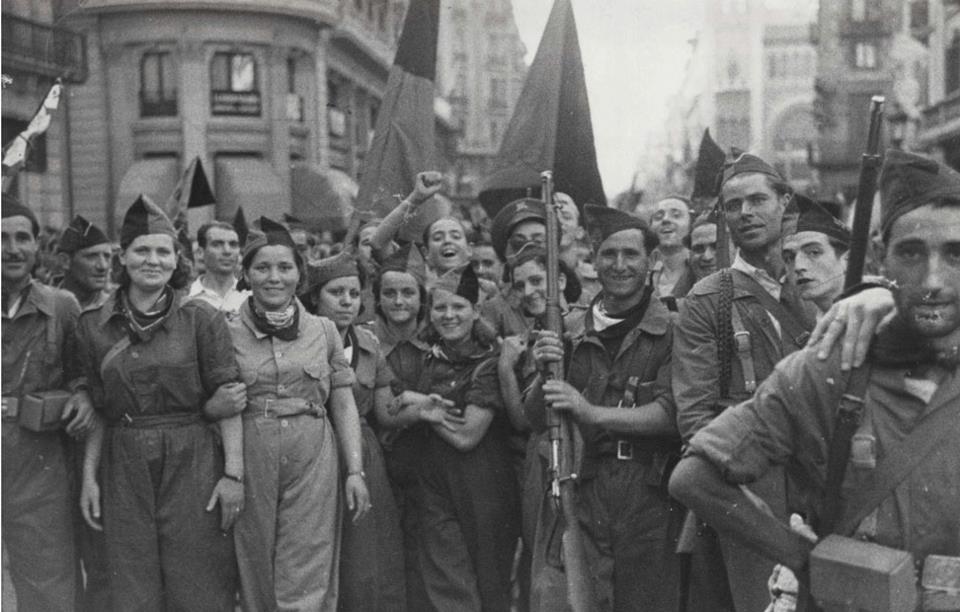
In this framework, both ‘liberal identity politics’ and ‘class politics’ have resulted in a further integration into capitalism and the promotion of representatives and institutions, whether black politicians or trade unions against the still racialised working class. We therefore need to look at class struggle, not as an affirmation of the working class within capitalism, but as the abolition of the working class and capital. This means recognising not only the co-option of struggles against discrimination into capitalism, but also the co-option of the ‘workers movement’ into the management of capitalism against workers and maintaining divisions based on ascribed identities, whether enforcing colour bars in professions, or recently both AFL-CIO president Trumka’s and UK Labour Party leader Jeremy Corbyn’s support for stricter immigration controls. Capital therefore not only reproduces race and gender divisions through class, but in turn those divisions undermine movements against capital and class – not the actions of those working to undo racism and misogyny but in the abstract appeals to ‘unity’ that obscure real divisions and power imbalances along lines of race, gender, social class, disability etc. which must be confronted if they’re to be overcome. We should not oppose black representation with class representation, but oppose self-organised class struggle to both.
In practical terms, while we may be opposed to wage labour and the state, we’re often fighting defensive battles – against wage theft or cuts to services. How do we reconcile opposition to wage labour with fights for higher wages, or opposition to the state with fights to protect social housing? How do we link these day-to-day struggles with the large scale mobilisations such as Ferguson in 2014 or the protests against the ‘Muslim Ban’ in 2017?
The IWW and its General Defense Committees, solidarity networks such as SeaSol and the model proposed by Fighting for Ourselves by SolFed in the UK offer a way to link disparate defensive struggles over wage theft, evictions, ICE deportations, community self-defense against far-right groups and the police into a unitary organisation opposed to wage labour and capital. Groups such as Project Salvage have focused on tackling misogyny and abuse within activist groups much as their predecessors in the Black Panthers and Mujeres Libres had to before them.
In this way, struggling around ‘particular’ issues which don’t affect all workers (equally, or at all), can be a condition of unifying struggles. This can be seen time and time again, with sexual violence driving people out of movements as perpetrators are protected by party and trade union hierarchies, or influential figures in more informal movements. While the accusations of ‘divisiveness’ and ‘identity politics’ are invariably hurled at those challenging sexual violence, it is the violence itself which blocks unifying struggles. Racism often plays a similar role, and in this way anti-racist efforts – understood in terms of self-organised class struggle – can be a necessary condition of class unity, rather than an inevitable step towards black representation and neoliberal managerialism. Autonomous struggles often emerge when these efforts are blocked, in an attempt to circumvent the blockage. The aforementioned example of DRUM in Detroit is a clear example.
Class unity against capitalism cannot come from abstract appeals to it, which more often than not are attempts to create a constituency for a policy platform or specific party grouping. Instead, unity must be constructed from the heterogenous movements against capital and the state. Rather than relegating movements against police and border violence, cuts to domestic violence services, trans access to healthcare as ‘identity politics’ we should instead recognise these as essential to a movement against capitalism. The support that both the Sanders and Corbyn campaigns gave to the police and border controls is not just an accident or disappointing policy misstep, but essential to a project that is based on administration of capital via the state.
Note:
Uday Jain’s recently published White Marxism, a Critique of Jacobin Magazine identifies a strand of anti-ID politics arguments promoted in the magazine from figures such as Vivek Chibber, Walter Benn Michaels, Nivedita Majumdar, and Adolph Reed. This reminded me of some critical reading I’d done of Reed earlier this year. However while Jain deals mostly with the racial politics of these arguments, my main criticism of Reed had been his understanding of class, which doesn’t seem to have much to do with either Marx or the history of class struggle. Since this had only been expressed in a couple of twitter threads, it was time to write it up finally after several months. This piece is not a direct response to Jain’s article at all.
Notes
1 https://libcom.org/library/black-representation-after-ferguson-%E2%80%93-john-clegg
2 https://libcom.org/library/black-particularity-reconsidered-adolph-l-reed-jr
3 http://www.leftbusinessobserver.com/Antiracism.html
4 http://www.leftbusinessobserver.com/Antiracism.html
5 http://articles.latimes.com/1986-02-22/local/me-10556_1_black-panther-party
6 https://libcom.org/library/black-particularity-reconsidered-adolph-l-reed-jr
7 http://www.historyisaweapon.com/defcon1/fhamptonspeech.html
8 http://newpol.org/content/adolph-reed-sanders-coates-and-reparations
9 https://platypus1917.org/2015/04/04/unite-many-interview-adolph-l-reed-jr/
10 http://www.theblackscholar.org/blacklivesmatter-labor-unions-presidential-politics-tbs-conversation-adolph-reed-part-2-jonathan-fenderson-tbs-associate-editor/
11 https://libcom.org/library/black-autonomy-civil-rights-the-panthers-and-today
12 https://libcom.org/library/identity-politics-class-struggle
13 http://www.leftbusinessobserver.com/Antiracism.html
14 https://libcom.org/library/holy-family-marx-engels
15 https://libcom.org/library/critique-of-the-gotha-program-karl-marx
16 http://www.alcoff.com/content/chap2polcri.html
17 http://nonsite.org/editorial/splendors-and-miseries-of-the-antiracist-left-2
This article first appeared on Libcom.
More content from this blog
- Andrew Tate and the Moral Bankruptcy of Muslim Proselytization, by Rasha Al Aqeedi – 26 January 2023
- Red Flags: A Reckoning with Communism for the Future of the Left. Interview with David Camfield – 14 March 2025
- Diane Abbott’s Suspension Highlights the Complexity of Different Types of Racism, by Ben Gidley, David Feldman and Brendan McGeever – 8 August 2025
- Decolonial Thinking and the War in Ukraine, by Pierre Madelin – 27 February 2023
- Who Is José Antonio Kast? [Chile], by Sophia Boddenberg – 18 December 2025
Except where noted otherwise, original writing and translations produced by the Left Renewal Blog Collective are published under a Creative Commons Attribution–NonCommercial–ShareAlike 4.0 licence. Republished and translated material remains subject to the licence and terms of its original publication.