From CIA recruits to Chinamaxxers
I’ve been in the business of explaining China to Americans for around 4 years now – starting from online interactions with American YouTube users, to the “I’m Diego, from Shanghai, China” introduction at college orientation, and finally to being an East Asia-focused International Comparative Studies major, it is a sometimes frustrating, often exciting and always complicated experience. I went from living in Shanghai, going to a high school with mostly other Chinese people, to going to a school in North Carolina where I’d explain how the city I come from has twice the population of the entire state of North Carolina.
It follows naturally that one does not explain Chinese problems to Americans in the same way that one does to other Chinese people. In the latter case, the work isn’t really that of explanation but that of argumentation. Without being the only one who has the unique (and perhaps questionable) natural legitimacy of having lived in the country, know the language and engage extensively with questions of society and politics in the country, one can mostly assume knowledge of background events, and argue about interpretation and prescriptive thought. With Americans, this is not always the case.
From my experience over the past few years, I want to zero in on two types of Americans in terms of their engagement with China: the U.S.-centric analysts and the anti-U.S. campist (sometimes, “Chinamaxxers”). Of course, there are exceptions – and if you are an American reading this article, I’d like to think that you don’t fall under either. Indeed, most of America probably falls under neither category – but these two types are probably the most vocal on China in the American context.
The U.S.-Centric Analysts
This is your Political Science majors specializing in International Relations, who speak of grand strategy and geopolitical rivalries. They could be liberal or conservative, establishment democrats or MAGA, or anywhere in between.
These are the people who write reports on Chinese AI policy or industrial secret transfer or war games on Taiwan. Their primary language is that of U.S. interest.
Case in point: Democrats say that Trump is giving a “gift to China” in shuttering the USAID and waging war on close allies with tariffs; MAGA says that the Democrats are “weak on China”, have allowed Chinese companies to offshore American industry for years, and is losing the civilizational struggle to China by enacting liberal policies on questions like immigration or social welfare.
This is also where most jobs are, if you want to be a “China person” as a Chinese person – being an advisor to the rival power to China, with your knowledge of China in order to advance the interests of this country that you chose by yourself rather than the “country assigned at birth”.
However, I have found that there is little to no point to try to “explain China” to the U.S.-centric analyst crowd (if not for employment or monetary purposes), for the simple fact that they don’t care about China per se; they care about China only insofar as it concerns the United States. They might take an intellectual interest in China, read the latest reports by the Politburo with keen academic eyes, but ultimately, they are able to log off and no longer be “the China person” by the end of the day.
No matter liberal or conservative, the U.S.-centric analysts are worried about issues like AI competition, national security, labor and supply chains, and international institutions only to the extent that China threatens to change what already exists. But perhaps more importantly, they deploy the figure of China as an instrument of argumentation: America should invest in more on-shoring because we cannot let China control our supply chains; America should blockade exports of H200s to China because we cannot let China get ahead in the AI race; or conversely, America should allow exports of H200s to China because it’s in the American interest for Chinese AI infrastructure to be built on the NVIDIA-ecosystem.
They may feel a certain righteousness in their work, and channel it through the many real social and political problems of China in order to justify something beyond “national interest of the United States” as their motivation to do this work. Many have, and I think correctly, questioned the sincerity of U.S.-centric analysts’ concerns for issues like human rights, illiberalism and authoritarianism in China. These issues are real, but for the U.S.-centric analyst, they are less “principal problems” but another reason why we cannot let China takeover (in AI, global aid, military, or whatever else).
The Chinese state is the first to point out the hypocrisy of American critiques of human rights in China, and have released several hilariously over-the-top white papers on both the human rights condition at home and in the U.S. And they are partially right. Just like how China does not really care about Guantanamo detainees, we should not be under the illusion that America really cares about free speech in China, at least at a national leadership level. This attitude then translates on the ground to the armies of analysts producing papers on China, without talking with any Chinese people in the process – because ultimately, they don’t have to. They do not aim to understand China, they aim to navigate American political directions through the rhetorical device called China.
The Campists and the Chinamaxxers
At first sight, these are the diametric opposites of the U.S.-interest crowd. They wave the banners of “Down with U.S. Imperialism” and repost Instagram reels of the trains going through buildings in Chongqing, with the caption “America could never”. These are the high-speed rail envying, Alipay-awestruck and skyscraper-adoring self-proclaimed Leftists, using China as a prime example of how well developmental socialism can work, and proof that America and the West are in decay because of decades of neoliberal economics, lack of investment in infrastructure, and constant foreign wars draining national wealth.
More specifically, I think this group can be subdivided between those who imagine China as a socialist utopia, and those who are simply amazed by China’s developmental progress without necessarily having any ideological attachment to the labels or ideologies of a nominally socialist state. Both are ripe for the Chinese state to convince that the Chinese model is superior to the West, and therefore criticism of the West naturally leads to an endorsement of China.
The term “useful idiot” is somewhat condescending – but even if we don’t relegate them to the category of “idiots”, they are certainly useful for the Chinese state, not only in terms of their role in American domestic political discourse, but for domestic propaganda in China that highlights how the American people are living in a cruel society of “deep water and hot fires” (水深火热).
The truth value of the claims here is immaterial – the important thing is that the domestic audience is convinced that “for as bad as things are here, at least we’re not what happens there.” Eagle-eyed readers may find that this is exactly the same dynamic that U.S.-centric analysts invoke to talk about U.S. domestic politics through the lens of China.
Those who imagine China as a socialist utopia in the West are of course, not a monolith. Many acknowledge to varying extents the problems with Chinese society, in somewhat unwilling concession to mainstream American thought about China. Hasan Piker, an influential political streamer on Twitch, acknowledged that someone like him (an explicitly oppositional political streamer) could not exist in China, but the higher priority of a state should be to provide good lives to its people, not guarantee the rights and freedoms of political streamers. It may be lost on Hasan that a state capable of suppressing political streamers is necessarily also capable of suppressing other things that he may not want to be suppressed.
Campists take the exaggerations and misunderstandings of U.S.-centric analyst’s view of China, and use this as evidence that any criticism of the Chinese state in the Western internet space, and to an extent, in the Chinese internet space (not that they read Chinese or engage with the Chinese internet at all, necessarily), are propaganda produced by the CIA and the State Department. The prime example here is the “social credit score” system, a widely-misunderstood system that is far less centralized and systematized than in the popular American imaginary. By correctly identifying the mythical elements of American criticism of Chinese “social credit scores”, campists establish themselves as more informed, and more authoritative sources on China, thinking independently of American propaganda.

The other version of the campist response to Western critiques of Chinese authoritarianism and capitalistic excesses is also the mirror image of the U.S.-centric analyst’s version: that “the West has X problem too.” Whereas the U.S.-centric analyst says “China has X issue but we don’t have that here, so we must protect our way of life”, when faced with the same issue, the Chinamaxxer says “China has X issue but we have that here as well, so Western critiques of China are hypocritical and should not be amplified in political discourse.” Clearly missing in both versions is one that does not fall back upon the Western “we”: the linguistic structure ceases to make sense the moment that the “we” is a Chinese subject. The two discourses equally deny the Chinese subject the ability to speak.
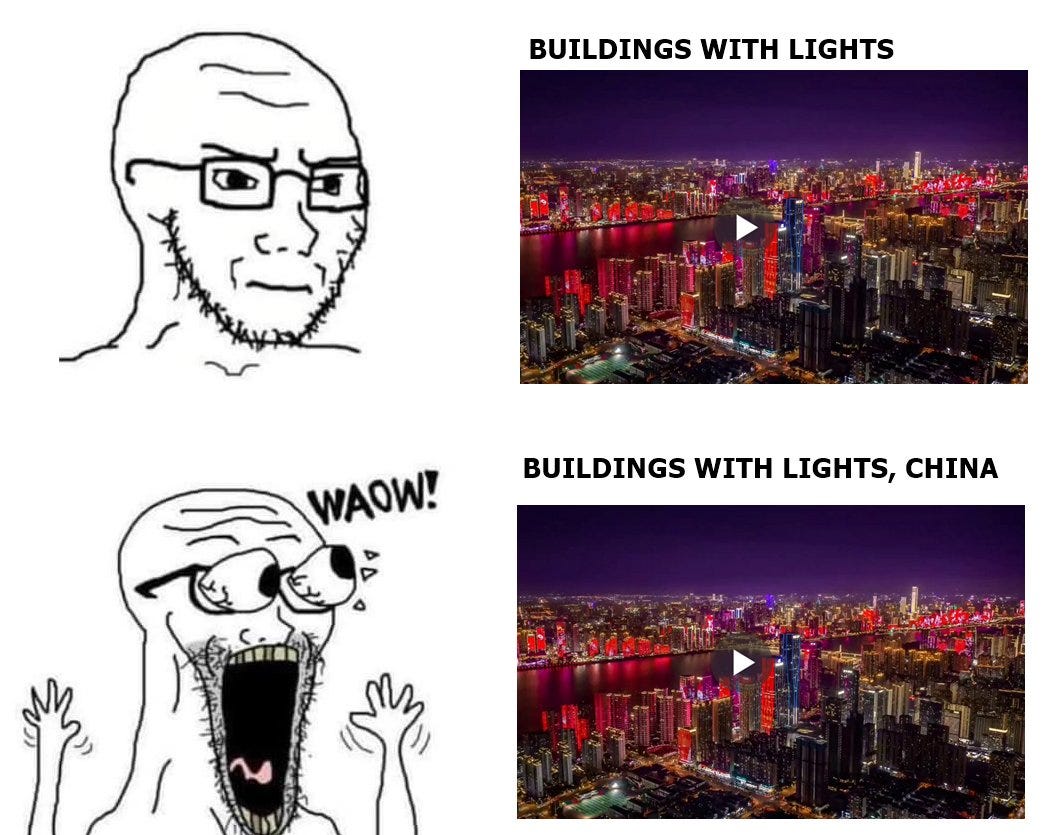
The somewhat more common amazement when looking at China’s economic and infrastructural accomplishments is understandable, but nonetheless rooted in a surface-level understanding of the “Chinese economic miracle.” The basic sentiment here is “wow, building tall, train fast, city big, China good”; and the basic methodology here is one of China as spectacle. Having lived in both American suburbia and Chinese metropolises, I can 100% understand the envy of Chinese high-speed rail. But at the end of the day, this analytic’s engagement with China begins and ends with the identification that “thing exists in China but not in the US.” My response would be — why can’t you just make a case for high-speed rail, walkable neighborhoods, and livable infrastructure in your home context, based on trade-offs that you understand and have lived through yourself?
In the case of high-speed rail, behind the spectacular images is the labor of railway construction, the colonial implications of extending rail to the borderlands, the debts taken on by the state and by extension, the citizenry, and the opportunity cost of a society with low welfare and unevenly distributed social safety nets.
But to explain all this to the Chinamaxxer would require them to engage with more of China than is necessary for them – i.e., more than is necessary to utilize China in a debate of American questions.
Concluding notes
I write this not to condemn, but to reflect. Indeed, who among us can genuinely claim to discuss the affairs of others without projecting our own concerns? When Chinese people discuss the Russian invasion of Ukraine, U.S. tensions with Iran, or the MAGA movement, how many of us truly understand these dynamics beyond the confines of our own bubble? How often do we use these events to advance a domestic narrative rather than engaging with them on their own terms?
Rather than “Americans just don’t understand China”, my point is that we should all be a little more reflective and self-critical when talking about contexts distinct from ours, and be vigilant to the fact that none of us is immune to propaganda. Indeed, the ones most convinced they are “immune from propaganda” are usually the ones most propagandized. Hopefully, one step at a time, we can move beyond the phase of “explaining” our home contexts to one another, into the phase of discussing how we can each contribute to common ideals from our own perspectives.
兄弟爬山,各自努力。
Diego Ge was born and raised in Shanghai. He studies political science and international comparative studies at Duke University in the US.
This article first appeared on positions – a personal blog on politics, migration, change
More content from this blog
- Peru: State of Emergency After Young Rapper Killed in Protests, by ANRed – 23 October 2025
- The Palestinian Male Body Between Patriarchy and Colonialism, by Ward – 20 February 2026
- Victory Day: Three Interventions from the Left, by the Posle Editorial Collective – 7 May 2025
- Field Guide to Antisemitic Comment Sections, by the Nexus Project – 29 May 2026
- Straight From Putin’s Playbook: Turkey’s Islamists Are Jailing LGBTQ Activists in ‘Morality’ Drive – 16 September 2026
Except where noted otherwise, original writing and translations produced by the Left Renewal Blog Collective are published under a Creative Commons Attribution–NonCommercial–ShareAlike 4.0 licence. Republished and translated material remains subject to the licence and terms of its original publication.