Neo-Maoist websites copy the far right and spread antisemitic ideas, but the world’s fastest censorship apparatus leaves them untouched. In North Korea, the same theories are propagated by the State itself.
In China, conspiracist antisemitism has a stable public voice that is broadly tolerated by the regime. In Italy a great deal is written about Chinese censorship and the repression of dissent, but the spread of antisemitism in China is essentially ignored. The subject surfaced in the Italian media only indirectly, when last February the Jewish People Policy Institute, an Israeli institute linked to the Jewish Agency, published a report on Chinese antisemitism over the past five years. The few articles that appeared at the time confine themselves to summarising that document, and what is missing is work that starts from the Chinese texts themselves and from the websites that publish them. That is what I will attempt to do here, in order also to understand why the regime lets this kind of material circulate. I will then broaden the focus to North Korea, where the same theory does not even need the regime’s toleration, as in China, because it is formulated directly by organs of the State.
The prompt came to me while reading Utopia, the best-known Chinese neo-Maoist website, which on 1 August this year published, within a few hours of each other, two complementary texts. The first, signed by a commentator who goes by the name Dena, argues that an entity called ‘Jewish capital’ is waging a long-term cognitive war against China through finance, the media, the universities, the foundations, feminism and artificial intelligence. The second is the translation of an extract from a 2011 North Korean textbook for students, according to which the politics and economy of the United States are firmly in Jewish hands, to the point of making America a ‘Jewish republic’. The simultaneous publication naturally raises the question that will guide my article. How is it that a system capable of removing the report of a workplace accident within minutes leaves racist theorisations of Jewish domination of the world online for years, while treating as threats to be repressed feminists, workers demanding back pay, journalists documenting environmental disasters, and even young people who simply cease to take an active part in social life?
The repertoire
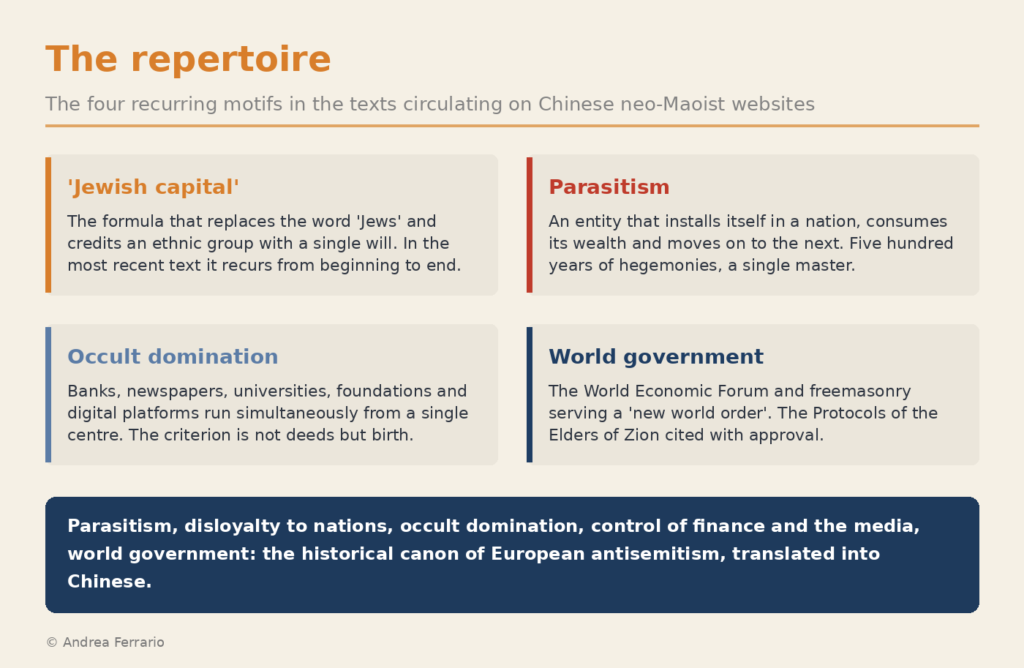
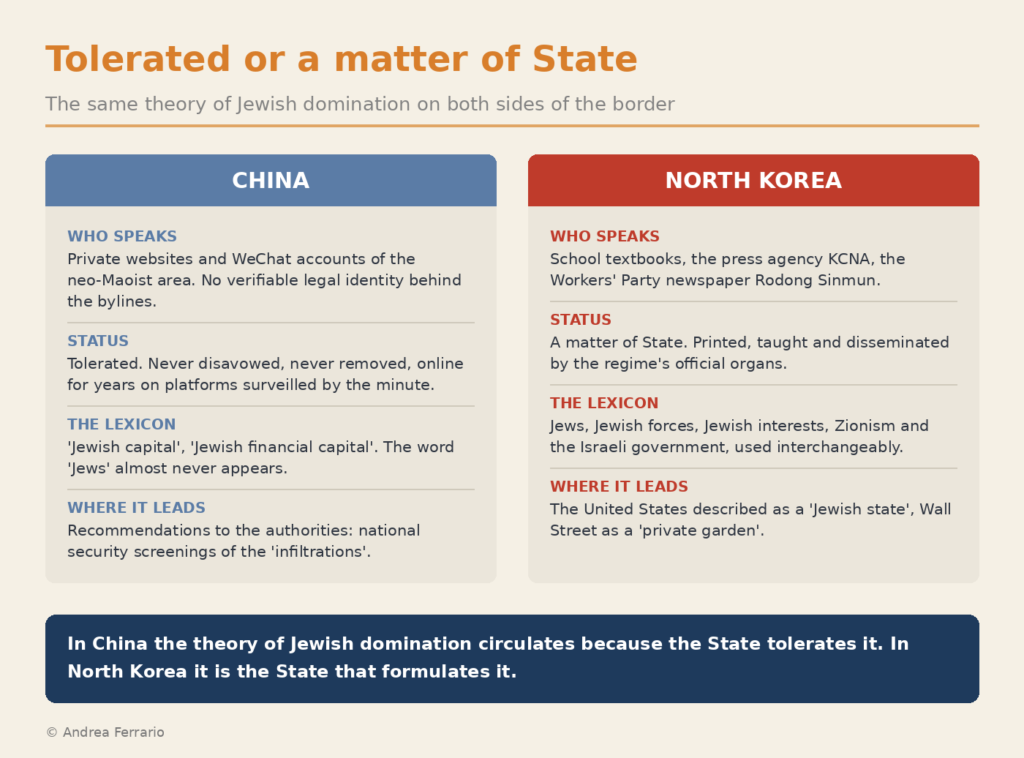
The first thing that strikes one in Dena’s article is what it does not contain, namely the word ‘Jews’. The expression that recurs from beginning to end is ‘Jewish capital’, sometimes expanded into ‘American Jewish capital’ or ‘Jewish financial capital’. The absence of the term changes nothing, however, because the context makes clear that the target is an ethnic entity credited with a single collective will, capable of simultaneously directing unrelated institutions. Anyone wishing to defend it as criticism of a government or a political movement would find no purchase. The North Korean text, by contrast, performs the fusion openly, passing without distinction from Jews to Jewish capital, Jewish forces, Jewish interests, Zionism and the Israeli government. One reads there that the White House and the leaderships of the two main parties are ‘firmly controlled by the Jews’, that Wall Street is by now ‘their private garden’, and that the number of media outlets in Jewish hands ‘can no longer be calculated with any precision’.
The most systematic exposition of the repertoire, however, is found in a long essay that circulated in June 2025 in the same milieux, signed by the commentator Zhang Jie, which constructs a veritable antisemitic philosophy of modern history. Jewish capital is described there as a parasite that installs itself in a nation, feeding on its wealth and then moving on to the next one. According to the author, over the past five hundred years the hegemonic powers have succeeded one another, from England to the United States, but Jewish capital has always remained at the summit of world domination. Even the diaspora becomes an opportunistic choice, because for the Jewish elite having no homeland to be loyal to would have been a commercial advantage. The essay goes so far as to claim that racial discrimination lies ‘in the marrow’ of Judaism and that the hostility Jews have suffered over the centuries derives from their own doctrine, which supposedly discriminates against other peoples first. Dena’s article of 1 August adds an esoteric piece to the puzzle, defining the World Economic Forum as ‘a platform controlled by American Jewish financial capital and by freemasonry’ in the service of a ‘new world order’. Parasitism, disloyalty to nations, occult domination, control of finance and the media, world government: here is the entire historical canon of European antisemitism.
From admired people to enemy
A reader who knows China might object that Jews have for decades had a positive image there, made up of admiration for their intelligence and their success in business. The objection is well founded, and the texts in question are perfectly aware of it. Zhang Jie’s essay in fact opens by observing that the Chinese ‘harbour no ill will towards the Jews’ and that the Chinese media constantly celebrate their successes. Immediately afterwards, however, he writes that since 2020, with China’s entry into the decisive phase of its rise, the relationship with Jewish capital ‘has changed in nature’, because Chinese growth threatens Jewish domination of the world.
The numerous articles published in China on the educational wisdom of Jewish families are reread by Zhang Jie as ‘reheated broth’ deliberately spread about, because the Jews, ‘monopolists of the world’s top educational resources’, supposedly preach lax methods of study to other peoples while reserving the harshest discipline for their own children. The extreme point of this logic concerns the memory of the Jewish refugees taken in by Shanghai during the Second World War, one of the most frequently cited chapters in the relationship between China and Jewry. An article published in July 2025 by the platform Kunlun Ce, to which we will return, claims that the content circulating online about the protection the Chinese offered the Jews and about Jewish gratitude towards China in fact derives from an Israeli strategy document of thirty years ago, designed to steer Chinese public opinion.
Authors and platforms
The ecosystem that produces and circulates these texts is small and works smoothly. Utopia, the site we started from, functions as an aggregator. It collects and relays texts circulating on the Chinese internet, and the original source of the 1 August article is a WeChat account registered to Dena, for which no verifiable legal identity, let alone an editorial structure, can be found. The account has been active since at least 2022 and its texts are regularly picked up by Utopia, Kunlun Ce, the Red Song Club and various other neo-Maoist sites.
Kunlun Ce, the platform that published the article on the Shanghai refugees, deserves separate treatment, because it presents itself as a strategic research institute. Behind the name is a private consulting company based in Beijing, which hands out the title of ‘special researcher’ to assorted contributors, placing their texts in sections devoted to global strategy and national security. The platform also declares that it works for the ‘great rejuvenation of the Chinese nation’, the ritual formula of Xi Jinping’s propaganda. This mode of self-presentation carries a certain weight, because thanks to it conspiracism takes on the appearance of a risk assessment addressed to the authorities.
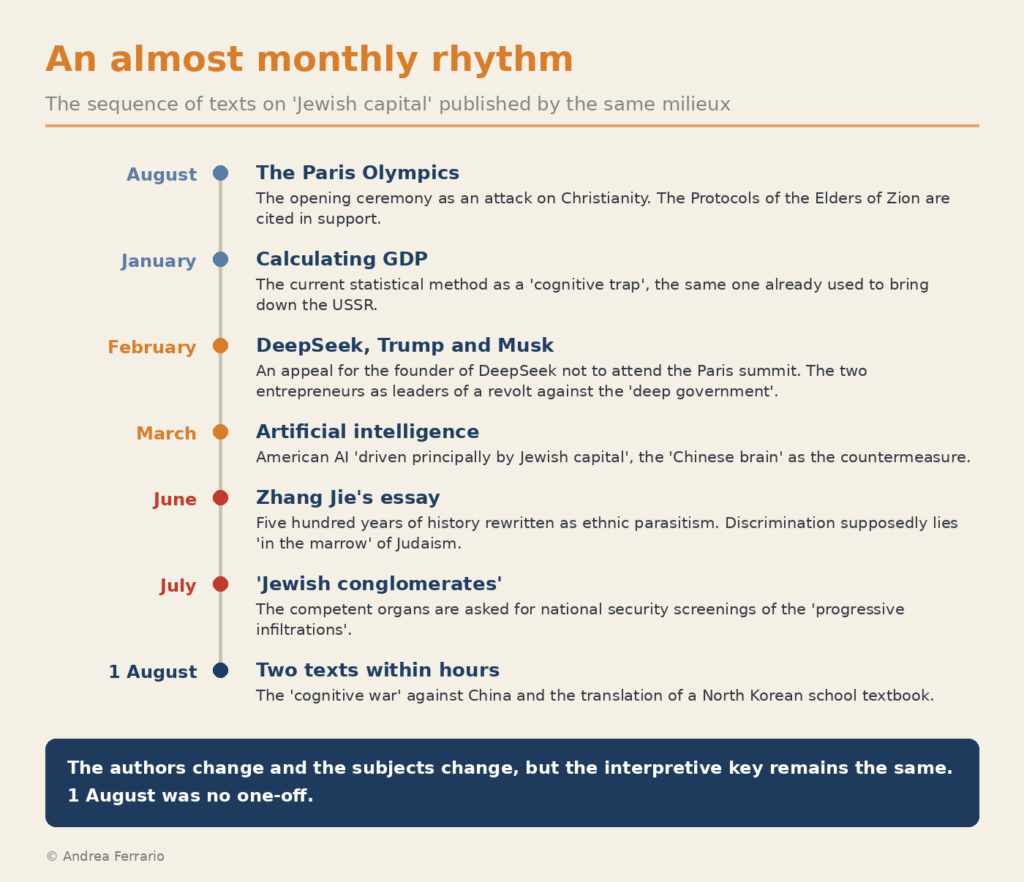
On these platforms antisemitic content appears almost monthly, and one need only scroll through the output of 2025 to rule out the idea that 1 August was a one-off. In January 2025 Dena wrote that the current method of calculating GDP is a cognitive trap, the same one already used to convince the Soviet leadership of its own weakness and to impose on the USSR the shock therapy that destroyed it. In the text one reads that liberal Chinese scholars ‘echo America’ and belittle the country’s economy using the statistical instruments of the cognitive war waged by American Jewish capital. In February of the same year came an article on the founder of DeepSeek and one on Trump and Musk, which I will analyse below. In March, a long essay on artificial intelligence; in June, the Zhang Jie text already cited; in July, the analysis of the ‘Jewish conglomerates’, the same text that rereads the memory of Shanghai. Going back further, in August 2024 Dena had devoted an article to the opening ceremony of the Paris Olympics. The authors change and the subjects change, but the racist interpretive key remains the same.
The bridge to the Western far right
The sources of this interpretive key are easily recognised in the article on the Olympics. For Dena, the Paris opening ceremony was an attack by Jewish financial capital and the Illuminati against Christianity. In support of the thesis the article approvingly cites the Protocols of the Elders of Zion, the forgery fabricated by the tsarist police, and closes by pointing to Putin’s Orthodox Russia and to China as the last civilisations left to defend traditional values. The repertoire of the American and European radical right is also imported wholesale into the rereading of American history. For Dena, Watergate was an ethnic duel, in which the Jewish forces led by Kissinger brought down Nixon, representative of the Anglo-Saxons, closing off for ever the possibility of wresting America from Jewish control. Kennedy was supposedly assassinated because he contested Jewish capital’s power to issue currency, held by a Federal Reserve in private Jewish ownership. Trump and Musk consequently become the leaders of a revolt against the ‘deep government of Jewish capital’, which includes USAID, the federal agencies, inclusion policies and the pharmaceutical industry. Bill Gates figures in it as the man who ‘first spread the poison, the novel coronavirus, and then sold the antidote’, that is, the vaccines, defined as ‘another form of genetic biological weapon’. Zhang Jie, for his part, goes so far as to enlist Galileo and Giordano Bruno among the freemasons in the service of Jewry. It is striking that this milieu sets itself up as the defender of a besieged Christian civilisation while the regime that tolerates it demolishes churches and arrests the faithful of unregistered congregations. The contradiction is only apparent, because Christianity serves here as a symbol of order, while flesh-and-blood Christians remain an autonomous social network to be repressed.
The link that welds this repertoire to Chinese nationalism is the concept of baizuo, which translated literally means ‘white left’, the insult with which the Chinese internet designates Western progressives deemed moralistic and naive. The term established itself between 2015 and 2016, at the time of the refugee crisis in Europe and of Trump’s election campaign, and circulated first among anti-communist liberal intellectuals before being adopted by the ultranationalists. Studies of the phenomenon have identified some recurring features of this discourse. Irony and a common-sense tone make ideas pass as normal that would otherwise appear extreme. Han men of the majority are presented as the true victims, penalised by the undeserved favours that the State and the market supposedly grant to women and minorities. Every grassroots mobilisation is branded as foreign interference, and the world is ordered according to a hierarchy of civilisations, with China on the rise and a West in decay through its own openness. Antisemitism grafts itself onto this structure by supplying it with a hidden director. Zhang Jie writes it out directly: ‘what the Jews inject into you is baizuo, harmlessness, feminisation, entertainment’, and the right-wing forces the baizuo oppose are precisely ‘those that protect the interests of the other peoples and that are antisemitic’. In terms of content, this is pure far-right material with a neo-Maoist veneer.
DeepSeek and the conquest of minds
One of the most recent instalments in this strand concerns artificial intelligence, a detail which shows that the phenomenon is certainly no mere residue of the past. In February 2025, when France invited Liang Wenfeng, the founder of DeepSeek, to the Paris AI summit, Dena published an appeal on Kunlun Ce urging him not to go. France, he claims, is controlled by Jewish capital, and Macron, described as a ‘Jew’ and a former banker of the house of Rothschild, is its agent, as supposedly demonstrated by the dismemberment of the French industrial group Alstom to the advantage of the US and by the arrest of Pavel Durov, the founder of Telegram. According to the author, the invitation concealed a trap to arrest Liang, on the model of the arrest in Canada of Meng Wanzhou, the Huawei executive, and to extort the model’s secrets from him. Dena writes that ‘the personal security of Liang Wenfeng concerns the destiny of the nation’ and demands special-level State protection for him at home as well, transforming the private entrepreneur into the custodian of a strategic weapon.
Another of Dena’s essays on AI, published in March 2025, goes further still, attributing an ethnic soul to the technology itself. American artificial intelligence is supposedly ‘driven principally by Jewish capital’, whose ‘chosen-people mentality’ could imprint upon it an ‘anti-human’ tendency. Against this threat is set the ‘Chinese brain’ of DeepSeek, which, being trained on the Chinese language, supposedly incorporates the dao, yin and yang, the dynamic balance of opposites and the strategic wisdom of Sun Tzu’s Art of War. The decisive contradiction, however, lies in a single sentence of the text. Dena writes that DeepSeek must ‘occupy the minds of users throughout the world’, using the verb that in Chinese designates the military occupation of a territory, arguing that in this way the thought of Chinese civilisation will spread imperceptibly, draining all force from Jewish capital’s attempt to control the minds of the peoples through AI and making China ‘the new beacon of thought’ for humanity. The verb used for this imperceptible diffusion is the same one with which the text elsewhere describes the enemy’s cultural infiltration. The model’s open source code and free availability are presented as technological equality and digital democracy, in the service of the reconstruction of the world digital order under the guidance of Chinese culture. The colonisation of thought, to use the formula with which these milieux brand the actions of others, thus remains the supreme crime when the enemy commits it, but becomes a universal mission when the actor is China. In this double register antisemitism performs an essential function, because painting the competitor as an occult ethnic force allows one’s own hegemonic ambition to be presented as self-defence.
North Korea, where the theory is a matter of State
In China the theory of Jewish domination continues to circulate because it is tolerated by the State. In North Korea it is directly a matter of State, printed in school textbooks and disseminated by the regime’s official agency. The extract published by the Chinese neo-Maoist site Utopia on 1 August comes from a general-knowledge textbook for students printed in Pyongyang in 2011 by a youth publishing house. The text’s method is accumulation. The textbook starts from terrain that is in appearance purely political, the influence of the pro-Israel lobby AIPAC on Congress, a subject that is in itself obviously legitimate and on which a debate exists in the United States themselves. The slide happens immediately afterwards. Parliamentarians hostile to Israel are not opposed by this lobby but encircled by the ‘Jewish forces’ present in politics, business, the media and the judiciary, as if ethnic belonging automatically dictated a judge’s or a newspaper editor’s behaviour. Following the same logic, the text lists the Jewish personalities who have reached top positions, from Kissinger on down, as evidence of a unitary ethnic command, and claims that the wealth of individual Jews ends up with the organisations serving Israel. The criterion is no longer what a political actor does, but what people are by birth.
Anyone wishing to dismiss the textbook as a relic of the past is quickly contradicted. In December 2023 the KCNA, the regime’s official press agency, circulated a commentary taken from the Rodong Sinmun, the newspaper of the Workers’ Party, in which one reads that ‘the United States themselves are a “Jewish state”‘ and that the levers of American political, economic and media power are ‘almost entirely in the hands of the Jews’. The old anti-Zionist lexicon of Soviet derivation, which North Korean propaganda has used for decades, is here openly overstepped, because the discourse extends from Israel to Jews as such. The same propaganda knows, for that matter, how to use the opposite register when it suits. In 2019 the Rodong Sinmun condemned the attacks on American synagogues as the fruit of American racism. In Pyongyang’s media, Jews can thus appear as a persecuted minority or as the masters of America according to the need of the moment. A final detail concerns circulation. Some pro-North Korean diaspora websites in the United States have published even more explicit material, and one of their leading figures has stated that he derived his theories from Chinese blogs.
Why the regime lets antisemitism circulate
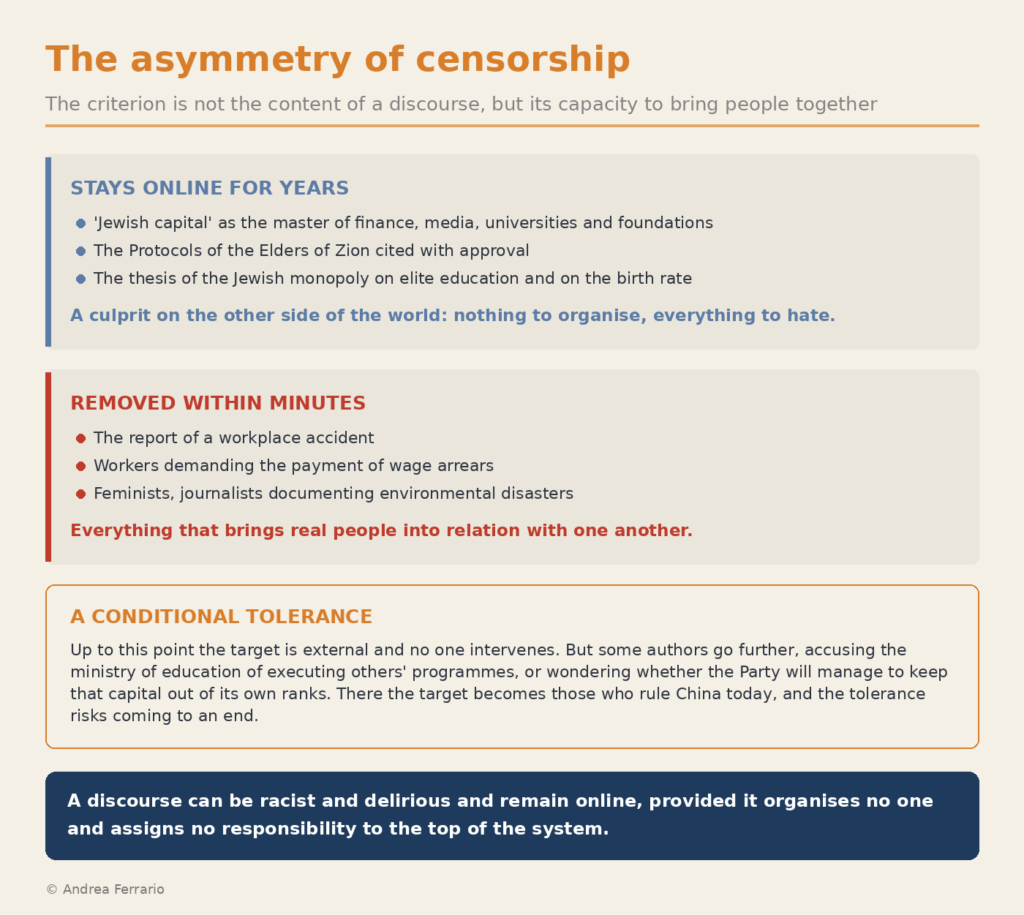
Let us return to China and to the question posed at the outset. The Communist Party does not produce official antisemitic propaganda, and the point is rather the total asymmetry in what it tolerates. To explain it, one should start from what studies of Chinese censorship have documented for years. In China, what is censored most rapidly is everything that can facilitate coordination between people, far more than material that confines itself to criticism without generating such an effect. A discourse can be violent and delirious and remain online as long as it organises no one and assigns no responsibility to the top of the system, while a demand as elementary as the payment of wage arrears becomes dangerous the moment it brings real workers into relation with one another.
For a system that reasons in this way, antisemitic propaganda is almost ideal content. A worker who does not receive his wages has very concrete targets: the owner of the company, the local officials who fail to enforce contracts. Each of these claims can turn into a dispute, that is, into organisation. The theory of Jewish capital instead offers a culprit on the other side of the world — someone to hate, but no one to organise against. The anger finds an outlet, and whoever is not paying the wages disappears from the picture. Online one may insult America, the Jews, the feminists and anyone who expresses doubts about a war over Taiwan; but on the ground it is impossible to start a trade union or open an independent newsroom. The venting is permitted because it threatens nothing and no one. Antisemitism adds two specific advantages to all this. On the one hand the target is almost entirely external, given that the Jews resident in mainland China number a few thousand and do not constitute a political actor; on the other, the myth of ‘Jewish capital’ is extraordinarily convenient, because it unifies finance, media, universities, foundations, technology and politics in a single enemy.
Websites of the Utopia or Kunlun Ce type play the role of peripheral laboratories in which formulas too compromising for the official media are tested, and of reservoirs of arguments held ready in case of crisis. A noisy minority of internet users draws its vocabulary from them, and anyone who sees their content circulating undisturbed works out unaided which targets can be struck without risk. The stereotypes in circulation — Jewish control of American wealth, of the media, of Washington politics — have nothing to do with judging the record of a government, and their presence on Chinese platforms predates the latest Gaza war, as shown among other things by Dena’s activity since at least 2022.
The most alarming document, however, remains the article on the ‘Jewish conglomerates’ of July 2025, already encountered twice. The text asks the competent organs for systematic long-term studies and for ‘national security screenings of the progressive infiltrations of Jewish capital’. It is the tone of a genuine intelligence assessment, in which prejudice stops explaining the world and starts proposing how to surveil it. The Chinese regime’s tolerance is in any case conditional. Pointing to Jewish capital as an external enemy exposes one to no risk, but going further, as some authors do, is another matter. Zhang Jie accused the ministry of education in one essay of executing the programmes of the compradors, the watchword with which Chinese nationalism today designates the internal agents of foreign interests — in his case, of Jewish capital. In the same essay he goes so far as to wonder whether the Party will manage to keep that capital out of its own ranks. Accusations and questions of that kind are on the edge of ‘sacrilege’ because they concern those who rule China today, and the system represses everything it considers a potential threat, regardless of the political colour of whoever embodies it.
The soil in which antisemitism grows
It remains to be understood why such texts sound so little out of tune in the context of Xi Jinping’s China. The answer lies in the ground they share with official propaganda, from which they take three themes and push them to their extreme consequences. The first is hierarchy founded on merit and discipline. The texts examined radicalise it in an ethnic key, transforming educational competition into a war between peoples, and China is supposedly the target of the moment because its ‘child prodigies’ threaten Jewish primacy. The same logic governs the thesis on the birth rate, according to which Judaism, being unable to proselytise, spreads among the other nations the culture of not having children. The Xi Jinping regime’s obsession with school discipline and with demographic recovery finds here its conspiratorial version, with an ethnic enemy in place of social causes. The second theme is the idea that every grassroots mobilisation conceals a foreign hand, and here the antisemitic texts in fact have little to radicalise, because the official doctrine of national security has for years treated non-governmental organisations, foreign funding and contacts with abroad as so many channels of infiltration and subversion. The third theme is the Chinese regime’s goal of imposing its own model on the world. Diplomacy formulates it with conciliatory expressions such as ‘Chinese wisdom’ and ‘community with a shared future’. Kunlun Ce says the same thing without mincing words, affirming that the model must be imposed by occupying the minds of users throughout the world. The substance of all this is that official propaganda has for years described an enemy made up of foreign finance, foundations, media and universities, but without giving it a name. These milieux take that ready-made portrait and write the word ‘Jews’ underneath it.
Andrea Ferrario is an Italian international politics blogger with a focus on East Asia. He has collaborated with the weekly magazine Internazionale and is co-editor of the website Crisi Globale.
The Italian original of this article first appeared on the author’s Substack. This English translation was first published on the Left Renewal Blog.
More content from this blog
- In the Wages for Housework Archives, by Emily Callaci – January 2026
- Interview with Taras Bilous – 24 February 2026
- China FAQ – Is China a Capitalist Country? – 29 March 2022
- African Slaves in Islamic Lands. Interview with Eve Troutt Powell – 3 December 2011
- Lachlan McNamee on Settler Colonialism – 19 November 2024
Except where noted otherwise, original writing and translations produced by the Left Renewal Blog Collective are published under a Creative Commons Attribution–NonCommercial–ShareAlike 4.0 licence. Republished and translated material remains subject to the licence and terms of its original publication.