It’s hard to ignore the selective fixation on the Ukrainian far right and ‘Ukrainian nazis’.
To be clear, I’m not interested in making excuses for the Ukrainian far right and we can skip the part where we pretend it doesn’t exist. There is no reason to sanitise Bandera worship or play PR manager for ultranationalists. Anyone who points exclusively to ballot boxes to argue that the problem doesn’t exist clearly has no idea how street movements, paramilitaries, and ideological networks actually leverage power outside the legislature (and I say this because I see this effect in real time, in my own city with its homegrown variant roughly 1,000 kilometres from Ukraine).
But the selective framing that pretends Ukraine is some unique wasteland overrun with blood-thirsty Nazis (and Zionists apparently?) is incredibly disingenuous. For a nation supposedly entirely subjugated by a Nazi junta, Ukraine is doing a remarkably embarrassing job of electing them. In the 2019 parliamentary elections, the united far-right front managed a staggering, regime-toppling 2.15% of the vote. If this was a fascist takeover, it was the most poorly managed coup in European history.
If the concern is truly about the structural danger of the far right operating outside formal electoral channels, then the brave TikTok nazi hunters scrutinising patches ought to look a bit further east. Russia’s own sprawling, State-tolerated far-right ecosystem can’t be accidentally missed. It manifests as routine racist street violence, systemic anti-migrant crackdowns, and openly neo-Nazi formations that Moscow has happily deployed as State proxies since 2014.
Turning the Ukrainian far right into a totalising dismissal of the entire country while ignoring Russia’s own deep-rooted, State-integrated far-right infestation is not a serious position.
Let’s start with the violence inside Russia itself.
SOVA’s (a Moscow-based NGO) 2025 monitoring recorded 295 victims of ideologically motivated violence, including seven killed, and stressed that the numbers are incomplete because official data is unavailable and many cases never surface. Even on that conservative basis, it still logged 161 ethnically motivated attacks in 2025, including four killings, among them two children.
SOVA also reported that, for the third year in a row, most attacks came to light through far-right Telegram channels where a new generation of neo-Nazis posts daily ‘direct action’ reports. These attacks were spread across 22 regions, with the Moscow region, Moscow, and St Petersburg most prominent, and many were tied to symbolic far-right dates such as Hitler’s birthday, anniversaries of celebrated neo-Nazi figures, and the Russian March. More than half of the property attacks SOVA tracked targeted religious sites, especially Muslim ones.
In late 2024, citing Kavkaz Realii and the Nazi Video Monitoring Project, Meduza reported that about 100 new clips of racist violence per month were appearing online, targeting migrants from the Caucasus and Central Asia, LGBTQ+ people, homeless people, and other designated ‘outsiders’.
In October 2025, Meduza highlighted reporting that shows how St Petersburg’s new wave of neo-Nazis includes children as young as 12, who were radicalised mainly through Telegram and TikTok and were often drawn in first by the aesthetic and later by ideology.
Experts told Meduza that unlike in the 2000s, when street assaults were later reflected online, violence now often spreads from the internet to the streets, with young men filming attacks for Telegram clout. In January 2026, Meduza reported that the neo-Nazi group NS/WP claimed responsibility for vandalising Anna Politkovskaya’s memorial plaque and framed it as a ‘tribute’ to its ‘glorious predecessors’ from BORN, one of Russia’s most notorious neo-Nazi terror groups.
But the real issue is not just that neo-Nazis exist in Russia. The real issue is that racism is woven into ordinary social and institutional life.
Meduza reported in 2025 that requirements like ‘Slavic appearance’ were appearing not just in private classifieds but in official tenders and government-linked contracts, including contracts from the Moscow Centre for Hygiene and Epidemiology and repeated tenders issued by the Dzerzhinsk city administration.
Other documents used language excluding people of ‘Caucasian appearance’ or ‘Caucasian heritage’. Levada’s 2024 polling points in the same direction: 62% of respondents named at least one ethnic category whose residence in Russia they would like to restrict, while 56% said migrants from Central Asia should be admitted only temporarily or not at all.
Human Rights Watch has reported that Central Asian migrants in Russia have faced ethnic profiling, arbitrary arrests, and harassment by police and private actors, including far-right nationalist groups, along with new abusive administrative restrictions.
After the Crocus City Hall attack, migrants faced a wave of violence, mass raids on warehouses, construction sites, bathhouses, and mosques, and in some cases pressure to enlist for the war under threat of deportation or imprisonment.
13 regions banned migrants from certain jobs in 2024, the Moscow region introduced app-based tracking for some visa-free migrants, and new rules made immigrant children’s access to school contingent on passing a Russian-language test that many could not even properly access.
Meduza and BBC reporting reveals that Russia’s largest far-right organisation, a vigilante group called Russkaya Obshchina, operates as a direct extension of State power. While the group claims to be a grassroots network, financial documents show it’s bankrolled by Kremlin-aligned billionaires and State propagandists. It’s reported that the organisation was likely created by the FSB, which continues to coordinate and protect its operations. This State patronage guarantees total impunity: when local police temporarily detained a few of its activists, the head of Russia’s Investigative Committee personally intervened to prosecute the arresting officers instead.
Between 2023 and 2025, Russkaya Obshchina conducted over 900 raids targeting migrants and LGBTQ+ individuals, roughly a third of them executed jointly with police. In St Petersburg, members flanked by officers raided a private birthday party, beating guests and subjecting the host to criminal charges over suspected ‘LGBTQ+ propaganda’. In the Novosibirsk region, the group weaponised law enforcement against a Kyrgyz migrant family over a local dispute, using fabricated kidnapping charges to force them to flee the country.
Russkaya Obshchina isn’t part of a fringe subculture operating on the margins of Russian society. It’s a well-funded, State-managed paramilitary network deployed to enforce domestic social control.
Then there’s the Russian military, where the hypocrisy becomes almost cartoonish.
It’s not just that Russia ‘has extremists too’. Moscow has spent decades actively cultivating, funding, and deploying openly neo-Nazi formations as core instruments of State policy.
The clearest example is Rusich, led by Alexey Milchakov. Milchakov is one of Russia’s most notorious neo-Nazi figures, a man who publicly declared in 2014, ‘I’m a Nazi. I won’t go into details — nationalist, patriot, imperialist — [but] I say it directly: I am a Nazi’, and whose reputation even among many Russian nationalists has long been that of a violent fanatic and a pariah. He’s open about the fact that he began his public career by filming himself decapitating a puppy as a teenager.
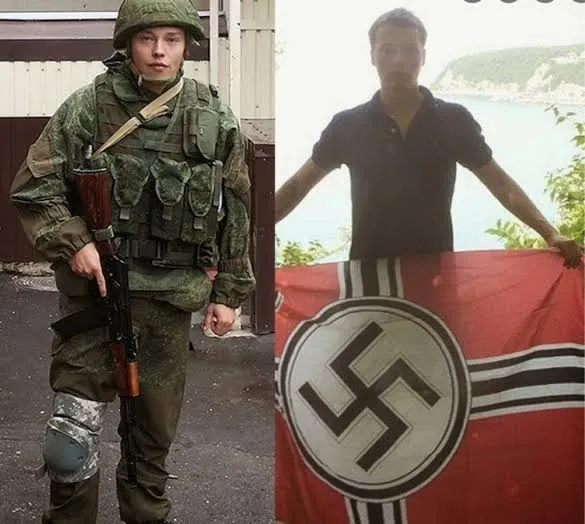
Rusich has been accused of numerous war crimes, including looting, videoing the act of mutilating prisoners, and executions. They regularly use their Telegram channel to crowdsource participation in war crimes, publishing detailed, step-by-step instructional manuals on how to torture prisoners of war, mutilate corpses, and extort the families of the dead.
And the Kremlin can’t claim plausible deniability when it comes to Rusich, especially when considering who publicly embraced Milchakov. In 2025, a scripted video came out featuring Apti Alaudinov, the commander of Chechnya’s Akhmat forces and the deputy head of the Russian Defence Ministry’s military-political department, cosying up to Milchakov. This bizarre display of mutual respect consisted of a high-ranking official (Alaudinov) speaking about ‘common cause’ with an avowed white supremacist who considers non-Slavs subhuman. It was an official State endorsement of a known (and particularly depraved) neo-Nazi.
And Rusich isn’t the only case. The Russian Imperial Movement (RIM) shows that this isn’t just an out-of-control embarrassment but part of a wider far-right ecosystem tied to Russian imperial aims.
RIM is an imperialist, ultra-reactionary, Russian Orthodox fascist organisation whose paramilitary wing, the Russian Imperial Legion, was active in Ukraine from 2014 onwards and returned after the full-scale invasion. RIM shares training infrastructure and personnel with Rusich, but with an added twist: it’s an internationally designated global terrorist organisation.
Then there’s Española, which shows how far-right subculture gets repurposed into wartime infrastructure. Cherta Media describes Española as emerging from a neo-Nazi brawling community inside Russia’s football hooligan world before reorganising into a combat formation in occupied Donetsk.
Though recently undergoing ‘restructuring’, its broader societal integration continues. The group has launched youth outreach programmes in occupied Horlivka, grooming local children into a football team modelled directly on Española’s neo-Nazi iconography. The group also employs Gregory Wayne Rossell, an infamous American white supremacist, as its English-speaking spokesperson.
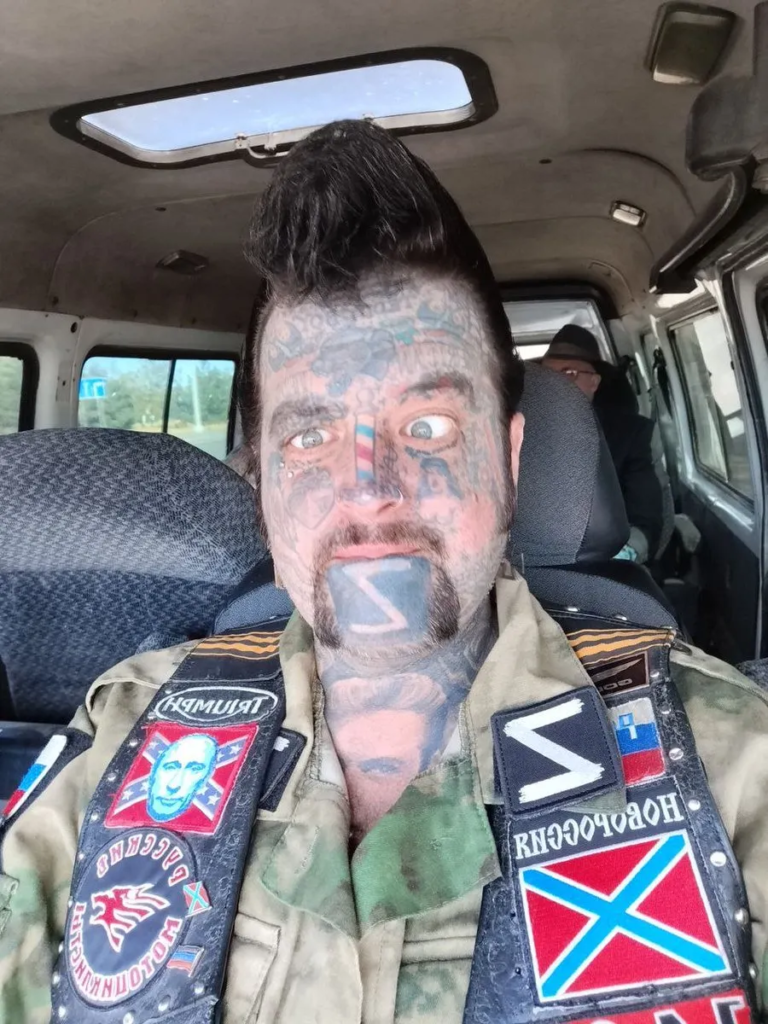
And Española is more of a corporate subsidiary than an anti-system underground movement. By 2024, the battalion was heavily sponsored by Viktor Shendrik, the head of security at the State railway monopoly, Russian Railways, and a direct protégé of Arkady and Boris Rotenberg – two of Putin’s closest billionaire oligarch allies. Its fighters sign official contracts through Redut, the pseudo-PMC that serves as a mercenary recruitment front for the Russian Defence Ministry, while its founder, Stanislav Orlov, had been embedded in Donbas since 2014 prior to his death in late 2025 (which was followed by a funeral with full, solemn honours at Moscow’s Cathedral of Christ the Saviour).
Since the death of Orlov, many members of Española have joined the previously mentioned far-right vigilante group, Russkaya Obshchina.
Russia has also tried to position itself as a symbolic refuge for parts of the global far right and broader Western reactionary scene.
The official ‘Shared Values’ visa is a tangible result of these attempts. Russian consular materials say it’s for citizens of countries accused of imposing ‘destructive neoliberal ideological attitudes’ contrary to Russia’s ‘traditional spiritual and moral values’, and it waives both quotas and the usual Russian-language/history requirements for temporary residence.
Meanwhile, admiration for Putin inside the American far right has hardly been subtle: at AFPAC (America First Political Action Conference) in 2022, after Nick Fuentes asked for applause for Russia just days after the invasion, the crowd responded with chants of ‘Putin! Putin!’. This overt affinity is part of a deliberate ideological lineage: white nationalist Richard Spencer previously lauded Russia as ‘the sole white power in the world’, a sentiment echoed in Charlottesville where marchers chanted ‘Russia is our friend!’. The historical roots run even deeper – as early as 2001, former Ku Klux Klan leader David Duke designated Russia as ‘the key to white survival’.
The structural bridge between American white supremacists and the Kremlin is anchored by transnational Christian nationalism. The World Congress of Families, an American religious coalition, has been co-opted as a soft-power tool for Russian interests. Hacked communications reveal that the group’s Russian liaison connects directly to Konstantin Malofeev, a sanctioned, ultra-nationalist Russian oligarch who openly advocates for the restoration of the Russian Empire and bankrolls far-right initiatives. By framing geopolitical conflicts as existential spiritual battles (casting Ukraine as a proxy for morally corrupt Western ‘globalists’), the Kremlin gives Western extremists an easily digestible vocabulary to justify their opposition to democracy.
By 2026, this relationship has solidified into a physical and legal sanctuary for Western disruptors. At Russia’s premier St Petersburg International Economic Forum (SPIEF) in June 2026, the Kremlin rolled out the red carpet for American far-right commentators like Candace Owens alongside misogynistic ‘manosphere’ influencers Andrew and Tristan Tate, the latter currently facing trial in Romania for human trafficking and rape. For the Tates, Moscow offers a potential haven from Western extradition and financial regulations. For Putin, hosting these figures allows Russia to project itself as the ultimate refuge from the Western liberal order.
The American Village project makes this dynamic even clearer. On its website, the initiative describes itself as a pipeline to help native English speakers start a new life in Russia alongside ‘like-minded individuals’. Founded by Tim Kirby, an American-born conservative Russian media figure, the project offers a step-by-step relocation pipeline tied to housing and immigration paperwork near Istra. Kirby explicitly sells the settlement in culture-war terms, targeting Westerners fleeing the ‘woke mind virus’ and ‘LGBT propaganda’ who want to live among other white nationalists.
This setup feeds directly into the Kremlin’s institutional propaganda and security apparatus. On 27 May, the State-run agency Rossotrudnichestvo hosted a high-profile roundtable titled ‘Preserving and Protecting Traditional Spiritual and Moral Values on the International Stage’ at the First International Security Forum. Moderated by Pyotr Tolstoy, Deputy Chairman of the State Duma, the event brought together prominent Russian figures like Konstantin Kosachev and Elena Malysheva alongside Western far-right sympathisers, including Hans-Joachim Frey, Pierre de Gaulle, and Fabrice Sorlin, the co-founder of the International Russophile Movement.
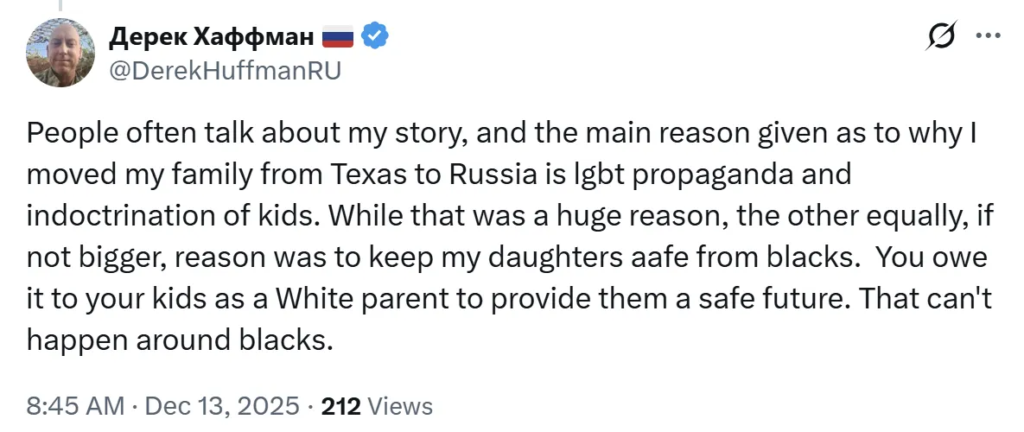
The forum perfectly illustrated how ideological migrants are transitioned from expat recruits into State tools. Among the featured speakers paraded to address why foreign nationals are relocating to Russia was Derek Huffman.
The Huffman family had uprooted their lives to join this migration, and Derek was introduced to the forum as an American father of a large family who relocated to Russia and subsequently took part in the ‘special military operation’. And Huffman himself serves as a textbook example of the radicalised demographic most deeply attracted to Russia’s State-marketed ‘traditional values’. Far from a benign conservative seeking a quiet life, Huffman’s online presence laid bare the explicit white supremacist motivations behind his relocation, featuring YouTube videos where he ranted about escaping ‘dangerous blacks’ in Texas and posts on X filled with racial slurs and Great Replacement theory rhetoric. His subsequent embrace by the Kremlin’s propaganda machine underscores the dark reality of Moscow’s cultural warfare: its ‘anti-woke’ branding operates fundamentally as a dog whistle designed to recruit and weaponise Western extremists.
So let’s be entirely clear: fascism deserves absolute condemnation, without exception or borders.
But if your anti-Nazi outrage appears only when criticising Ukraine, yet suddenly falls dead silent when confronted with Moscow’s rampant neo-Nazi networks, brutal anti-migrant violence, and global white supremacist pipelines, you aren’t actually engaging in anti-fascism.
You’ve simply made a calculated choice to look away and in doing so, you’ve become the exact kind of useful idiot the Kremlin is banking on.
radical dumpling: screaming into the void about anti-fascism and anti-imperial consistency, from somewhere between east and west.
This article originally appeared on the author’s Substack.
More content from this blog
- Reports from the past Week on Workers’ Struggles and Other Protest Movements in Iran, by Hayat Almasi and Evin Rezaei – June 2025
- The Rise of Neoliberal Public Finance, by Melinda Cooper – 2 September 2024
- Race and Racism in Africa and the Middle East – 8 September 2020
- Women’s Liberation Mustn’t Stop at Either Side of the Gaza Fence, by Samah Salaime – 22 December 2023
- Iran between Repression, Co-optation, and War: Three Waves of Counterrevolution, by Somayeh Rostampour – 19 March 2026
Except where noted otherwise, original writing and translations produced by the Left Renewal Blog Collective are published under a Creative Commons Attribution–NonCommercial–ShareAlike 4.0 licence. Republished and translated material remains subject to the licence and terms of its original publication.