On March 9, U.S. Secretary of State Marco Rubio announced that the State Department was “designating the Sudanese Muslim Brotherhood as a Specially Designated Global Terrorist and intends to designate the group as a Foreign Terrorist Organization, effective March 16, 2026.” The designation followed upon sanctions issued by the Treasury Department in September 2025 against “Gebreil Ibrahim Mohamed Fediel (Gebreil) and the Al-Baraa Bin Malik Brigade.” Both decisions were framed in terms of punishing destabilizing actors in Sudan and curtailing alleged Iranian influence.
As with other American government (federal and state) actions against “the Muslim Brotherhood,” analysts immediately questioned whether there was something as cohesive as “the Sudanese Muslim Brotherhood” that could even be designated and sanctioned in the first place. As Lauren Blanchard sketched in a useful thread, the Sudanese Islamist scene was fragmented even before the overthrow of longtime President Omar al-Bashir in 2019, let alone the current civil war that began in 2023. Blanchard suggests that the fuzziness of the U.S. government’s label is not just politically incoherent, but could also raise difficult logistical questions for banks and firms operating in Sudan. Within the Islamist scene, meanwhile, various individuals and parties say they have no formal connection to the Brotherhood, raising further questions about the applicability of the sanctions.
So who are Sudan’s Islamists? That’s a question requiring a book-length answer at minimum, but a quick sketch may be helpful for readers following Sudan. We can look first at pre-2019 history and then at some present dynamics.
Historical Personalities and Movements
Hasan al-Turabi (d. 2016): Virtually any conversation about Islamism in Sudan, or the Muslim Brotherhood there, begins with a reference to Hasan al-Turabi. The scion of a scholarly family from eastern Sudan, al-Turabi studied law at the University of Khartoum and pursued further education in Europe, earning a Ph.D. in law at the Sorbonne. From the 1960s onwards, he was a key figure in Sudanese politics and especially within the Islamist scene, where he led a series of movements and parties while also publishing numerous books and articles laying out his thinking about Islam and politics. The most prominent of those movements were the National Islamic Front and the National Congress Party (NCP). At times at odds with Sudanese presidents, he was also at the heart of power twice, first as attorney general in the late 1970s and early 1980s, and then as a key thinker and policymaker during the first decade of Omar al-Bashir’s presidency (1989-1999). At the peak of his power in the 1990s, al-Turabi and his colleagues fashioned Sudan into an international hub for Islamists, including Osama bin Laden for a time. After falling out with al-Bashir, al-Turabi was placed in detention for several years and spent the rest of his life more or less in opposition; the bulk of the NCP remained loyal to al-Bashir, while al-Turabi formed the Popular Congress Party (PCP), which attracted some elites from Darfur as the PCP charged that al-Bashir’s regime drew from a narrow stratum of northern Sudanese tribes and constituencies. A major biography of al-Turabi is Willow Berridge’s 2017 book; for an obituary that quotes some of al-Turabi’s followers, see here.
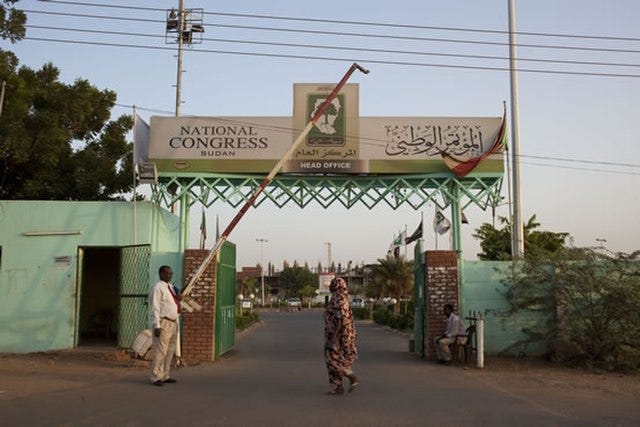
Ali Osman Taha: Born in the 1940s (different accounts give varying dates), Taha, like al-Turabi, studied law in Khartoum (see one brief biography of him here, and his career is also extensively discussed here). A member of al-Turabi’s National Islamic Front from his student days onwards, he was the parliamentary leader for the NIF during a brief period of multi-party democracy in Sudan in 1986-1989, and then he became an even more important figure after the 1989 coup. He served as Foreign Minister from 1995-1998 and then, in 1998, became Sudan’s First Vice President. He aligned with al-Bashir during the schism with al-Turabi. Taha was the administration’s key mediator for the 2005 Comprehensive Peace Agreement that ended a long north-south civil war and paved the way for South Sudan’s secession in 2011.
Nafie Ali Nafie: Also born in the 1940s and a longtime associate of al-Turabi, Nafie (see one biography of him here) was trained as an agriculturalist and geneticist but developed a practical specialization in security and intelligence matters, first in the Islamist opposition in the 1980s and then in al-Bashir’s regime from the 1990s onwards. Regarded as a hardliner, Nafie was another key personality who sided with al-Bashir amid the split with al-Turabi. Within the regime, however, Nafie was a major rival to Taha, competing for power and disagreeing over the 2005 peace deal. How “Islamist” any of these insiders remained after 1999 is debatable, meanwhile; al-Bashir’s approach to ruling, especially after 1999, has often been analyzed as a pragmatic effort to stay in power rather than as an ideologically driven quest.
There is much more that could be said about the 1989-2019 period, but for brevity’s sake I’ll pause here. Two key books covering that period are Noah Salomon’s 2016 ethnography of the atmospherics of Islamist rule, and Khalid Medani’s analysis of the political economy of Sudanese Islamism in his 2021 book Black Markets and Militants (see Chapters 2 and 5).
Current Dynamics
Amid the civil war since 2023, much attention has focused on the military and political roles of Islamists within the camp of General Abdel Fattah al-Burhan, leader of the Sudanese Armed Forces (SAF). The SAF is fighting the Rapid Support Forces (RSF) for control of Sudan. Both the SAF and the RSF, meanwhile, oversee shifting coalitions of political-military actors.
In terms of Islamist politicians, the former ruling NCP is down but not out. Some reporting, for example from the journalist Gwenaëlle Lenoir at OrientXXI, has depicted former Islamist regime members as the guiding hand behind the SAF, but to me the Islamists scan as one faction among many within al-Burhan’s camp. All of those factions are jockeying for power in the present and the future. In July 2025, Reuters’ Khalid Abdelaziz reported:
In his first media interview in years, Ahmed Haroun, chairman of the former ruling National Congress Party (NCP) and one of four Sudanese wanted by the International Criminal Court, told Reuters that he foresaw the army staying in politics after the war, and that elections could provide a route back to power for his party and the Islamist movement connected to it.
[…]
Haroun, wanted by the ICC for alleged involvement in war crimes and genocide in Darfur in the early 2000s — charges he dismisses as political — suggested a referendum to choose which army officer would lead the country.
The revival of Islamist factions began before the outbreak of the war in April 2023, during a period when a transition towards civilian rule was veering off course.
For al-Burhan, meanwhile, the Islamists’ presence appears deeply awkward; they bring some political and military capital to the table, but also serious reputational and political risks.
In terms of the Islamists’ military footprint, most coverage (and sanctions) have focused on the Al-Baraa bin Malik Brigade. That paramilitary force is aligned with the SAF and associated with the Popular Defense Forces, a wider paramilitary unit disbanded in 2019 but reinstated in 2023. The Brigade has been credibly accused – like almost every major faction in Sudan, including the SAF and above all the RSF – of conducting serious abuses against civilians and rivals.
Middle East Eye’s Mohammed Amin offered a look at the Brigade in a 2025 report:
Just before the war broke out in April [2023], some members of al-Bara ibn Malik re-emerged in Khartoum, organising Ramadan breakfasts and making rally speeches against the framework agreement then being thrashed out between the army, the RSF and the civilian Forces for Freedom and Change (FFC) coalition.
The framework deal was one of the causes of the war, and al-Bara ibn Malik’s presence and influence grew rapidly after it broke out, particularly once army chief Abdel Fattah al-Burhan opened military training camps in the summer of 2023 for anyone who wanted to volunteer to fight against the RSF.
In an exclusive interview, al-Bara ibn Malik spokesman Amar Abdul Wahab Sid Ahmed said the number of army-aligned fighters in groups like his, which he described as “jihadi”, is now above 20,000.
Following the U.S.’ terrorist designation announcement in March 2026, Sky News reported on the “escalatory” and defiant speech by Brigade leader Abu Zayd Talha. The Brigade describes the fight against the RSF as existential, and it is not clear to me that the designation will fundamentally affect their financial position – I tend to see such designations as more symbolic than anything else. But the designation certainly creates new headaches for al-Burhan, who is fighting for control on the ground but also seeking to manage perceptions in Washington and elsewhere, including by presenting himself as a “counterterrorism partner” to the Trump administration.
The Islamists, including the al-Baraa bin Malik Brigade, are an important component of al-Burhan’s coalition – but the coalition is much broader, absorbing various factions and forces who see the RSF as unacceptable; even some “democracy activists” have joined the SAF coalition out of opposition to the RSF. Civilians, meanwhile, often seem to prefer SAF rule to RSF rule, given how destructive, predatory, and outright genocidal the latter can be, but few civilians appear interested in seeing the return of Islamist rule. The short-term stability offered by the SAF, then, only postpones broader questions about who will rule Sudan when the war ends. Burhan himself, finally, appears to me a relatively non-ideological figure; he appears mostly interested in power and in the corporate interests of the SAF.
Lessons from Elsewhere?
Without flattening the differences across contexts, one pattern in the wider region is that former regimes do not often get a straightforward path back into power, even when new strongmen emerge. In Libya, for example, Khalifa Haftar may resemble Muammar Qadhafi in certain ways, but Haftar has his own close associates and is not a mere vehicle for the former regime to return to rule. Even in Egypt, Abdel Fattah al-Sisi has ruled in some fundamentally different ways than did Hosni Mubarak, despite coming out of the senior ranks of Mubarak’s administration. The dynamics of war also induce their own transformations; the old guard dies off, and the new leaders adapt to different political landscapes.
So an NCP restoration, at least in a one-to-one kind of way, does not appear likely in Sudan. Moreover, generational change – many of the fighters in al-Baraa bin Malik Brigade are young – is redefining what it means to be a Sudanese Islamist. When the Brigade’s leaders disavow the NCP, that could be mere rhetoric, but it could also mean that young Islamists are not necessarily interested in aligning themselves with the parties and factions of a now-disappearing generation of politicians and activists. For his part, finally, al-Burhan would have a serious incentive to marginalize Islamists when and if he consolidates control.
Alex Thurston is an associate professor in the School of Public and International Affairs at the University of Cincinnati. He studies Islam and politics in Africa.
This article was first published on Alex Thurston’s Substack.
More content from this blog
- An Anthology of Critical Assessments of Left Responses to 7 October – 16 February 2024
- On Collateral Damage, Selective Anti-Imperialism and the Path to Liberation, by Tereza Hendl and Selbi Durdiyeva – 5 December 2025
- How Anarchists Saw the Iranian Revolution (Part 2), by Tom Goyens – 17 May 2026
- The Trump Right’s Pro-Israel Antisemitism, by Zack Beauchamp – 19 March 2025
- Who Is José Antonio Kast? [Chile], by Sophia Boddenberg – 18 December 2025
Except where noted otherwise, original writing and translations produced by the Left Renewal Blog Collective are published under a Creative Commons Attribution–NonCommercial–ShareAlike 4.0 licence. Republished and translated material remains subject to the licence and terms of its original publication.