Alexander Snezhkov and Lyubov Lizunova are not names you usually see mentioned in general anti-war statements from leftist groups in the west. They were 19 and 16 when arrested in Chita (a Siberian city) and were later formally charged for running an anti-war anarchist Telegram channel and painting graffiti. Alexander got 6 years. Lyubov got 3 years and 6 months. Alexander has since spent over 90 days in solitary confinement on fabricated rule violations and now sits in a strict-regime PKT unit, the kind of facility normally reserved for organized crime bosses, not teenagers with spray cans.
Alexey Rozhkov threw a Molotov cocktail at a military enlistment office 16 days into the invasion. It was one of the earliest direct actions of the war and inspired a wave of arson attempts that eventually forced the military to digitize conscription records nationwide. He fled to Kyrgyzstan, was abducted by Russian security services, and returned to a 16-year sentence on terrorism charges. Ruslan Sidiki, an anarchist from a farming cooperative in Leningrad region, tried to destroy a strategic bomber with drones, failed, then successfully derailed a freight train. He contacted Ukrainian intelligence for tactical advice but refused their material support. He got 29 years, nearly three times the going rate for murder in Russia. The network claiming responsibility for a chunk of this sabotage campaign, BOAK, has lost so many members to exile that it now spends more time writing security guides for the cells replacing them than claiming new actions.
You would reasonably expect an article about wartime repression, written by a prominent Western leftist with a large platform, to highlight these exact cases. Yet none of them appear in the text examined below. And this glaring omission is where our analysis begins.
The absence is easy to miss at first because the piece does not read like crude propaganda. It contains no simplistic tankie slogans, no Z-symbols, and no heavy-handed denazification talking points. It does not deny a single documented war crime. Instead, it presents a passionate call for workers on both sides of the conflict to turn their weapons on their own officers. If you accused the author of carrying water for the Kremlin, they would likely ridicule you.
But there’s still a problem.
Pro-Russian narrative laundering within the left does not rely on conscious bad actors. It relies on sincere, well-read writers who are highly selective. It weaponizes arguments built from true facts, interspersed with convenient omissions and structural gaps born from a lack of regional expertise. The asymmetrical “analysis” does the heaviest lifting.
It’s deeply revealing that this is possibly the only modern occupation where so many self-described anti-imperialists feel compelled to endlessly debate whether the victims deserve unambiguous solidarity. No other invasion faces this level of forensic scrutiny directed at the invaded rather than the aggressor from people who should know better. Countless dialectical frameworks and historical detours are deployed to obscure the most fundamental fact of the conflict, which is that Russia launched an imperial war of aggression against Ukraine, and the Ukrainian people are actively resisting that domination.
While cartoonish tankie accounts cheering for Russian artillery are easily dismissed, sophisticated narrative selection is far more effective and dangerous. It manifests when an essay dedicates paragraphs to the torture of two Ukrainian communists but offers only a single, vague sentence about the domestic terror inside Russia. It names the far-right Azov regiment but completely ignores the neo-Nazi Rusich group fighting for Moscow. It quotes an isolated Ukrainian Telegram channel as the definitive voice of the local working class while ignoring an organized socialist organization fighting the oligarchy from within the resistance.
Very few of these individual points are outright lies, but together they manufacture a false equivalence that quietly balances the aggressor against the invaded. Because this picture is delivered with the authority of genuine scholarship, it carries immense moral weight.
This analysis is not an attempt to prove the author is a secret Kremlin asset. That kind of speculation belongs to conspiracy theorists who wage mindless X wars with Shiba Inu profiles, and it misses the entire point. The reality is that selective framing does the work of state propaganda far more efficiently than a bot farm ever could. It arrives pre-laundered through the appearance of intellectual rigor and leftist ideology. What follows examines exactly how this selection operates, what it systematically omits, and why labeling this framework as principled anti-imperialism is a mistake.
We can start by taking a look at the opening paragraph, and for easy reference, here’s a link to the article itself.
“Despite the worsening conditions for workers in the region, pro-war leftists continue to argue that the current bloodbath in Ukraine (which has now resulted in almost two million casualties) must still have our critical support because of the historically ‘progressive’ character of Ukrainian liberalism over Russian Putinism.”
By framing solidarity with Ukraine as a preference for “Ukrainian liberalism over Russian Putinism,” the author relies on a highly dishonest reductionism. Eastern European and Ukrainian leftists do not “support” the war because they are enamored with bourgeois liberalism (and I don’t think “liberal” is even a good descriptor for Ukrainian society). No one wants this war, and every day people feel genuine pain to find out their friends have died at the front or their families have lost their homes in overnight bombing campaigns. Ukrainian leftists choose to resist because they recognize that a Russian victory means the physical liquidation of their communities and the total erasure of any civic space to organize.
And “pro-war leftist” is a condescending descriptor used the way “class traitor” or “petit-bourgeois deviation” gets used, to put a political position outside the boundary of acceptable leftism without arguing against its content. It’s aimed specifically at people like Taras Bilous, a Ukrainian socialist who has served on the front as a drone operator since the invasion began. He has argued from inside the material conditions this article theorizes about from a distance, exactly why resistance is a class question and not a nationalist one. He wrote about this at length, most recently in Jacobin.
“This article focuses on this myth; on how the Ukrainian state has discreetly used wartime conditions to enact the same repressive conditions that are constantly condemned in Russia and has consolidated extreme wealth in the hands of a corrupt capitalist elite while sending its countrymen into the killing fields (increasingly against their will). As communists, we see these concerning developments as further evidence for an end to the imperialist slaughter in Ukraine and for soldier-worker revolt against the parasitic capitalists, beyond the mirage of national borders and flags.”
The assertion that Ukraine has enacted the same repressive conditions as Russia is a massive false equivalence that functions as pure narrative laundering. It relies on the reader’s complete ignorance of what actual Russian totalitarianism looks like to score cheap points. While the Ukrainian state has undoubtedly used martial law to push through terrible neoliberal policies and protect oligarchic wealth, a materialist analysis recognizes that an embattled democracy still leaves workers with the civic space to organize and fight back. Leftists and anarchists in the region are actively fighting these policies on the ground. Russia, by contrast, operates a fascist autocracy where independent organization is permanently liquidated and dissent is answered with a penal colony.
The call for a soldier worker revolt beyond the mirage of national borders is a textbook (and laughably absurd) example of a western academic with zero understanding of the people involved in this war. It’s basically trying to theorize away an existential war. Borders are indeed state constructs, but right now, the Ukrainian border is the only physical barrier preventing further massacres. Telling Ukrainian soldiers to turn their guns on their own commanders in the middle of a fascist invasion is not a revolutionary strategy for liberation. It is a direct invitation for Russian imperialism to finish the job. Under the guise of radical purity, this conclusion serves only to demand Ukraine’s surrender while completely erasing the responsibility of the invading power.
“State Abductions”
“As it stands this uncomfortable burden remains a wholly Ukrainian responsibility, and one which Ukrainians are increasingly sick of. While nationalist propaganda proved effective at driving men into battle in the early months of war, the state has increasingly found itself depending on coercive and violent methods of military recruitment. War fatigue and desertion have become increasing responses to the horrors of drone-trench warfare. On social media, chilling videos of young boys snatched in broad daylight and thrown into white vans by state troops provide rare glimpses of reality. Many will never get to see their mothers ever again.”
The coercive mobilization tactics and white van videos the author highlights are genuinely abhorrent and worthy of critique, but analyzing this state violence in a total vacuum serves a deceptive purpose. By focusing exclusively on the brutality of Ukrainian conscription while completely ignoring the external catalyst (which is a fascist Russian invasion) the author reframes Ukraine’s defense as the primary threat to working class lives. And the assertion that nationalist propaganda drove people to fight in the early months completely erases the agency of ordinary Ukrainian workers, trade unionists, and anti-fascists who volunteered not because they were brainwashed by the state, but out of a basic need for physical survival. The emotional conclusion about young men never seeing their mothers again deliberately misdirects the blame, because it is Russian artillery and occupation forces that will ultimately kill them, not the defensive mobilization itself. By weaponizing genuine war weariness while obscuring the existential threat that causes it, this passage creates a false moral equivalence that makes a colonial war of survival look like a cynical dispute between an oppressive government and a passive population.
It’s also worth noting that the author never applies this level of scrutiny to Russia’s own mobilization practices (in this article or elsewhere), revealing a massive blind spot regarding state violence that should deeply alarm any anti-fascist. The piece remains completely silent on how the Kremlin uses digital tracking systems to trap conscripts, hands out draft summonses to silence anti-war demonstrators, and uses deceptive narratives from educators to lure university students to the front lines. While fixating on Ukraine, the author ignores a predatory Russian system that co-opts desperate debtors with promises of erased debt, traps migrant workers under false promises of employment, and deliberately drains poor rural and indigenous regions to shield wealthy ethnic Russians in the west.
“While ordinary Ukrainians have sacrificed themselves for ‘the nation’, political and capitalist elites have seen the war as the perfect time for their own self enrichment. In 2024 it was uncovered that a Ukrainian arms firm, in collusion with political elites in the ministry of defence had stolen some $40,000,000 from the public purse. Repeated cases like these have sown deepening distrust amongst the Ukrainian working class, helping to break down the lie of ‘national unity’ that dominated the early stages of the war.
This higher level of consciousness – a redefining of the enemy to one at home – is already finding expression in Ukraine.”
This is an example of weaponizing genuine anti-capitalist critique to push a dangerous, pseudo-revolutionary defeatism that would ultimately result in colonial subjugation. For any anti-authoritarian, the reality of wartime corruption, oligarchic self-enrichment, and the defense ministry scandal highlighted by the author are deeply despicable, yet the author completely misrepresents how these realities actually function in Ukraine. This corruption was uncovered and publicized by Ukrainian journalists, activists, and anti-corruption bodies, reflecting a resilient civil society demanding accountability rather than a passive population suddenly having a top-down epiphany. By framing this justified anger as a redefining of the enemy to the one at home, the passage uses leftist terminology to imply that Ukrainian workers should pivot away from resisting the foreign invader to fight their own elite. This is a fatal distortion of anti-imperialism because it treats the domestic capitalist class and an invading, fascist superpower as equal threats. If Ukrainian workers abandon the front lines to focus exclusively on internal class struggle, they do not achieve liberation. They simply pave the way for Russian occupation forces to crush both them and any remaining space for political dissent.
The author selectively pathologizes Ukrainian corruption while completely ignoring the institutionalized, multi-billion-dollar kleptocracy of the Russian war machine, creating a dishonest narrative where domestic greed somehow invalidates a people’s right to armed self-defense against external annihilation.
“Deepening Inequality & State Capture”
“Perhaps this violence and authoritarianism could be justified if it were being done for the benefit of the Ukrainian working class as a whole. This is sadly not the case. Rather than being waged in the interests of the Ukrainian workers, the war has been the perfect opportunity for escalation of attacks by the Ukrainian ruling class. Poverty has spread like a disease across the country. In 2021 5% of people were estimated to be living in poverty, while today that percentage has climbed dramatically to 37%. The spread of poverty has not been an even product of war – while ordinary people have grown increasingly impoverished, the richest have actually grown their wealth since the outbreak of war.”
The statistic that poverty in Ukraine has risen to 37 % is a tragic reality verified by the World Bank. But the explosion of the poverty rate is the direct mathematical result of Russia systematically dismantling the foundational components of regular working-class life. By executing hundreds of coordinated missile and drone strikes targeting electricity generation, transmission networks, and centralized heating infrastructure, the invading forces have forced routine rolling blackouts that paralyze local businesses, trigger mass job losses, and spike utility costs. This deliberate strangulation extends to the country’s physical geography, where the dense mining of agricultural fields has transformed vast swaths of fertile land into lethal grid zones, destroying rural livelihoods and driving food inflation to brutal levels. And the relentless targeting of transport hubs, rail lines, and shipping ports has choked off the trade networks that thousands of workers depend on for income, while the destruction of more than 14 % of the nation’s housing stock has turned millions of ordinary citizens into internally displaced refugees who have lost everything overnight.
“Most concerning is the continued mass privatisation of Ukrainian state assets, mass deregulation of labour laws and business and allowing the full privatisation of Ukrainian agricultural land. This is what the Ukrainian working class is dying for, not ‘freedom’ or a national flag. Only the right to dig its own grave.”
The deregulation of labor laws and the privatization of state assets are genuine betrayals of the Ukrainian working class that local leftists actively condemn. However, the author makes a cynical and deeply offensive leap by claiming that this corporate exploitation is what ordinary Ukrainians are actually dying for. This logic completely strips Ukrainian workers of their own consciousness and motivations while erasing the immediate, visceral reality of Russian imperialist violence. Ordinary people are not risking their lives on the front lines to line the pockets of foreign investors or domestic oligarchs, but to prevent their families from being slaughtered, their cultures erased, and their towns turned into mass graves by an invading army.
The author ignores the fact that inside Russia and its occupied territories, independent labor movements have been violently dismantled, with grassroots organizers facing systematic imprisonment, torture, and extrajudicial execution. Within the Russian Federation, international labor solidarity is actively criminalized, independent unions are legally liquidated. In the occupied regions of Ukraine, the situation is even more perilous, as genuine trade unions are dissolved by force, their assets are seized, and workers are coerced into joining state-controlled Russian unions under threat of termination or violence. Labor organizers who refuse to collaborate are blacklisted by security services, leading to a documented pattern of abductions, enforced disappearances, and summary extrajudicial killings inside clandestine detention sites. Defending Ukrainian sovereignty is not about worshiping a national flag, but about preserving the basic democratic space required to defend workers’ rights (which simply would not be possible under Kremlin subjugation).
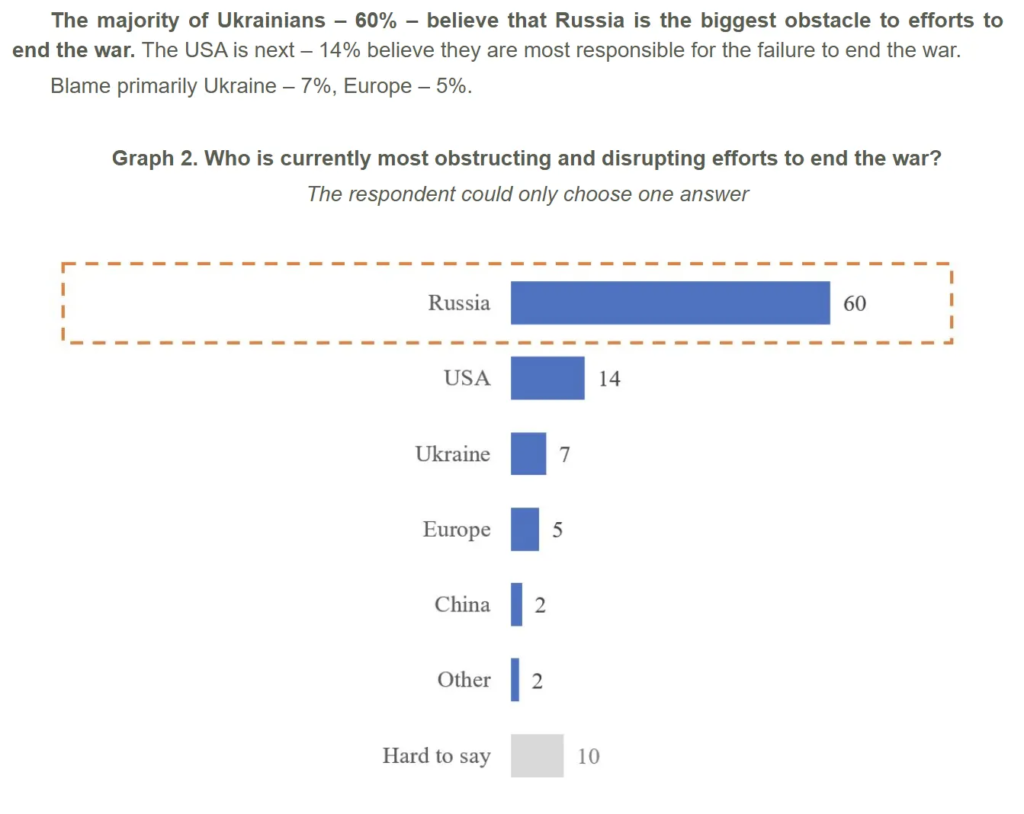
These polls directly shatter the author’s paternalistic claim that Ukrainians are ready to abandon the fight or redefine their own state as the primary enemy. Empirical data from KIIS polling shows that 60 % of Ukrainians blame Russia for obstructing peace while only 7 % blame Ukraine.
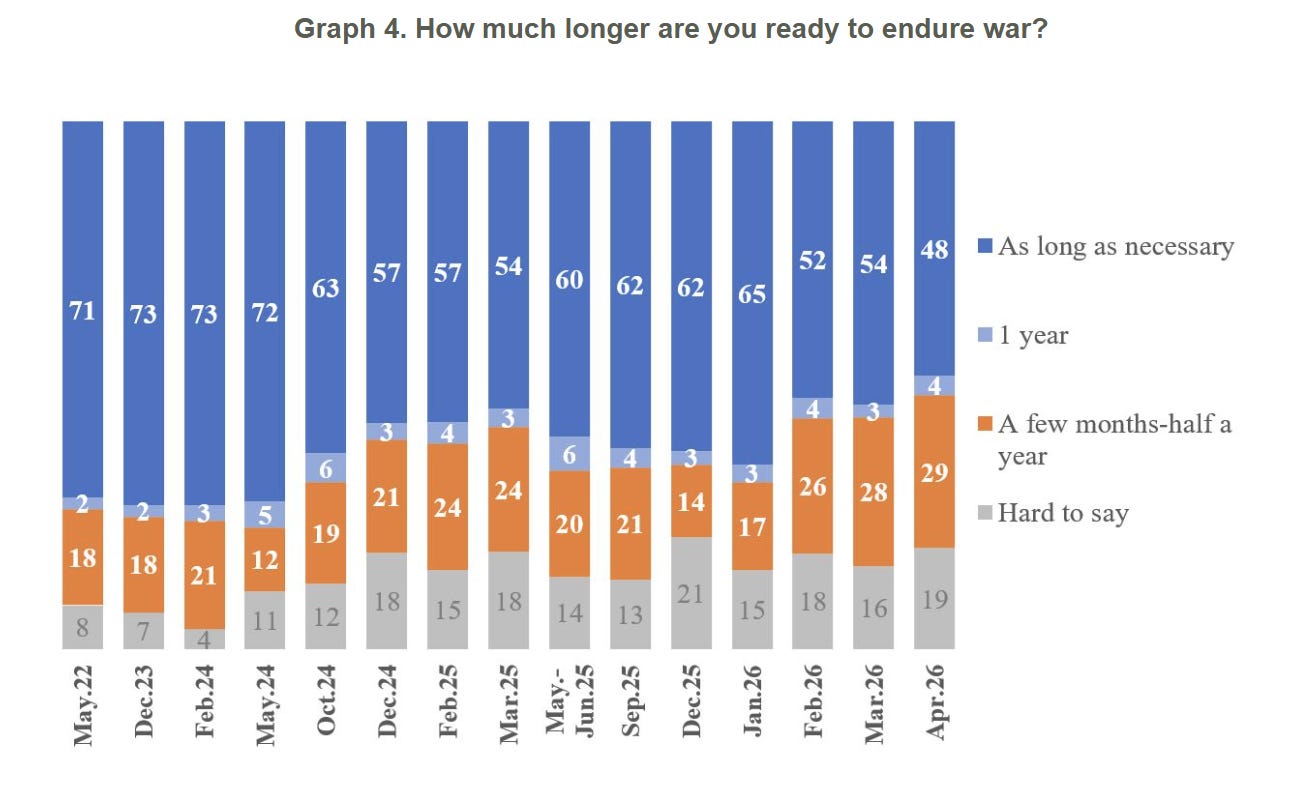
It also reveals that nearly half the population remains willing to endure the war for as long as necessary.
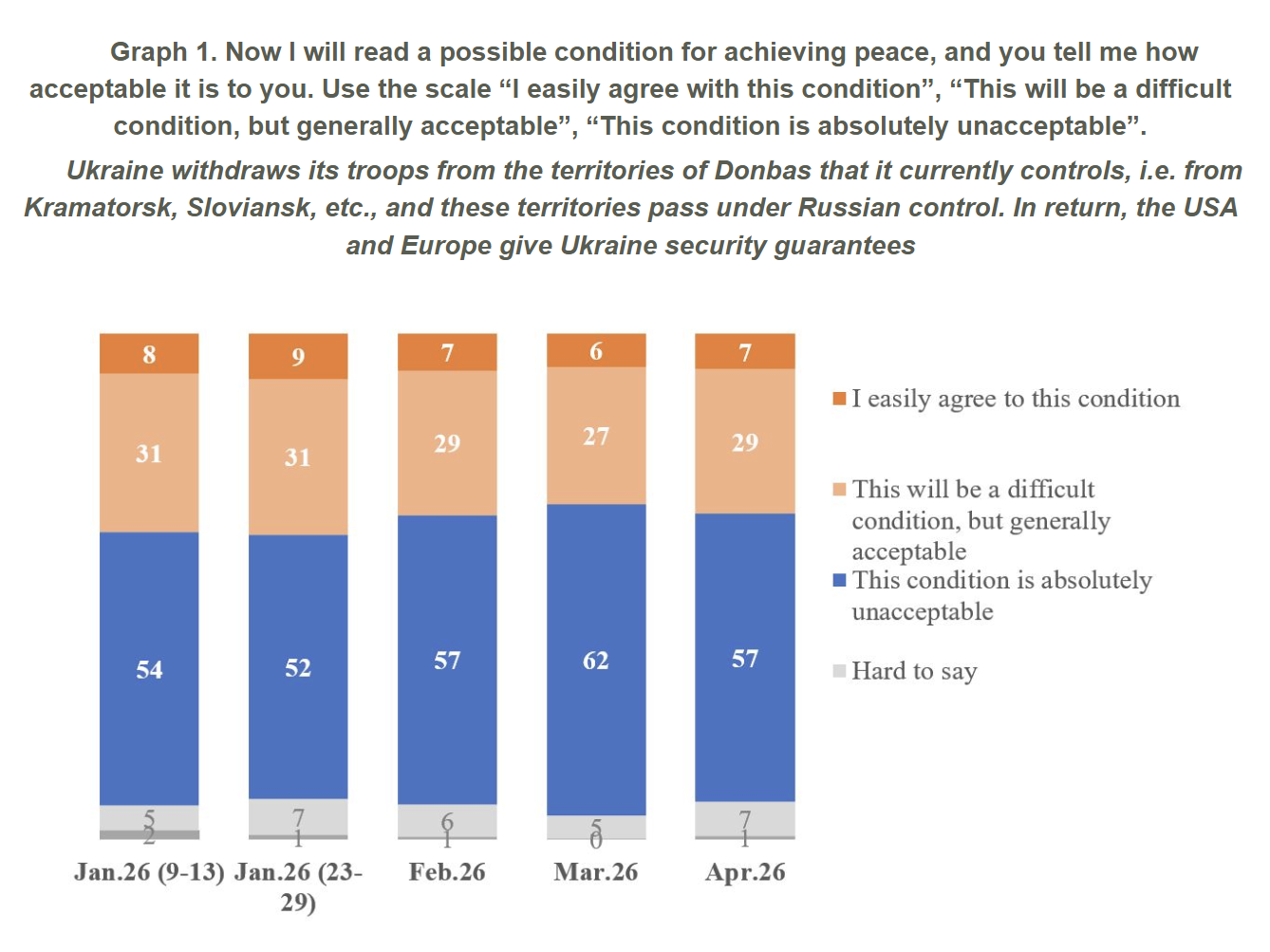
And 57 % percent view ceding territory to Russia as absolutely unacceptable.
“Repression Against the Left & the Growing Fascist Threat”
“While the Ukrainian state has long engaged in authoritarian practises, the escalation of the war has given the ruling class the political room for sweeping repression against organised labour and political opposition. Since the outbreak of war, national elections (meant to be held in 2023) have been indefinitely suspended while 11 opposition parties have been banned. Most prominently, the centre left Eurosceptic Opposition Platform – For Life party, which held 44 parliamentary seats and was meant to be the main opposition party was banned, despite the party’s condemnation of Russia’s invasion.”
The suspension of national elections is a constitutional and statutory requirement under Ukrainian martial law, enacted because free and fair democratic processes are logistically impossible when millions of working-class citizens are displaced, living under foreign occupation, or fighting on the front lines. Every 90 days, Ukrainian parliament votes to extend this suspension. According to 2025 polling from KIIS, only 9-11 % of Ukrainians believe that should elections should be held before a ceasefire, and even Zelenskyy’s rivals (Petro Poroshenko and Yulia Tymoshenko) have echoed this sentiment.
The author’s description of the banned Opposition Platform – For Lifeparty as a benign, centre-left Eurosceptic opposition is a major distortion of reality. In truth, this party was a notoriously corrupt, oligarchic, pro-Russian fifth column led by Viktor Medvedchuk (a close personal ally of Vladimir Putin) making its dissolution an act of existential self-defense against a collaborationist network rather than the suppression of an authentic domestic left.
“Parties banned since the outbreak of war:
Opposition Platform – For Life
Party of Shariy
Nashi (Ours)
Opposition Bloc
Left Opposition
Union of Left Forces
Derzhava
Progressive Socialist Party of Ukraine
Socialist Party of Ukraine
Socialists
Volodymyr Saldo Bloc”
The author counts on readers’ lack of regional knowledge to imply that Ukraine is executing an ideological crackdown on an authentic, progressive opposition. In reality, many of these groups were not grassroots working-class organizations or anti-capitalist resistance movements, but astroturfed oligarchic vehicles and overt collaborationist fronts aligned with a foreign fascist superpower.
The Volodymyr Saldo Bloc is named after a man who literally became a Russian-appointed puppet governor in occupied Kherson, while the Derzhava party was led by prominent collaborators, such as Dmytro Vasylets who formed an exile group in Russia aiming to act as a Kremlin-backed transitional government. Even the ostensibly left-wing groups on this list expose the author’s major knowledge gap, such as the Progressive Socialist Party of Ukraine, which is a National Bolshevik, Eurasianist organization deeply tied to the fascistic ideology of Aleksandr Dugin.
“Just a year before the ban on communist party activities, on the 2nd of May 2014, around a thousand fascist thugs under the banner of Right Sector (a Neo-Nazi paramilitary group) surrounded the House of Trade Unions in Odessa, setting fire to the premises where dozens of terrified workers had sought sanctuary. Right Sector members, barricaded exits and beat the men, women and children who threw themselves out of the windows of the building trying to escape.”
The violence in May 2014 actually began when armed pro-Russian militants attacked a peaceful pro-Ukrainian march in the city center, shooting and killing several demonstrators first. The subsequent clash at the trade union building was a chaotic street battle between two armed political factions rather than an unprovoked massacre of passive workers, and independent investigations proved that the building was being used as a fortified position from which anti-Maidan activists were also firing weapons and throwing Molotov cocktails. Furthermore, the author completely suppresses the well-documented fact that many pro-Ukrainian demonstrators actively risked their lives to rescue those trapped inside the burning building.
“While apologists for the Ukrainian state often claim that ‘every country has a far right problem’ this is an dishonest distortion of reality in the country, where openly neo-nazi units are systematically integrated into the structures of the Ukrainian state, in particular its military. From the infamous Azov Battalion (which once Congress banned from receiving US arms, then suddenly decided it no longer cared) to the National Corps and Right Sector’s volunteer paramilitaries, fascist organisations have become unaccountable and powerful players within the Ukrainian military, able to hurt, intimidate and kill those who stand in their way.”
The far-right origins of groups like the original Azov Battalion in 2014 are undeniable and reprehensible. But the author presents a completely distorted view of domestic power dynamics, since Ukraine’s far-right political parties have consistently failed to achieve any meaningful electoral success (winning only roughly 3 % of the popular vote). This fixation on Ukrainian far-right elements serves as a massive smoke screen to hide the fact that Russia openly integrates unvarnished, state-sanctioned neo-Nazi combat units like the Rusich Group and the Russian Imperial Movement into its front-line operations. It also refuses to address systemic racism within Russia, including a massive uptick in racially motivated violence both from ordinary people and the Russian police. Hyper-focusing on the military adaptations of a defending nation while completely ignoring the institutionalized fascism of the invading superpower is deeply unserious.
“Furthermore, for Ukrainian apologists on the left, war is defended primarily because the Ukrainian state is seen as ‘historically progressive’ when compared with the authoritarian and nationalist Russian state. However if ultra nationalism in Ukraine is increasingly adopting the reactionary and neo-fascist elements of the Putinist state, it raises the question of what exactly hundreds of thousands of working class Ukrainians are really dying for.”
While it’s undeniably true that some liberal activists in the West routinely romanticize Ukraine as if it were a magical superhero state, this superficial framing is not the fault of the Ukrainians living through the bombs, and insisting that supportive leftists are naive enough to buy into it is deeply condescending. The decision to resist the invasion has absolutely nothing to do with endorsing the Ukrainian government or its nationalist factions, both of which local leftists actively challenge. Instead, hundreds of thousands of working-class Ukrainians are fighting for a far more immediate material reality, which is the right to physical survival and the preservation of a pluralistic civic space that allows them to organize, strike, and protest.
“The Kidnapping and Torture of the Kononovich Brothers”
“In the south Russian forces were advancing quickly, having taken Kherson (the first major city to fall) in the early days of March, and were pushing toward Mariupol, which was already under siege. Nobody knew how long the Ukrainian state could withstand the overwhelming might of the Russian military. Amidst this fraught backdrop, the Ukrainian state remained as committed as ever to its favourite practise – repression against its own people. On the 6th of March Ukrainian security services abducted Mikhail Kononovich and his twin brother Aleksandr Kononovich who led the Leninist Communist Youth Union, the youth wing of the (already banned) Ukrainian Communist Party.”
The author relies entirely on the “communist” label to manufacture a martyr story, completely hiding the well-documented fact that Mikhail and Aleksandr Kononovich were arrested not for their political beliefs, but for acting as active cross-border influence assets for the invading regimes in Moscow and Minsk. Far from being innocent youth organizers, the brothers regularly collaborated with Russian state media outlets like Rossiya-1 and News Front to broadcast war-justifying propaganda, traveled to the occupied “Luhansk People’s Republic” (LNR) to host joint press conferences whitewashing proxy rule, and operated astroturfed front groups like “Syabry Volyni” to stage pro-Lukashenko rallies on the literal eve of the full-scale invasion.
“The [Kononovich] brothers now face years in prison. They will not be alone. Since 2022 hundreds have been prosecuted under new ‘collaborator’ legislation, which has been used lavishly to restrict speech and anti-war organising. A year after the arrest of the Kononovich brothers, 77 year old Communist veteran Georgi Buiko was also arrested, charged with possessing communist materials and of ‘collaboration’. In the spring of 2025 Ukrainian Trotskyist Bogdan Syrotiukwas also seized and arrested, facing life in prison for writing anti-war pieces for the World Socialist Web Site, which supposedly amounts to ‘high treason’. Socialist and communist activists – already restricted in activity since the victory of the far right in 2014 – have now been forced to operate in a clandestine manner.”
While any principled anti-authoritarian must maintain that no one should ever be imprisoned or prosecuted for their political affiliation or peaceful activism, the author weaponizes genuine civil liberties concerns to run a profoundly dishonest, one-sided campist narrative. To be clear, state overreach under martial law must always be fiercely critiqued, but the author strips these cases of vital material context, such as the fact that Georgi Buiko was investigated for actively advocating the sovereignty of Russian-backed proxy statelets in the Donbas, rather than just possessing historical texts.
More egregiously, the author fixates on the arrest of Trotskyist writer Bogdan Syrotiuk to paint Ukraine as a uniquely totalitarian state, while maintaining a cowardly, total silence on the wholesale destruction of the left across the border. The passage completely ignores how the Kremlin systematically imprisons, tortures, and liquidates actual anti-war leftists, anarchists, and independent unionists inside Russia, handing down draconian penal colony sentences and violently crushing underground Marxist circles.
Attacks on Trade Unions, Support for Corruption
“The draconian measures led to widespread and open protests across the country, the first since the outbreak of the war. Facing a sudden upswell of resistance that coincided with a renewed Russian offensive, the state found itself forced on the retreat, and begrudgingly restored the agencies independence. However, this episode shows clearly that the Ukrainian government is not a unifying ‘national’ voice for the whole people, but a military outfit acting in the interests of capitalists, outside imperialist powers and domestic political elites. The vicious repression of (left) political opposition, systematic integration of neo-nazi elements into the state apparatus and worsening material conditions for the working class break any illusions of national unity, or the progressive liberal fantasy which many in the West continue to believe in.”
After spending the entire piece painting Ukraine as a hermetically sealed, totalitarian fascist state where all dissent has been violently erased, they openly admit that working-class Ukrainians successfully organized “widespread and open protests” and forced the government to retreat and concede. If Ukraine were the inescapable military dictatorship the author claims, these protesters would have been systematically disappeared, tortured, or sent to penal colonies.
Conclusion
“Just as we have covered extensively the hostile and oppressive conditions in Russia, it is our duty to apply the same critical lens of analysis to the class struggle in Ukraine, where it is clear that similar processes of repression, state violence and capitalist-militarist corruption are taking place. The imperialist war in Eastern Europe has been the greatest gift to the ruling classes in Ukraine and Russia, who now easily smear all criticism as propaganda of ‘the enemy nation’, providing free cover for all sorts of horrific crimes committed against the working classes of both countries.
As ever, it is the role of communists to be a strong voice against imperialist war and the nationalism which permits it. Only through soldier-worker revolution across national borders can Ukraine and Russia once again return to the fraternity of common peoples, and put an end to the violence which has torn the region apart since the fall of the USSR.”
This conclusion descends into an incredibly arrogant, paternalistic savior complex that could only be written by someone sitting safely in the West, completely insulated from the physical reality of the region. By treating dying people as abstract pawns in a Western leftist fantasy, the author lectures an occupied population on how they should feel and behave, revealing a total lack of contact with actual Ukrainian or Russian people. If the author had ever spoken to regular people on either side of this border, they would instantly realize just how offensive and detached from reality this utopian fanfiction truly is.
The call for a joint “soldier-worker revolution” to restore a “fraternity of common peoples” completely ignores the grim reality of contemporary Russian sentiment toward Ukraine. The author treats the Russian working class and military as if they are closeted revolutionaries just waiting to link arms with their Ukrainian brothers. In reality, decades of state-driven media, institutionalized imperial chauvinism, and fascism have deeply conditioned large segments of the Russian population (including the very front-line soldiers pulling the triggers) to either actively support or passively acquiesce to the total destruction of Ukrainian statehood and identity.
To demand that Ukrainians pause their own physical self-defense to build a borderless brotherhood with an occupying force that largely views them with colonial contempt is not “revolutionary internationalism.” It is a patronizing, toxic fantasy that costs a Western writer absolutely nothing to type, but demands that Ukrainian workers pay for it with their literal lives.
This selective presentation is what makes this specific brand of Western leftist critique so insidious. It builds an airtight case solely for an audience that doesn’t know any better, counting on total regional ignorance to smuggle in falsehoods. There is something uniquely repulsive about a commentator sitting in the comfort and safety of the UK, completely insulated from the terror of a war where civilians are blown apart in their sleep every single week, using the structural agony of an invaded people merely to flex his theoretical purity. His absolute detachment from local realities, including the language, the history, and the living culture of the region, is glaringly obvious and amounts to intellectual fraud.
If this author were genuinely moved by working-class suffering, he wouldn’t have left half the board completely blank. He would have detailed the brutal mechanics of the Russian state machine. He would have written about the actual anti-war dissidents and leftists currently languishing in Russian penal colonies, the absolute criminalization of basic speech, and the predatory, forced mobilization stripping Russia’s poorest provincial regions of their youth to feed an imperial meat grinder. He would have examined how deeply entrenched actual fascists and neo-Nazi mercenaries are within the structures of the Kremlin’s military.
None of this is an argument that Ukraine’s abuses get a pass because Russia’s are worse, and pointing out what he left out is not whataboutism. The claim on trial is the author’s own: that these are “the same repressive conditions” and that the two states sit on comparable moral ground. You don’t get to assert symmetry and then skip the half of the comparison that breaks it. A symmetry argument does require that both sides be examined.
By subjecting the invaded nation to microscopic forensic scrutiny while completely erasing the totalitarian reality of the invader, this text abdicates all claim to principled anti-imperialism. It is a hollow, morally bankrupt exercise in narrative laundering, written by someone who would gladly watch the total colonization of Eastern Europe if it meant never having to challenge his own ideology.
To be clear, no one is demanding that every leftist write about or even care about Ukraine. But if someone is going to weaponize this horrific war as a rhetorical prop to grow their readership or chase intellectual clout, they could at least have the basic decency to consult the actual people living through it.
The Ukrainian state deserves rigorous, unsparing criticism, and leftists in the region are actively delivering it. I have offered my own on countless occasions, from attacking problematic memory policies to confronting the tolerance of NSBM music festivals. But it is entirely impossible to have a serious, nuanced conversation about domestic Ukrainian politics with Western commentators who exhibit such a patronizing savior complex, yet cannot grasp the absolute baseline fact of this entire crisis: this war is entirely Russia’s responsibility, and it ends the moment Russia leaves.
If you want a genuine, rigorous anti-imperialist perspective, stop looking to British, American, or other Western leftists who use Ukrainian suffering as a convenient theoretical exercise or narrative device. Stop listening to tourists of other people’s trauma, and start amplifying the voices of leftists from this actual part of the world who live this reality every single day.
radical dumpling: screaming into the void about anti-fascism and anti-imperial consistency, from somewhere between east and west.
This article originally appeared on the author’s Substack.
More content from this blog
- [The UAE in Sudan] Not All Empires Look the Same, by Cheriese Dilrajh – 9 June 2026
- The Far Right Is Quietly Building Power Under Trump, by Spencer Sunshine – 6 January 2026
- Stop Racist and Misogynist Attacks on the Emergent Indigenous, Eco-Feminist Left in Latin America: An open letter – 1 March 2021
- Who fought in 1948?, by Tom Pessah – 22 September 2021
- Lior B. Sternfeld, Between Iran And Zion, Jewish Histories of Twentieth-Century Iran – 13 September 2019
Except where noted otherwise, original writing and translations produced by the Left Renewal Blog Collective are published under a Creative Commons Attribution–NonCommercial–ShareAlike 4.0 licence. Republished and translated material remains subject to the licence and terms of its original publication.