If you solely look at policy, it’s pretty easy to see why the Soviet Union is often described at being at the vanguard of feminism. At least on paper. After all, Soviet women earned technical degrees, worked in the medical field, operated machinery and heavy agricultural tools, and ran entire factories while also being guaranteed the safety net of maternity leave and childcare, well before any capitalist states managed anything remotely comparable.
But the problem with the sweeping claims about Soviet feminism is that they’re all largely surface-level.
You can look at statistics like employment figures and you’ll see that women comprised a massive part of the workforce. But the same figures don’t really tell you who had the final say over a woman’s body (especially when pregnancy is involved), whether it was possible for women to organize and meaningfully criticize the state, or whether the law was at all concerned with violence against women.
It would be dishonest to deny the fact that the Soviet Union did change women’s lives. Access to education was meaningfully expanded and with it, access to professions and industries that had largely been closed off to women.
But there’s a crucial difference between expanding state-sanctioned opportunities and allowing people true autonomy and self-determination. Is it truly a hallmark of feminism to encourage women to become factory heads, doctors, or engineers while still denying them reproductive rights or allowing the state to decide which forms of political organizing are “acceptable” and as a result, what women’s liberation is truly supposed to look like?
If feminism means more than performative invitations to “participate”, allowing women ownership of their own bodies and allowing them the autonomy to choose their own forms of political organizing, then claims regarding Soviet feminism are far more complicated than many would lead you to believe.
the department that “solved the woman question” by ceasing to exist
Credit where credit’s due, the early Soviet state created an institution that was specifically devoted to improving the material conditions of women’s lives.
It all started in the chaotic years following the 1917 Revolution. Alexandra Kollontai, Inessa Armand, Nadezhda Krupskaya, and other Bolshevik organizers put pressure on the party to treat women’s concerns as more than just a secondary consequence of class struggle. As a result, the First All-Russian Congress of Working Women was born in November 1918. The event was attended by more than a thousand delegates (which was far beyond expectations), and it called for a permanent organization concerned with the political and social advancement of women. A year later, the Central Committee established the Zhenotdel (Женотдел), with Inessa Armand as its first director.
The Zhenotdel’s work was concrete, material,and extended past simple slogans. It established literacy programs, promoted childcare and communal services intended to reduce the burden of unpaid domestic labor, trained women for participation in local government, and expanded access to legal education.
In Central Asia and other Muslim-majority regions, its organizers created women-only clubs, where women could receive literacy instruction, medical care, and legal advice beyond the supervision of male relatives. The department also campaigned against practices such as child marriage and kalym, the payment of bride price. Much of this work was painstakingly local as it took the form of conversations in villages, literacy classes, legal assistance, and patient organizing rather than largescale performative politics.
Unfortunately though, the Zhenotdel never received universal support within the Communist Party itself. Many (if not the majority) of Bolsheviks viewed a “separate women’s organization” with suspicion and argued that emphasizing the interests of women was too much of a risk as it could encourage “bourgeois feminism” instead of the state-preferred general working class unity. As a result, requests for greater independence or resources were often dismissed, and officials associated with the department sometimes found themselves accused of “feminist deviation.” Even at the height of its influence, the Zhenotdel existed only because the party tolerated its existence just enough.
And that tolerance ultimately proved to be temporary. The New Economic Policy proposed by Lenin in 1921 brought cuts to social spending, women were pushed out of jobs as demobilized soldiers returned from the Civil War, and local party organizations increasingly treated women’s departments as expendable or insignificant. By the late 1920s, the Zhenotdel was surviving almost solely on institutional momentum.
In 1930, Stalin abolished it altogether. The official explanation was simple: the party felt that the “woman question” had been solved.
The dissolution of the Zhenotdel revealed a very uncomfortable reality. If women’s liberation could be declared “complete” by state decree, then it’s likely naive and simply inaccurate to believe that women ever possessed an independent political voice in the first place. The dissolution of the organization effectively eliminated the only institution within the Soviet system whose explicit purpose was to represent women’s concerns. And from then on, those very real concerns were expected to be filtered through the exact same hierarchy that had just decided they no longer required any real attention.
The Soviet state’s conclusion that women no longer needed advocacy had nothing to do with how women themselves felt, and everything to do with the fact that the state had decided that the debate was over.
representation, but without real power behind it
The dissolution of the Zhenotdel reflected a broader feature of Soviet political life, where women could be encouraged to participate, but were rarely allowed to occupy positions where the most consequential decisions were actually made.
At the Ninth Party Congress in 1920, only four of roughly 400 voting delegates were women (Clements, Bolshevik Women, 1997). By the middle of the decade, women still accounted for less than 10 % of delegates at party congresses. The Zhenotdel could help place peasant and working-class women in local positions, but the most powerful upper levels of the Communist Party remained overwhelmingly male.
And that gap only widened over time. The Supreme Soviet (the USSR’s nominal parliament) included a relatively high proportion of women for much of the Soviet period, and unsurprisingly this statistic is still often cited as irrefutable evidence of women’s political equality. But the Supreme Soviet did not truly determine the Soviet Union’s direction, as it simply and overwhelmingly approved decisions made elsewhere. Real authority rested with the Politburo and the Central Committee, and those institutions remained almost entirely male throughout Soviet history.
Yekaterina Furtseva became the first woman to hold full membership in the Politburo in 1957. Her time in this position lasted only four years before she was removed and reassigned as Minister of Culture. The next woman even to reach candidate membership was Alexandra Biryukova more than 25 years later in 1988, and she was never promoted to full membership before the Soviet Union dissolved.
Looking at numbers alone and without context is often misleading. A legislature filled with women may tell you something about how a state chooses to appear or present itself, but it does not necessarily tell you anything about where power actually resides. While the Soviet Union succeeded in terms of bringing women into public office in visible numbers, it was far less willing to place them in the small circle that actually determined national policy.
That exact distinction runs through much of the Soviet experience. Participation was encouraged, but authority always remained concentrated elsewhere.
the “new soviet woman” and the double burden
The Soviet Union’s “it girl” was presented as the antithesis of the supposedly idle, unfulfilled, objectified, or consumerist housewife found in the capitalist West. She was the New Soviet Woman and her likeness appeared everywhere. You’d find her plastered on factory walls, idolized in films or magazines, and often mentioned in state speeches. She operated heavy machinery, studied engineering, worked in labs, and proudly stood shoulder-to-shoulder with men while building a socialist future.
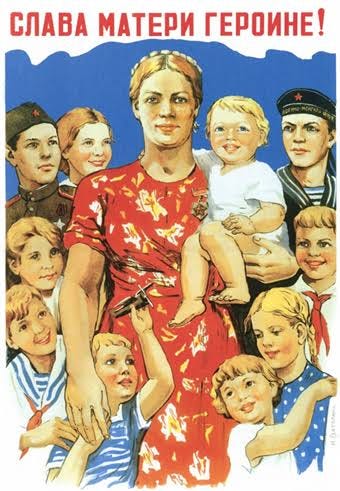
The imagery that portrayed the New Soviet Woman worked to normalize women as professionals, scientists, and skilled laborers at a time when most of the world still percieved these industries as being exclusive to men. But in reality, that same imagery concealed a problematic contradiction.
The New Soviet Woman was never imagined as someone emancipated from traditional domestic expectations. She was expected to excel at paid labor to further the aims of the Soviet state while remaining in rigid gender roles as the the primary caregiver, cook, and cleaner at home. The state celebrated her contribution to the workforce without fundamentally redistributing (or even really considering) the unpaid labor that made the household function.
Women finished a shift in the factory or office only to begin another at home, and later this became known as “the double burden.” Despite official commitments to equality on paper, men never assumed an equal share of domestic work. Any expansion of childcare and communal services only partially corrected that imbalance.
two kinds of objectification
Mid-century American advertising often presented women through a blatantly male and openly patronizing lens. A famous Van Heusen advertisement urged men to “show her it’s a man’s world” while a Chase & Sanborn coffee advertisement joked about a husband spanking his wife over poorly made coffee. Soviet posters from the same period depicted women as strong, capable, and professional members of the work force. They appeared respectable, confident, capable, central to the project of building a socialist society.

While it’s observably true that Soviet imagery generally granted women far more dignity than much of the marketing material produced in United States, dignity in representation and liberation in practice are far from being the same thing.
And it’s also worth asking whether this is the comparison we even really need to be making. Measuring Soviet attitudes toward women against one of the lowest points in 20th century American gender norms and treatment of women doesn’t tell us much. Clearing a very low bar is still clearing a very low bar.
American advertising largely reduced women to consumers, homemakers, or objects of desire in order to sell products. Soviet propaganda assigned women a different role: productive workers, exemplary mothers, and builders of socialism. The imagery changed. The underlying logic remained familiar. In both cases, women were frequently depicted in ways that served institutional goals larger than themselves, whether those goals were commercial or political.
Propaganda alone tells us very little about women’s actual freedom and real material conditions. A woman shown happily driving a tractor isn’t necessarily more autonomous or less objectified than a woman shown standing beside a washing machine. The more important point to consider is what happened once the poster came down. Could the woman on the poster make decisions about her own body? Could she influence political power? Could she organize independently when the state’s interests conflicted with her own?
bodily autonomy given and taken
Reproductive rights are often a litmus test in terms of whether a state truly respects women’s autonomy over their own bodies and futures. And the Soviet Union’s record on reproductive rights has nothing to do with consistent principle, but everything to do with prioritizing state needs over women’s bodies and choices.
Soviet Russia became the first country in the world to truly legalize abortion in 1920. It’s not wrong to consider that to be a groundbreaking move, and some feel that it was one of the strongest forms of evidence of the early Bolsheviks’ willingness to actually challenge traditional norms regarding the lives of women. Unfortunately, that “conviction” would turn out to be quite fragile.
Abortion was criminalized across the Soviet Union under Stalin in 1936. Officially, the state pointed to demographic concerns as the official justification. Birth rates had been falling and for such a rapidly industrializing socialist society, there was immediate concern about the lack of mothers and future workers. Rather than encouragiing women to have children out of their genuine desire to become mothers, motherhood became increasingly presented as a non-choice. It simply became a civic responsibility to the state.
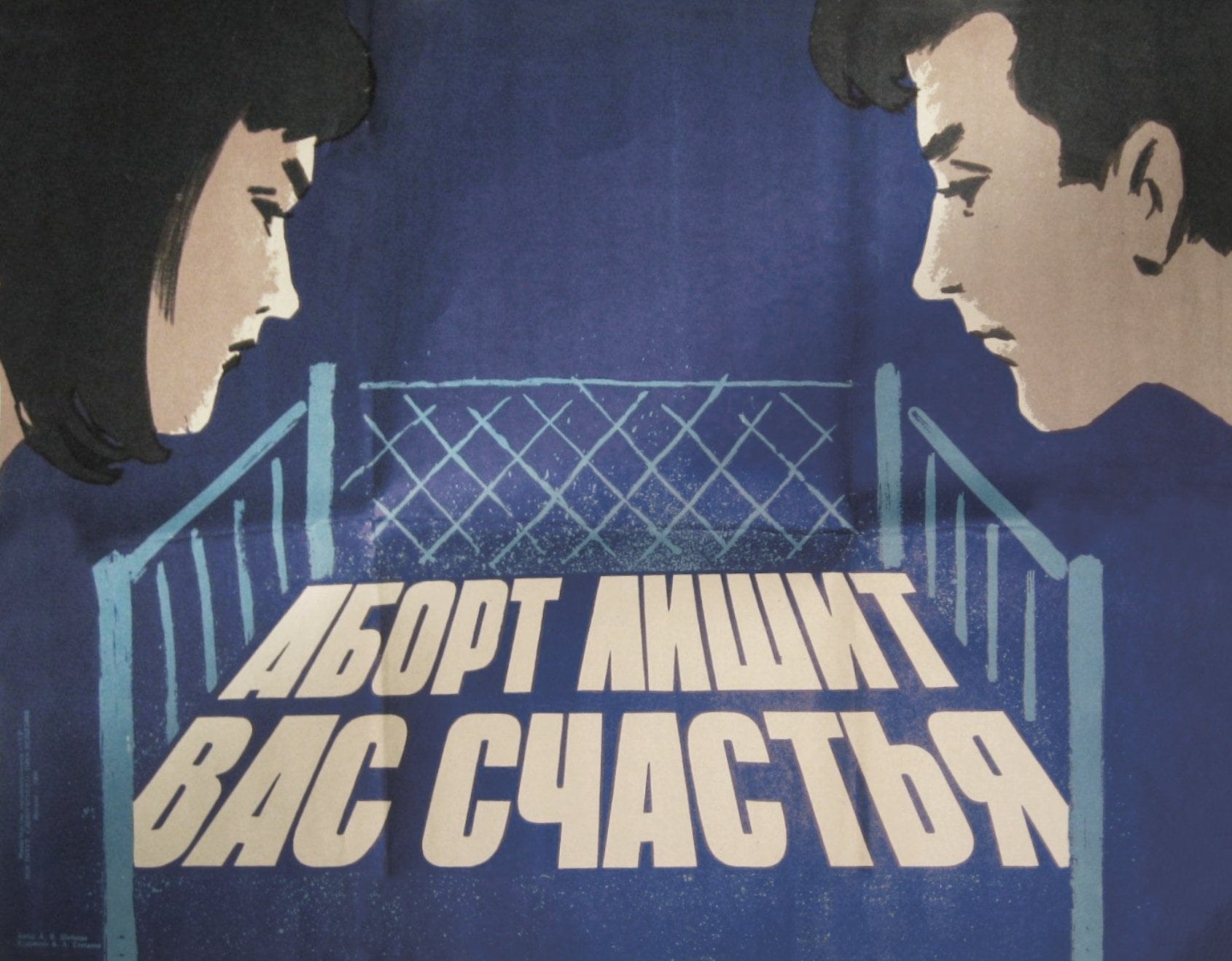
The reversal on access to reproductive care as part of a deeper pattern exhibited by the Soviet state. Legal abortion survived only so long as it aligned with the state’s priorities and needs. Demographic concerns outweighed women’s autonomy and so their right to make this choice for themselves went out the window. Access (or rather, non-access) to abortion remained solely an instrument of state policy.
And unfortunately the consequences of this policy were serious. As is always the case under strict abortion bans, the 19 years between the official ban in 1936 and the re-legalization in 1955 did not mean that there was an absence of need for abortion. Instead of having access to safe medical care, these procedures were pushed entirely underground. Illegal and dangerous procedures became a major cause of maternal mortality, while many women who survived suffered infections and injuries that left them infertile. Women died, or permanently lost control over their future fertility, because the state chose demographic policy over reproductive choice.
Even after abortion was legalized again under Khrushchev in 1955, it’s almost laughable to describe the Soviet system as one of genuine reproductive freedom. Even access to reliable contraception remained scarce and often ineffective throughout much of the Soviet period, making abortion the primary method of birth control for millions of women rather than a “last resort.” Many underwent the procedure repeatedly over the course of their lives, sometimes without adequate anesthesia and in hospitals where the experience was treated as routine and insignificant.
And the same paternalistic and state-centered logic around abortion policy also extended into general family policy. The 1944 Family Law made divorce substantially more difficult, particularly for women seeking to leave unhappy or abusive marriages. It introduced honors such as the title of “Mother Heroine” for women who bore ten or more children, while simultaneously stripping unmarried mothers of the right to identify a child’s father on the birth certificate or pursue child support from him.
violence at home, silence in the system
By the Stalin years, Soviet family policy had taken a rabidly pronatalist turn. Marriage was celebrated as a civic institution, motherhood as a patriotic duty, and the family as one of the foundations of socialist society. What never emerged alongside that rhetoric was a meaningful legal recognition of violence within the family itself.
Soviet criminal law punished assault, of course, but it didn’t treat domestic violence as a distinct social or legal problem. Abuse by someone’s husband was generally handled through the same provisions used for ordinary assault or broad public-order offenses such as “hooliganism.” The law recognized violence as a concept but it largely failed to recognize the relationship in which that violence occurred.
For a state that insisted that the family was one of socialism’s greatest achievements and most important pillars, acknowledging widespread abuse inside that family became too politically awkward. The result was a system that dealt with individual incidents while rarely treating domestic violence as a structural issue affecting women.
We can see the consequences in the historical record. Divorce files from Leningrad in the mid-1960s show that more than one in four women who mentioned a reason for seeking divorce identified domestic violence. Researchers found clear regional differences as well. In rural areas, many women described beatings simply as a consequence of their husbands’ drinking rather than as a separate form of abuse. This reflects both prevailing social attitudes and the absence of language that clearly framed domestic violence as its own category of harm.
Other evidence points in the same depressing direction. Studies of Soviet criminal justice note that violence committed inside families disappeared into broader legal categories, making it difficult even to measure domestic abuse separately from other violent crime in any clear sense. Women could appeal to comrades’ courts, trade unions, party organizations, or higher judicial authorities, but whether those efforts accomplished anything depended heavily on local officials and individual circumstances. There was no coherent system built around the idea that violence against women within the home required its own legal or institutional response.
reassessing Why Women Have Better Sex Under Socialism
One reason the image of socialist feminism remains so influential today is Kristen Ghodsee’s widely read book Why Women Have Better Sex Under Socialism. Its central argument is basically that socialist systems gave many women greater economic independence from men, and that economic security translated into more equal, satisfying intimate relationships.
The underlying premise isn’t exactly controversial or groundbreaking. Economic security absolutely plays a role in relationships. Stable employment, affordable housing, and a safety net of social benefits can reduce a woman’s dependence on a partner she might otherwise feel unable to leave.
But the difficulty comes when that observation is expanded into a broader claim about women’s liberation under socialism. Financial independence from an individual man is not the same thing as autonomy from the state. A government can reduce one form of dependence while preserving (or even expanding) its authority over women’s bodies, families, and political lives.
whose bodies counted?
The history of Soviet Central Asia illustrates the problem with Ghodsee’s sweeping claims. In 1927, the Soviet government launched the Hujum, a campaign to eliminate the veil among Muslim women in Uzbekistan and neighboring republics. Officials presented it as an act of emancipation or liberation and public ceremonies featured women dramatically casting their paranji into bonfires as symbols of freedom from patriarchal tradition.
But the women whose lives it enthusiastically claimed to “transform” had little say in how, or even how quickly, that transformation would actually take place. Women who unveiled under official state pressure were often disowned, assaulted, and in a number of documented cases murdered by relatives who viewed the act as a profound dishonor. The state once again had decided what “freedom” should look like for women and pursued it on its own timetable, while the women it involved had to deal with the actual consequences.
And this state control of women’s bodies “for their own good” could also be found in communist Czechoslovakia, a locale featured extensively in Ghodsee’s book. From the early 1970s onward, Romani women were subjected to inhumane coerced sterilization through the state medical system. Some were handed a form and pressured to consent while in labor or while in terrible physical pain with zero explanation. Others were threatened with the loss of welfare benefits or misled about the nature of the procedure itself and many didn’t even know they had been sterilized until even years afterward.
Czechoslovak communist officials used explicitly racialized language about “social inadaptability” and demographic engineering to justify this horrific policy. The Romani women themselves were left entirely out of the conversation. And this is ultimately why treating “women under socialism” as a monolith can end up erasing precisely those women whose experiences most directly challenge the broader narrative.
And then there comes the issue of Ghodsee herself. Of course an American academic can write about Eastern Europe. We can’t gatekeep an entire region. But there is a responsibility that comes with speaking authoritatively about and for millions of women whose experiences she did not share and could never actually understand. The stories chosen to represent “women under socialism” shape the conclusions readers draw, and the women whose experiences most complicate that narrative are often the easiest to selectively leave out. And we see this in real time with how many feminists in the collective west know nothing about the forced sterilization in Czechoslovakia, the suppression of feminist collectives in the Soviet Union, or what happened to women in state-sanctioned veil burnings.
the feminists the state silenced
Any talk of Soviet feminism really comes down to one crucial question. Could Soviet women organize independently to define their own liberation, even when their priorities differed from the state’s?
The clearest answer came in 1979, when a small group of women in Leningrad decided to find out.
Among them were Tatyana Mamonova and Natalia Malakhovskaya, who helped produce an underground guide titled Woman and Russia. It wasn’t very radical or anything resembling a manifesto calling for the overthrow of socialism. It was a collection of essays, testimonies, and reflections on problems the Soviet state had spent decades insisting were either solved or insignificant. It mentioned domestic violence, degrading conditions in maternity wards, the isolation of single mothers, the relentless exhaustion of the double burden, and the everyday realities of women’s lives that official propaganda rarely (if ever) acknowledged.
The state ultimately refused to engage with those criticisms or debate their validity in any form. Instead, the KGB placed the editors under surveillance, subjected them to repeated interrogations, and within a short time forced the leading figures into exile.
These women were not leading an armed rebellion or attempting to dismantle the Soviet state. Their only “crime” was creating an independent space in which women could describe their own experiences and articulate their own priorities, which was apparently unacceptable to the state.
For all its rhetoric about women’s emancipation, the Soviet system was not willing to support or even tolerate women organizing out of the narrowly defined framework of what the state found “acceptable.”
None of this erases the real changes the Soviet Union brought to women’s lives. Literacy expanded dramatically. Access to higher education and skilled professions grew. Millions of women entered careers that would have been closed to them under the Tsarist Empire and remained difficult to access in many contemporary capitalist societies. Those achievements mattered, and it would be intellectually dishonest to pretend they did not.
A genuinely feminist society does more than bring women into the workforce or celebrate them in political rhetoric. It protects their ability to make decisions about their own bodies regardless of demographic goals. It allows them to organize independently, even when they criticize the government. It recognizes violence against them as a political problem rather than a private inconvenience. Above all, it accepts that women themselves, not the state, have the authority to define what liberation should mean.
Measured against that standard, the Soviet Union was a paradox. It transformed women’s opportunities while refusing to relinquish control over the terms on which those opportunities existed. It educated women, employed them, and celebrated them as builders of socialism. But it never accepted that women’s freedom might include the freedom to disagree with the state’s own vision of what emancipation looked like.
radical dumpling: screaming into the void about anti-fascism and anti-imperial consistency, from somewhere between east and west.
This article originally appeared on the author’s Substack.
More content from this blog
- Peru: State of Emergency After Young Rapper Killed in Protests, by ANRed – 23 October 2025
- The Making of Musk, Episode 2: Technocracy, Inc. – 14 October 2025
- How the War in Ukraine Reshaped Israel’s ‘Russian’ Community, by Nikita Aronov – 21 July 2026
- Russia’s Billionaires Face a Dilemma – Putin Threatens and Protects Their Wealth, by Ilya Matveev – 14 July 2026
- Teaching Eastern Europe in the Age of Russia’s Imperial Invasions: A Conversation on Being Postcolonial When No One Takes Any Notice, by Oksana Dudko and Anna Hájková – 2 May 2025
Except where noted otherwise, original writing and translations produced by the Left Renewal Blog Collective are published under a Creative Commons Attribution–NonCommercial–ShareAlike 4.0 licence. Republished and translated material remains subject to the licence and terms of its original publication.