A concerningly large portion of the left have taken on the habit of telling themselves a fairytale about Russia. It goes something like this: somewhere out east, past the reach of Wall Street and NATO, sits a defiant civilization-state, bruised by history, standing against the American empire and refusing to bend in its ever noble goal of achieving a multi-polar world. Sanctions are just the empire lashing out at the one power brave enough to say no. Ukraine is a proxy battlefield in a war that’s really about Washington’s hunger for hegemonic control. And anyone who points out that Vladimir Putin runs a kleptocratic petrostate should probably check who signs their paycheck or what “western propaganda” they’ve consumed.
It’s a compelling and convenient story. It also happens to be almost entirely made up.
The reflex that keeps this story alive can be attributed directly to campism, the tired and overly simplified belief that whichever government stands opposite Washington deserves automatic solidarity, regardless of what that government actually does with its power, its money, or its army. It’s less a theory rooted in reality, and more a theory of vibes.
So let’s examine the record. What follows isn’t a moral case against Russia, though there’s plenty of material for one. Instead, it’s a materialist case built from lobbying disclosures, Treasury filings, court documents, and the Kremlin’s own public statements. You’ll see that Russia has spent three decades trying to get a bigger seat at the table it supposedly wants to burn down. Follow where the money sits, who Russia’s friends actually are, and how Washington treats Moscow compared to the country Moscow is currently invading, and the anti-imperialist framing stops becomes laughable.
the club russia never actually tried to leave
Russia joined the World Trade Organization in 2012, and it never left. It sat on the G8, the exclusive club of the world’s advanced capitalist democracies, right up until it got kicked off in 2014 over Crimea, despite the fact that it had assumed the group’s rotating presidency that very same year. From 1994 onward, Russia expanded its cooperation with NATO under the Partnership for Peace program, and cooperation only eroded after Kosovo, the 2008 Georgia war, and finally the 2014 annexation. Russia never formally withdrew from the program, instead it got frozen out.
The energy sector tells a similar story. Before the full-scale invasion of Ukraine, British oil giant BP held a $14 billion stake in Rosneft, Russia’s flagship state oil company. This holding accounted for roughly half of BP’s entire global reserves. ExxonMobil ran joint Arctic exploration ventures with Rosneft worth billions of dollars, and Putin himself showed up to the 2011 signing ceremony to call it a “genuinely strategic partnership.”
Rosneft, in turn, was offered minority stakes in Exxon projects back in Texas and the Gulf of Mexico. This was a typical case of two energy giants carving up joint ventures, except one of them happened to be owned by the Russian state.
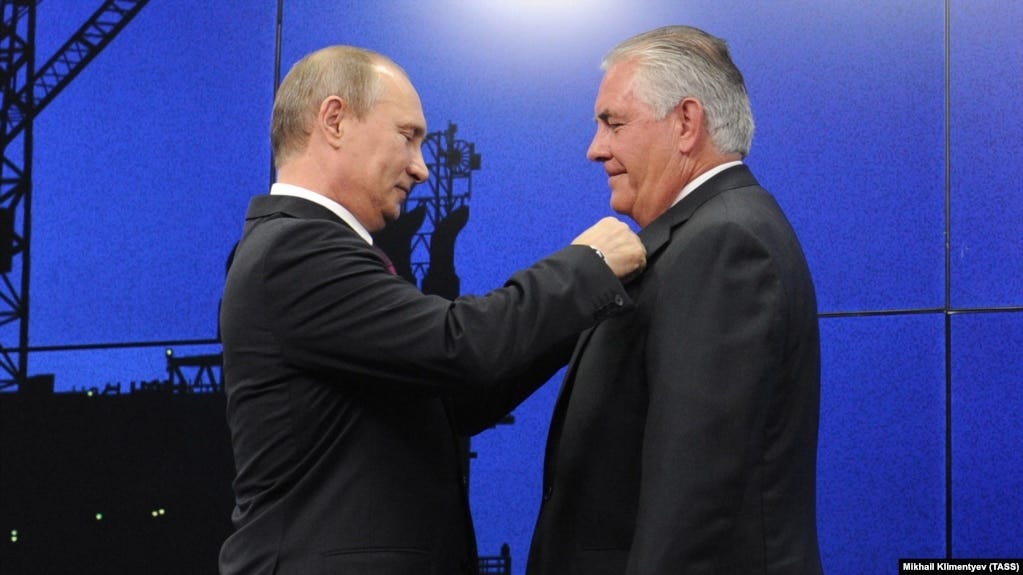
Then there’s Rex Tillerson, whose career is close to self-parody at this point. He rose to the top of Exxon largely by running the company’s Russian operations, got personally decorated with Russia’s Order of Friendship in 2013, and was praised by the Kremlin as a solid, serious figure the day Donald Trump made him America’s chief diplomat. His confirmation disclosures are worth mentioning here. Tillerson was sitting on close to $500 million dollars in net worth, nearly $200 million of it in Exxon stock, and buried deep in his portfolio was a personal stake in Yandex NV, Nasdaq-listed parent of Russia’s dominant search engine.
And there are other figures worth mentioning from Trump’s first-term inner circle. Paul Manafort spent more than a decade on the payroll of aluminum oligarch Oleg Deripaska, collecting a $10 million annual contract routed through a Delaware shell company. His 2005 pitch to Deripaska was clear when he proposed shaping American political and media coverage in ways that would specifically benefit the Russian government. During the 2016 campaign he stayed in contact with Konstantin Kilimnik, an operative U.S. intelligence assessed as directly linked to Russian intelligence. Michael Flynn sat at Putin’s own table at an RT gala the year before he joined the campaign.
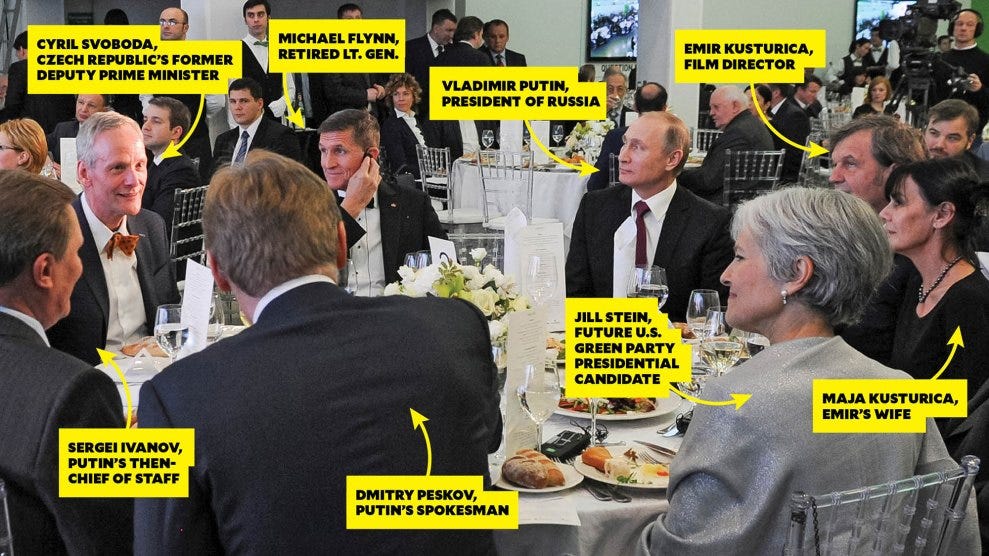
None of this required Trump specifically. It just required Moscow doing what it has always done, which is invest early in whoever looks likely to end up holding the keys to Washington.
And the instinct never really died. By 2025, with the Justice Department’s Task Force KleptoCapture (built to hunt sanctioned oligarchs’ assets) quietly wound down, Exxon was already signing a preliminary deal to chart its way back into Rosneft. This was Russia’s governing strategy that survived every crisis, every sanctions regime, and every war, because the goal was never separation from the Western economic order.
russia’s oligarchs already fell in line
If you want to know what a state actually believes about the global economic system, look at where its ruling class parks its money. While apologists often wave this away with the excuse, “oh, every country has oligarchs,” this misses a critical distinction: Russian oligarchs do not operate independently of the state. Under Putin, private wealth was effectively nationalized in function. Oligarchs retain their billions only at the Kremlin’s pleasure, serving as financial custodians who redeploy that capital abroad as a direct tool of Russian state influence.
This state-directed wealth has systematically targeted the United States, a pattern set early when the Bank of New York processed roughly $10 billion in illicit Russian funds through ordinary American finance in the late 90s. In the years since, billions more have poured into U.S. markets. Sanctioned oligarch Viktor Vekselberg became the largest client of the American investment fund Columbus Nova, channeling tens of millions into U.S. assets, while Oleg Deripaska used shell companies to secure a $15 million Washington mansion alongside tens of millions in New York property. In total, at least $2.3 billion has been laundered through American property markets, heavily concentrated in New York and Florida, forcing the U.S. Treasury to issue special targeting orders just to unmask the shell companies buying up luxury condos in cash.
And it didn’t stop at real estate. The Alfa Group’s investment vehicle, LetterOne, sat on more than $2 billion in American holdings, and even Russia’s own state innovation fund, Rusnano, ran a U.S. arm that pumped nearly $1 billion into American biotech and semiconductor startups.
Ultimately, a ruling elite that consistently entrusts its wealth to Manhattan law firms, Miami real estate, and American shell registrars is an elite whose material fortunes are inseparable from the American financial system. You cannot be an existential threat to Western capitalism and one of its most loyal clients at the same time.
white christian nationalist friends of the kremlin
Here’s where the story gets genuinely strange for anyone still clinging to the anti-imperialist framing, because when the Kremlin went looking for ideological allies in the West, it didn’t reach for the anti-colonial left. It reached for the American far right, and it built that relationship methodically, over decades, with real institutional infrastructure behind it.
The origin point is oddly specific: in 1995, Allan Carlson, president of the conservative Howard Center for Family, Religion and Society, sat down with Moscow State University sociologists Anatoly Antonov and Viktor Medkov, and out of that meeting came the World Congress of Families, a coalition built to export conservative Christian positions on marriage, abortion, and sexuality across borders. Russian representative Alexey Komov, guided by Russian Orthodox Archpriest Dmitrii Smirnov, spent years stitching together Protestant, Catholic, and Orthodox networks under that banner, all of it bankrolled by Kremlin-connected billionaires like Vladimir Yakunin and Konstantin Malofeyev. When sanctions forced the WCF to officially cancel a planned Moscow conference in 2014, the Russian chapter simply held an identical event at the Kremlin under a different name, with the WCF’s own managing director in attendance.
By June 2025, that decades-old scaffolding produced the Tsargrad Institute’s Forum of the Future 2050, held at Moscow State University with backing from the state space agency Roscosmos and a stable of other Russian institutions. It featured InfoWars host Alex Jones, the “MAGA-communist” influencer Jackson Hinkle, British politician George Galloway, economist Jeffrey Sachs, ex-CIA analyst Larry Johnson, and Errol Musk, who used the stage to praise Moscow as a cultural heir to ancient Rome and to ask why Russia was treated as an enemy given its historical role fighting Napoleon and Hitler.
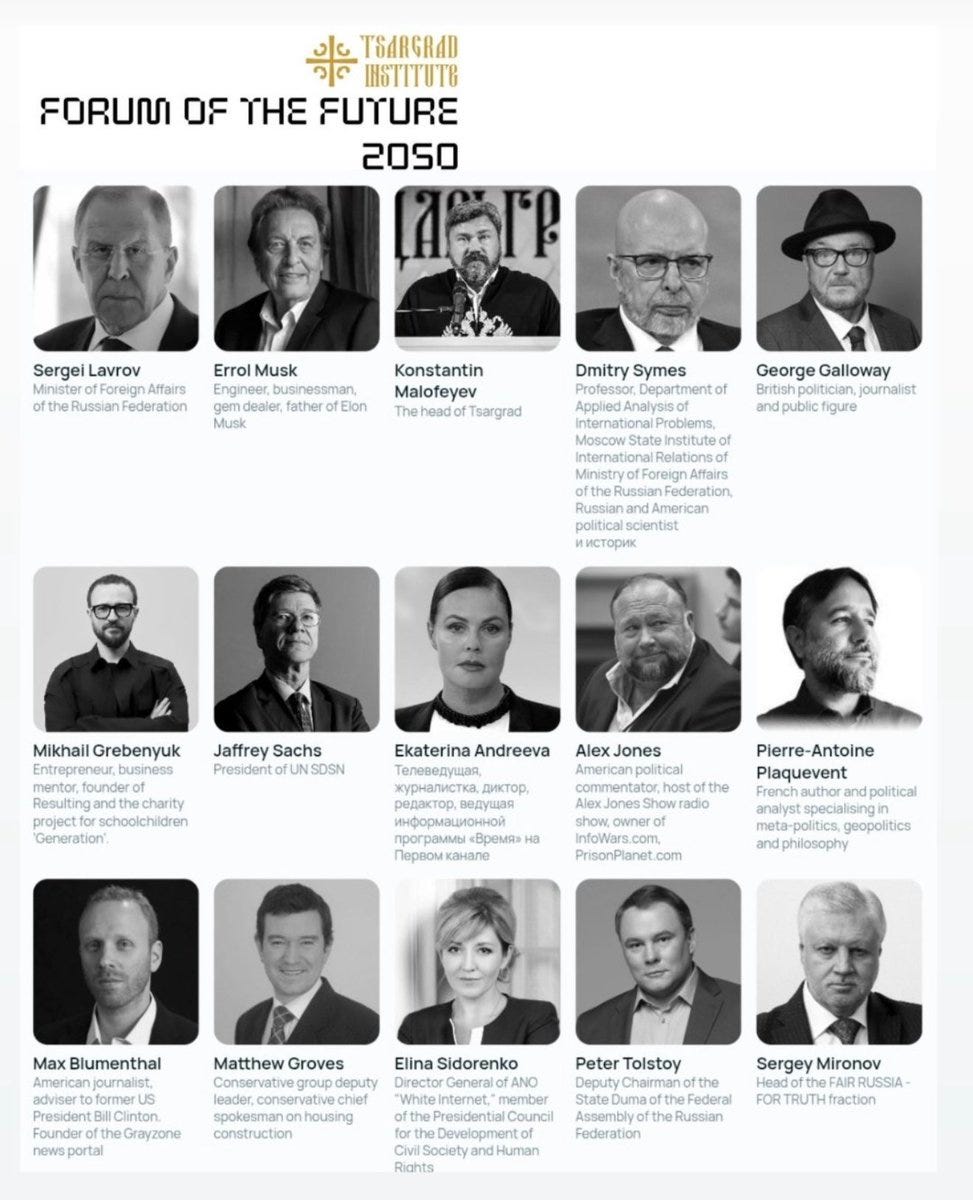
The forum unveiled a strategy document called Russia 2050, which leaned on venture capitalist Peter Thiel’s writing about stagnation to argue that Western liberal democracy has choked off real technological progress, and proposed fixing it with a doctrine borrowed from Orthodox political theology. This doctrine frames Russia as a civilizational restrainer holding back global chaos, justified with straight-faced references to Ivan the Terrible and Stalin. Buried in the policy specifics were targets for what a restored traditional society should look like. It claims that the overwhelming majority of children should be born to mothers under the age of 23, divorce rates near zero, abortion effectively banned, and women’s roles re-centered on the home. This is essentially a blueprint for authoritarian social engineering with a Christian nationalist gloss, and American right-wing media personalities lined up to be photographed next to it.
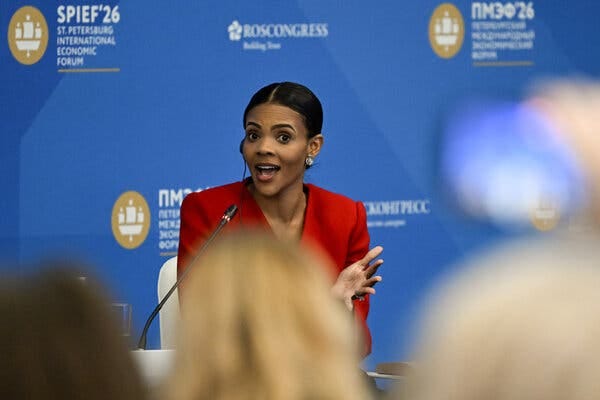
A year later, at the June 2026 St. Petersburg International Economic Forum, the pattern repeated with a cast that would have seemed like satire a decade ago. Candace Owens sat on a “family values” panel questioning continued American support for Ukraine.
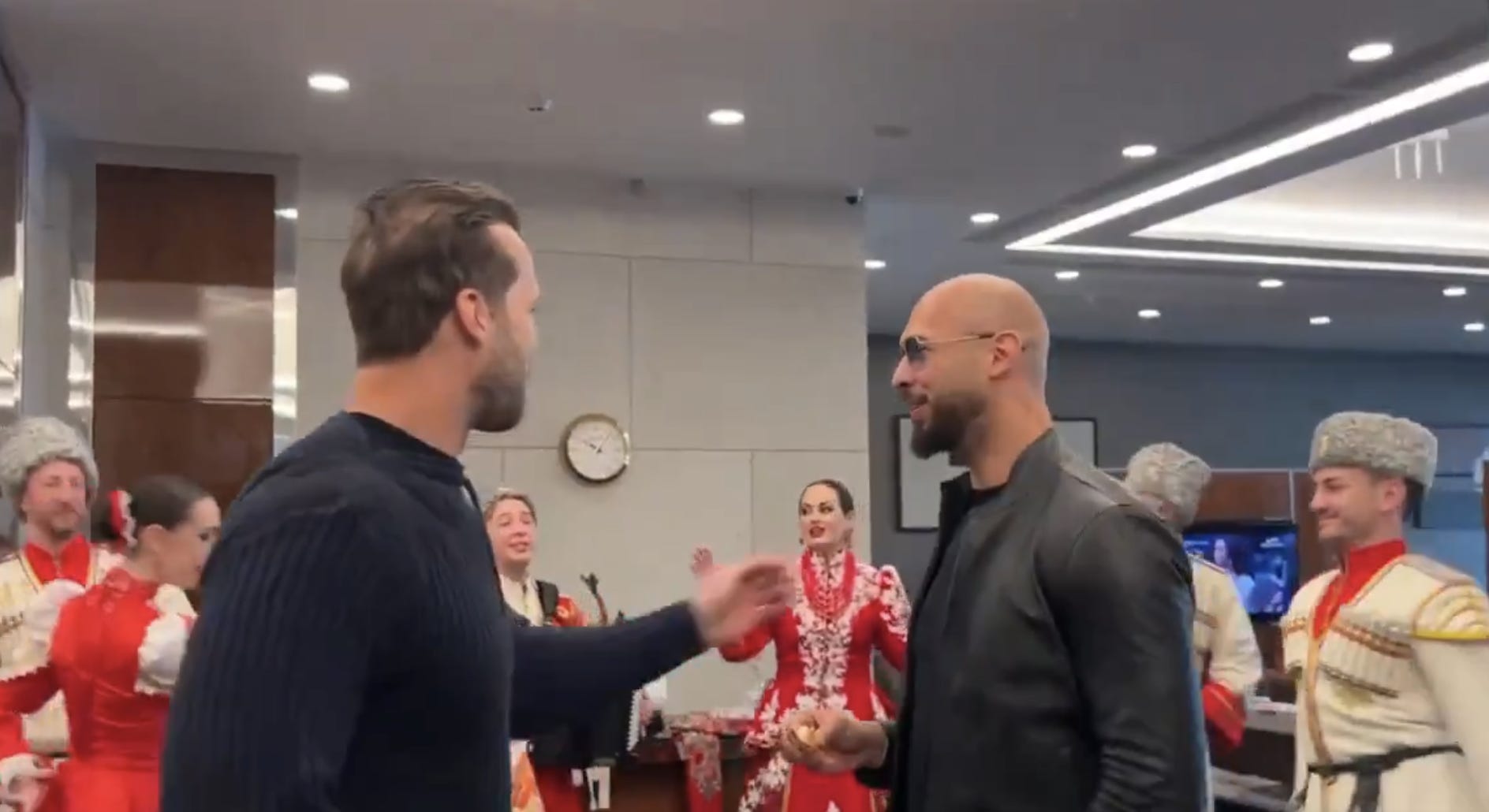
Andrew and Tristan Tate flew in to attend the same forum and received a traditional Russian welcome, all while facing active, severe criminal investigations and indictments in Romania and the UK over human trafficking, rape, assault, and money laundering.
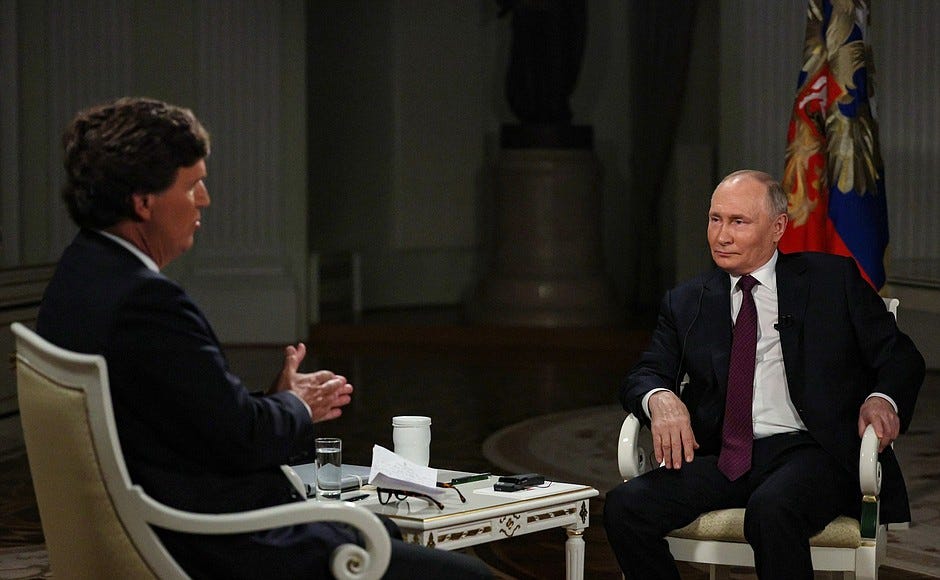
Rodney Mims Cook Jr., the chairman of the U.S. Commission of Fine Arts and an adviser on Trump’s White House ballroom renovation, shared a stage titled “Russia-US: A Cultural Dialogue” with the actor Steven Seagal and the sanctioned oligarch Viktor Vekselberg. Meanwhile Tucker Carlson had already delivered the two biggest interview gets in the Kremlin’s recent media history, sitting down with Putin himself in February 2024 and with Foreign Minister Sergey Lavrov later that year, both of which Russian state television looped endlessly as proof of Western sympathy. Leaked internal memos from 2022 had literally instructed Russian networks to maximize their use of Carlson’s broadcast clips, and RT built entire segments around recycling his commentary.
None of this is an accident of a few compromised individuals. It’s a sustained, well-funded project to build a transnational coalition, and the glue holding it together isn’t socialism or anti-colonial solidarity. It’s authoritarian traditionalism, Christian nationalism, demographic panic about falling birth rates, hostility to feminism, and a shared contempt for liberal democracy as a governing model. Call that project whatever you want, but anti-imperialism doesn’t really work in this case.
the anti-woke enclave and the shared values visa program
There’s one more piece of this network that deserves its own space, because it takes the ideological alignment described above and turns it into something closer to a business model, complete with a visa category, a marketing campaign, and eventually a body count. If Tsargrad and the World Congress of Families represent Russia’s attempt to win American conservatives over on paper, the American Village project is what happens when the Kremlin tries to actually move them there.
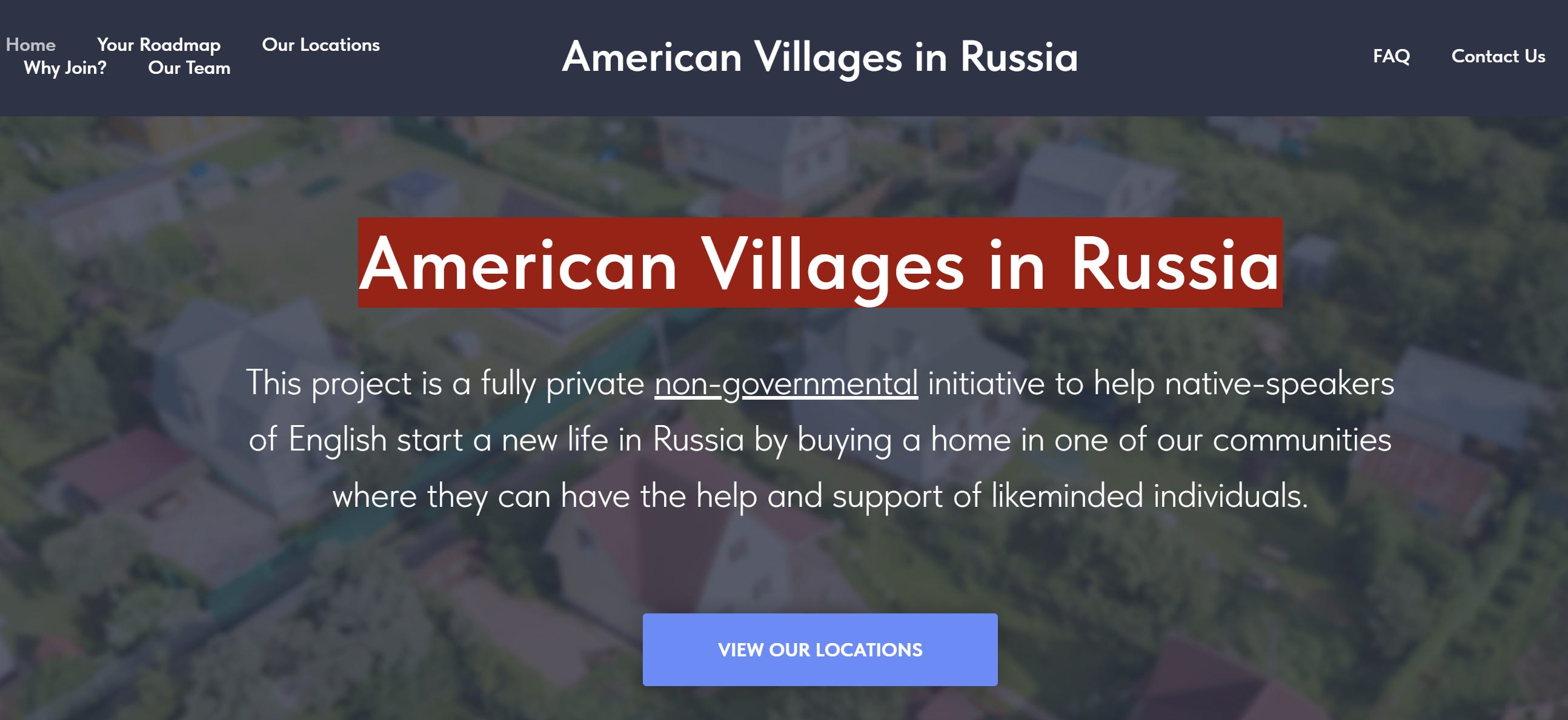
The idea came from Tim Kirby, a Cleveland-born blogger who’s lived in Russia since 2006 and hosts a show on the state-aligned Radio Mayak. He developed it while filming a documentary about Father Joseph Gleason, an American-born priest who converted to Orthodoxy and relocated his own family to Russia’s Yaroslavl region back in 2017. Kirby and Gleason both kept fielding messages from Westerners who wanted to do the same thing, and eventually decided to build something for them, a dedicated settlement rather than a scattering of individual conversions. They brought in Joseph Rose, who’d moved from Tallahassee to Russia with his Russian wife Svetlana Anokhina-Rose in February 2022, to handle grassroots outreach, and a Russian immigration lawyer named Timur Beslangurov to work the bureaucracy.
The pitch was demographic and cultural rather than economic and promised a rural, English-speaking, explicitly Christian community insulated from what its promoters called the West’s gender discourse, its progressive schooling, and its declining birth rates. It’s a pitch that draws on the same well of demographic panic that Tsargrad’s own “Radical Natalist Mandate” spells out in policy form. And it’s worth being precise about who that pitch is actually built for. It’s marketed almost exclusively to white, native English-speaking, culturally conservative Americans who feel displaced by multiculturalism and secularism at home, and that framing sits comfortably alongside the broader “great replacement” anxieties that circulate through the same corners of the American right the Kremlin has spent a decade building relationships with. Whether any individual family signs on for those reasons or simply for cheaper land and a quieter school system, the program itself was clearly built to appeal to that current.
A perfect match was made for the project on August 19, 2024, when Putin signed Decree No. 702, creating what’s now called the Shared Values Visa. It simplifies residency for citizens of 46 countries Russia has designated unfriendly, provided the applicant rejects what the decree calls “destructive neoliberal policies” and affirms traditional Russian spiritual and moral values. Applicants get waived out of the usual Russian language exam, history test, and employment quotas. Between September 2024 and March 2025, around 480 of these visas were issued, and state media spent that whole window promising an American exodus was imminent.
One of the applicants was Derek Huffman. Huffman is a 45 year old welder and former construction crew leader from Texas who arrived in March 2025 with his wife DeAnna and their three teenage daughters. He’d filed for bankruptcy in 2019, was dealing with a handful of financial and minor legal troubles, and had grown fixated on what he described as “LGBT-related content creeping into his daughters’ public schooling.” Once in Russia, faced with living costs the American Village’s own promoters hadn’t warned him about and a naturalization process that was crawling, Huffman signed a one-year contract with the Russian Ministry of Defense just two months after landing, expecting his welding background to land him a safe rear-echelon repair job that would fast-track citizenship, unlock school enrollment for his daughters, and get his family onto the Russian healthcare system. Instead he was sent straight to the front in Ukraine, and started calling himself a “Russian American.” You can find him on X, proudly sharing his white nationalist ideas and praising his new home.
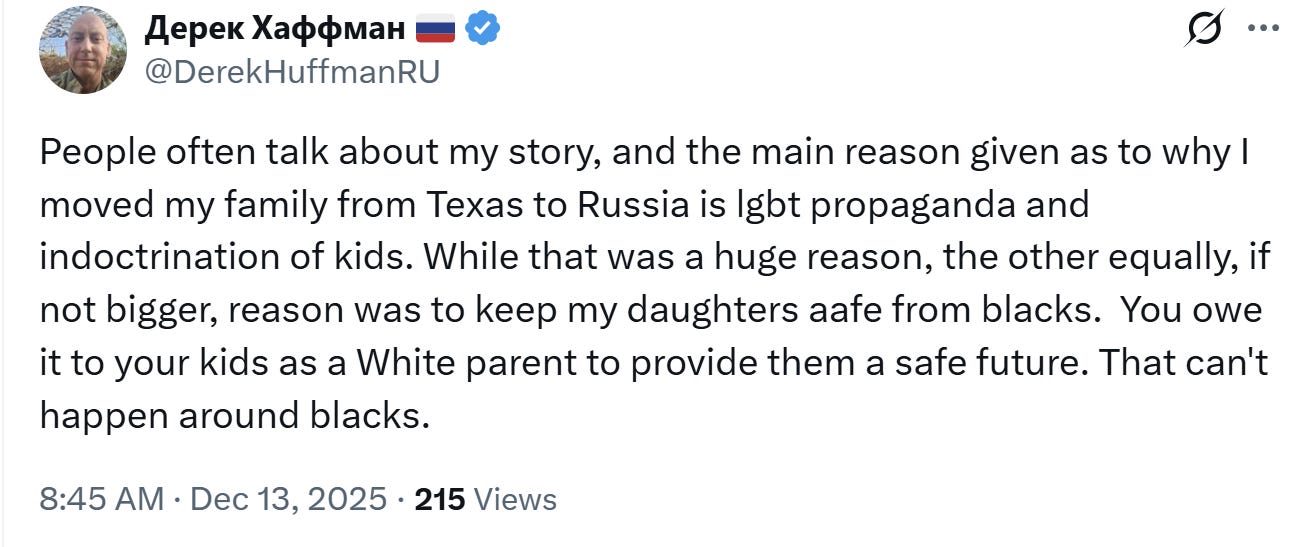
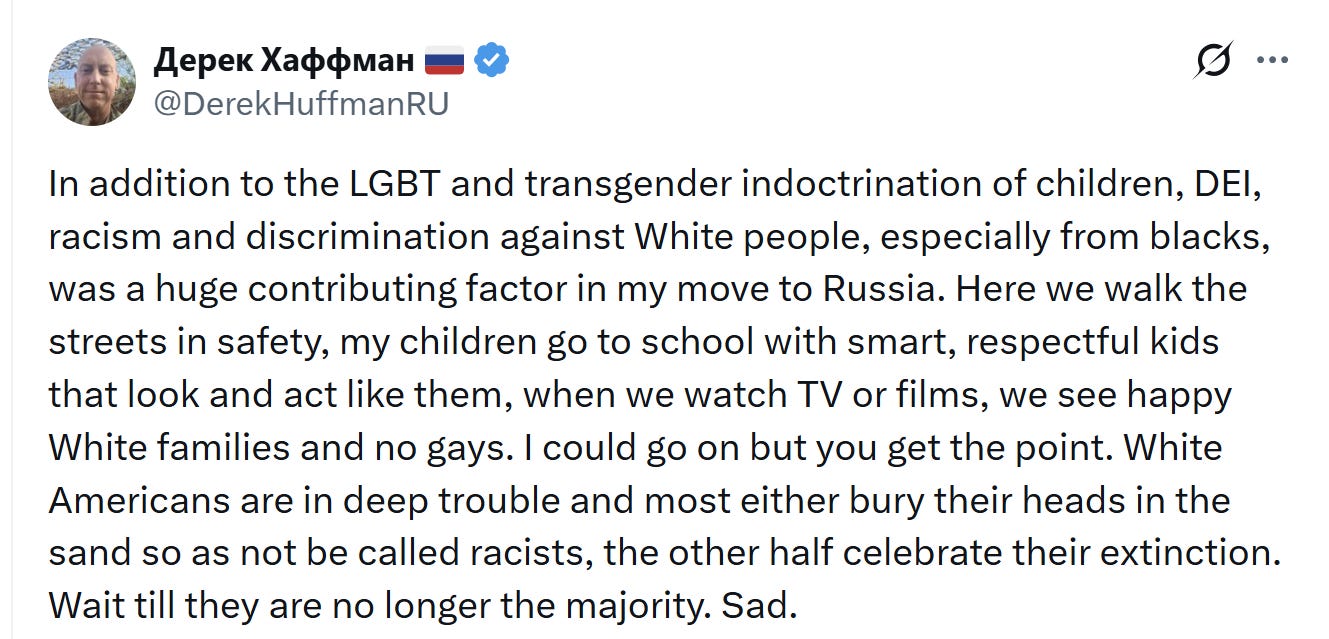
On May 27, 2026, the Russian state broadcast agency Rossotrudnichestvo and the Security Council put Huffman on a panel at Moscow’s International Security Forum, at a roundtable literally titled preserving and protecting traditional spiritual and moral values on the international stage, moderated by a deputy chairman of the State Duma. He sat alongside speakers denouncing Western liberal globalism and technocratic dictatorship, presented to the room as living proof that citizens of the U.S. were choosing Russia and taking up arms for it. Huffman, of course, proudly blogged about the event.
diplomatic double standards
If you want the single clearest piece of evidence that Russia functions as a favored partner rather than a targeted enemy, just watch how the Trump administration has actually treated the two governments sitting on opposite sides of this war.
Start with the third anniversary of the full-scale invasion, February 24, 2025, when the United States voted against a U.N. General Assembly resolution that simply named Russia as the aggressor and called for its withdrawal from Ukraine. It cast that vote alongside Russia, Belarus, and North Korea. Washington then floated its own competing resolution, a vaguer one that called for the war to end without saying who started it, and ended up abstaining on even that watered-down version once European members amended it back toward acknowledging what had actually happened. Asked to explain the vote, Trump told reporters he’d rather not get into it, calling the decision “self-evident.”
Four days before that vote, Defense Secretary Pete Hegseth stood in front of Ukraine’s own allies and declared that restoring the country’s pre-2014 borders was an unrealistic goal and that NATO membership was out of the question, handing Moscow a set of concessions before a single round of negotiations had happened with Ukraine even in the room. That same day, Trump phoned Putin, called the conversation “highly productive,” and only afterward rang Zelenskyy to relay a decision about his own country’s war that had already been made without him. Six days later, at Mar-a-Lago, Trump told reporters Ukraine “should have never started” the war, a statement that requires ignoring who actually crossed whose border. The next day, after American and Russian officials met in Riyadh with no Ukrainians present at all, Trump’s Truth Social account produced the line that defined the week, branding Zelenskyy a “Dictator without Elections,” citing a 4% approval rating he never sourced, and treating Ukraine’s constitutionally mandated wartime election postponement as proof of tyranny.
Then came February 28, 2025, the Oval Office meeting that will probably end up in the history books as the diplomatic low point of the whole war. Zelenskyy arrived to sign a minerals agreement and left without lunch. What was supposed to be a signing ceremony turned into a public dressing-down, with JD Vance demanding Zelenskyy say thank you and accusing him of disrespect for questioning whether Putin could be trusted to honor a ceasefire, despite Russia’s extensive track record of breaking them. Trump answered that question himself on camera, insisting Putin “didn’t break” agreements with him personally and “wants to make a deal.” He told Zelenskyy he didn’t have the cards and was gambling with World War III, and when Zelenskyy pointed out that the killing had continued unchecked from 2014 through 2022 under three separate American presidents, Trump cut him off.
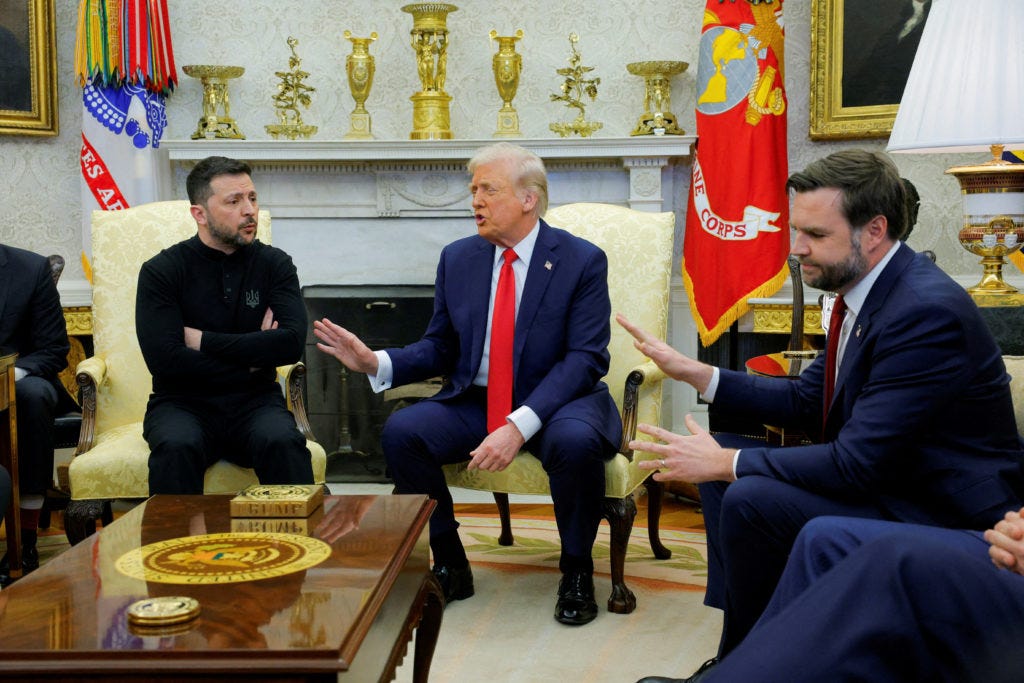
White House officials later complained to reporters that part of the problem was that Zelenskyy hadn’t worn a suit. The scheduled lunch and press conference were both scrapped, and the Ukrainian delegation was asked to leave the building. Within days, Washington suspended military aid and intelligence sharing to a country in the middle of being invaded, restoring it only after Kyiv agreed to a ceasefire framework and signed over half its future critical mineral royalties, structured so that American weapons deliveries now count as Washington’s own capital contribution to the arrangement.
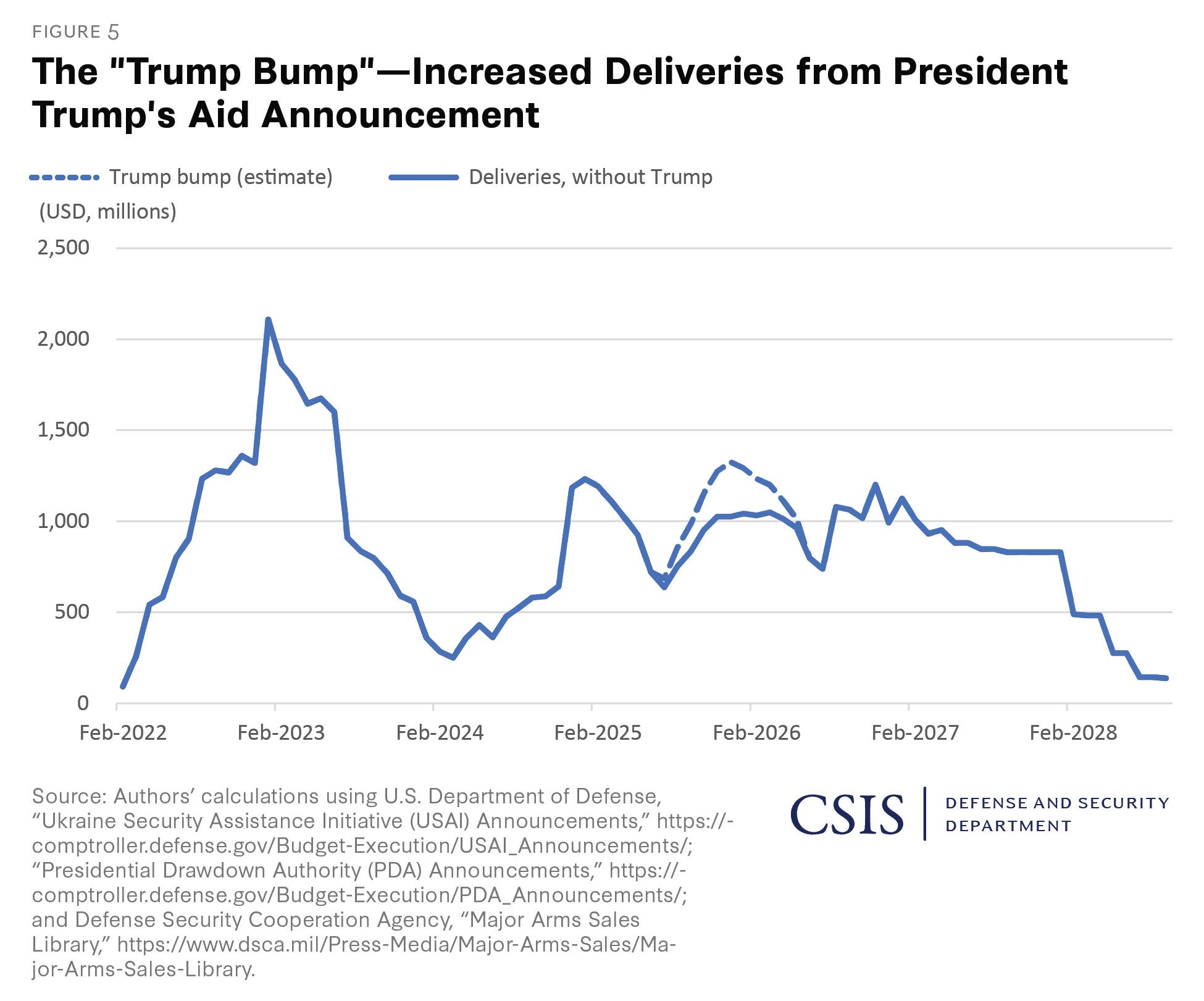
By the second half of 2025, that aid relationship had been formally converted into a sale. Under the new Prioritized Ukraine Requirements List, European allies now pay the United States for weapons out of existing American stockpiles, rather than Washington simply supplying them. According to the Kiel Institute’s tracking, total Western military aid to Ukraine fell by roughly 43 % in July and August compared with the first half of the year. Patriot interceptor stocks got thinner once the Iran war started, competing for the same supply lines, and by the time the fiscal year 2027 budget draft appeared, the Pentagon’s dedicated Ukraine Security Assistance Initiative had been zeroed out completely, with Hegseth telling Congress that Europe should cover the whole bill so Washington could focus elsewhere.
A chart from a July 2025 report went viral in pro-Russian corners of the internet claiming to show Trump quietly arming Ukraine all along. Its own authors at CSIS said the opposite in plain language: the bump was moderate, not a realignment, and the administration never adopted its predecessor’s goal of helping Ukraine win. Most of the “bump” was equipment the Biden administration had already paid for. The one genuinely new mechanism was the pay-for-weapons scheme itself, which relabeled a sale as a gift and then took credit for the gift.
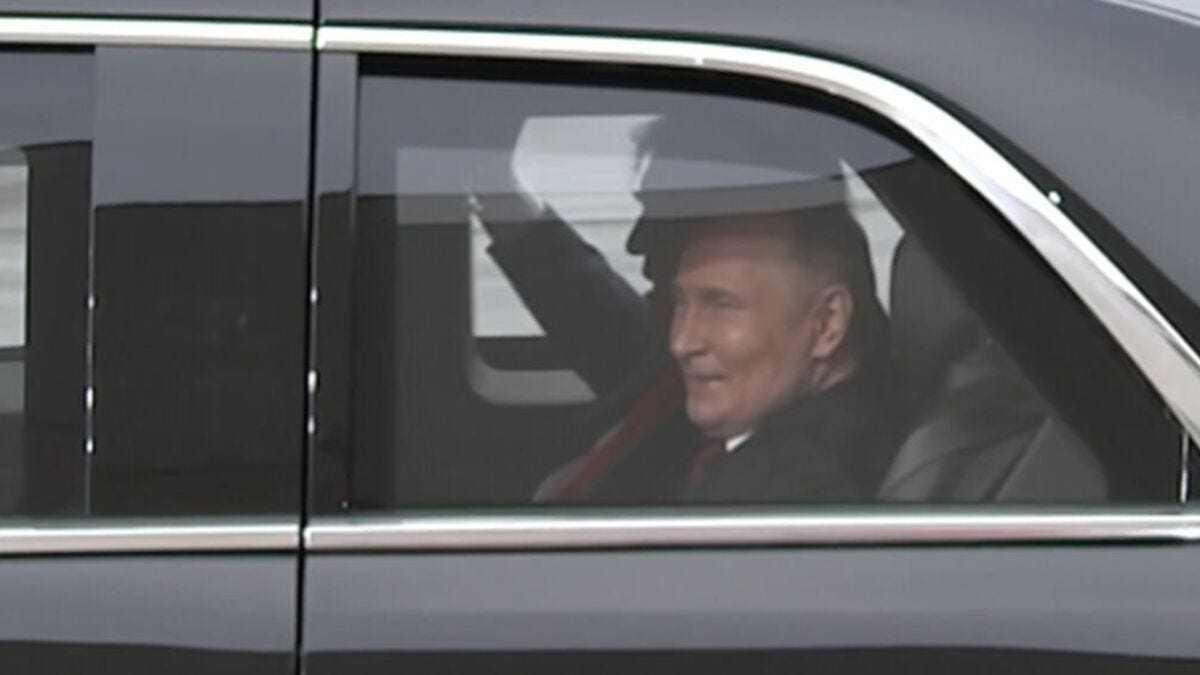
Then there was Alaska. In August 2025, Vladimir Putin landed in Alaska to a red carpet, a flyover from F-22 Raptors, and a B-2 stealth bomber overhead, with a podium stenciled “ALASKA 2025” framed by fighter jets and Trump applauding him across the tarmac. Putin, who carries an outstanding International Criminal Court warrant for war crimes, became the first Russian president to set foot on American soil since before the full-scale invasion, riding in the presidential limousine chatting through tinted windows like an old friend catching up. And he left having secured exactly what he came for: no ceasefire, no deadline, and no new sanctions, despite Trump’s own pre-summit threats of severe consequences, plus a glowing broadcast reel for Russian state television. Even John Bolton said afterward that Trump hadn’t lost, but Putin had clearly won.
The favoritism eventually stopped being just rhetorical and became logistical. Leaked transcripts of an October 14, 2025 call between U.S. special envoy Steve Witkoff and Putin adviser Yuri Ushakov showed Witkoff actively coaching Ushakov on how Putin should approach Trump to keep the negotiations tilting Russia’s way, then proposing a call between the two presidents the night before Zelenskyy’s own scheduled visit to the White House. That call happened, and within days the long-range Tomahawk missiles Zelenskyy had traveled to Washington specifically to request were off the table. A second leaked call caught Putin adviser Kirill Dmitriev telling Ushakov that Washington’s own negotiating draft was being shaped to land as close as Moscow could hope for to Russia’s original proposal.
Days later, the resulting 28 point plan surfaced, built from a paper Russian officials had submitted the month before. It required Ukraine to cap its own army and permanently renounce NATO membership while handing Russia more territory than it had managed to seize by force in nearly four years of fighting. The president’s own special envoy for Russia and Ukraine, Keith Kellogg, resigned the day the plan became public.
A month later, the Kremlin accused Ukraine of launching 91 drones at Putin’s own residence. Trump said he was very angry and took Moscow’s account at face value before a shred of evidence existed. Intelligence services from multiple countries later confirmed what Kyiv had said from the first hour (that the attack never happened), but by then Russia had already used the invented incident to harden its negotiating position and reject a proposed Christmas truce.
And the money moved in the same direction as the rhetoric. In March 2025, the Riyadh-brokered Black Sea export deal had the White House explicitly committing to restore Russia’s access to global agricultural and fertilizer markets and to ease its banking and insurance restrictions.
When U.S. strikes on Iran sent oil prices spiking in early 2026, the Treasury Department issued a string of general licenses that effectively suspended the G7 price cap on Russian crude entirely, authorized insurance and docking for sanctioned tankers, and handed Moscow roughly $150 million dollars a day in extra revenue.
That same month, the New START treaty (the last agreement capping and inspecting both countries’ nuclear arsenals) was allowed to lapse, freeing Russia from every quantitative limit and inspection regime it had operated under for over a decade.
And it was in that same window that Kremlin investment envoy Kirill Dmitriev went fully public with a pitch worth more than $14 trillion dollars in prospective joint American-Russian projects spanning Arctic energy, rare earth mining, aviation, and civilian nuclear cooperation, all contingent on the West lifting sanctions and restoring Russia’s access to dollar-based settlement systems. Zelenskyy had already disclosed a roughly $12 trillion version of the same package based on his own intelligence briefings, and Kremlin spokesman Dmitry Peskov didn’t bother denying any of it, telling reporters it was simply obvious that Moscow was offering cooperation.
Layered on top of all this were the smaller gestures, each unremarkable alone but telling in aggregate: a symbolic U.S.-Russia hockey game took place on July 1st as a goodwill gesture in Russia, Putin flattered Trump by agreeing the 2020 election had been rigged, NASA extended the International Space Station partnership with Roscosmos through 2028, and joint Arctic fisheries cooperation continued without interruption.
Put the two case files side by side. The entity defending itself against invasion got accused of bad manners, had its intelligence and weapons cut off until it signed away mineral rights, and now watches its allies buy its weapons retail. The entity that ordered the invasion got a red carpet, a fighter jet flyover, and a trillion-dollar joint venture pitch.
None of this requires anyone to conclude that Russia is simply a good actor, or a bad one, or anything else quite so simple. The point is narrower and, in its way, more important: anti-imperialism was never supposed to be a matter of picking a team based on who annoys Washington the loudest. It was supposed to describe actual material opposition to systems of exploitation, extraction, and domination, wherever they show up and whoever runs them.
Judged against that standard, Russia fails on nearly every axis that matters. Its ruling class stores its wealth inside the exact Western financial institutions it claims to be resisting. Its energy conglomerates built their fortunes in joint ventures with American oil majors. Its foreign ministry spent thirty years trying to get into the WTO, the G8, and NATO’s outer structures rather than building alternatives to any of them. Its most cultivated Western allies aren’t anti-colonial movements or labor internationalists but Christian nationalists, manosphere influencers, and Silicon Valley reactionaries. And when push comes to shove diplomatically, the American government it supposedly threatens keeps extending it red carpets, sanctions waivers, and multi-trillion dollar investment fantasies while the country actually fighting off Russian tanks gets billed for its own weapons.
Campism, at the end of the day, isn’t really a theory of imperialism at all. It’s a lazy reflex that treats (even imagined) hostility toward the American flag as self-evidently progressive regardless of who’s waving the other flag or what they’re actually doing with their money. Real anti-imperialism requires following the material facts wherever they lead, even when they lead somewhere as unglamorous as a Delaware shell company or a Manhattan penthouse. The facts lead straight back to the empire that Russia never actually tried very hard to leave.
radical dumpling: screaming into the void about anti-fascism and anti-imperial consistency, from somewhere between east and west.
This article originally appeared on the author’s Substack.
More content from this blog
- Tigray war: Modern geographies of mass violence and the invisibilization of populations, by Teklehaymanot Weldemichel – 24 February 2025
- Anti‑War Coalition Ignores Putin’s War on Ukraine, by Fred Leplat and Liz Lawrence – 28 June 2026
- The Greater Evil. What Is Lost When Donald Trump Wins, by Kavita Krishnan and Aditya Sarkar – 16 December 2024
- Where’s the Outrage over ‘Systematic’ Sexual Violence Against Palestinians?, by Samah Salaime – 17 April 2025
- Make Apartheid Great Again?, by Zeb Larson and William Minter – 21 February 2025
Except where noted otherwise, original writing and translations produced by the Left Renewal Blog Collective are published under a Creative Commons Attribution–NonCommercial–ShareAlike 4.0 licence. Republished and translated material remains subject to the licence and terms of its original publication.