For years, the Kremlin has cast itself as the patron of a besieged Global South and a defender of Palestinian statehood against Western-backed Israeli power. Leftist commentators in the West have often taken this framing at face value, treating Russia and Israel as belonging to opposing camps in a broader civilizational struggle. Material reality does not support this. Russia and Israel have spent the last two decades building a relationship defined by personal rapport at the top, military coordination in the field, and structural integration running through citizenship, migration, language, and finance. Whatever rhetorical positions Moscow strikes at the UN, the underlying relationship looks far more like managed partnership than genuine hostility, and that fact should complicate any claim that Russia is acting as an anti-imperial counterweight on behalf of Palestine or the Global South.
putin and netanyahu
The Putin-Netanyahu relationship was never unintentional. Over Netanyahu’s years in office, he met with Putin more than a dozen times between 2015 and 2020 alone, an extraordinary occurrence for two leaders whose countries supposedly sit on opposite sides of a global divide. And Netanyahu treated the closeness as a political asset rather than an embarrassment to downplay. During his 2019 campaign, his party hung a giant poster of the two men shaking hands at its headquarters, essentially advertising a Russian-Israeli alliance.
And the genuine rapport has outlasted the optics. Netanyahu told the Knesset in December 2025 that he speaks with Putin regularly and that the dialogue “has significance for protecting security interests, including on our northern border.” A month later, he used Putin as a back channel to send Iran a message that Israel was not seeking to widen their conflict, essentially using Moscow as its own diplomatic instrument. Israel values Russia precisely because the Kremlin can talk to actors that it cannot, transforming what looks like external hostility into a vital diplomatic safety valve. And Russia certainly does not object to this.
military coordination, not confrontation
The clearest evidence against the “adversaries” framing sits in Syria. After Russia’s 2015 intervention, Russia and Israel built a formal deconfliction mechanism so that Israeli jets could keep striking Iranian and Hezbollah-linked targets without running into Russian air defenses. For nearly a decade, Israel conducted hundreds of strikes in a country full of Russian personnel and equipment, and not one of them produced a direct Russian-Israeli clash. That kind of sustained restraint requires an active, cooperative arrangement, which is the exact opposite of adversarial posture.
The pattern held even after the stakes rose dramatically. During the 2025 Israeli-American strikes on Iranian nuclear facilities, Russia offered Iran no concrete support. Analysts covering the relationship have noted that the Kremlin criticizes Israeli and US actions against Iran rhetorically but “avoids steps that could lead to irreversible escalation,” and is “not yet prepared to place Israel among its open adversaries.” A state genuinely committed to defending an ally under direct attack does not sit on its hands to protect an unrelated relationship, unless that other relationship matters more than the rhetoric admits.
israel’s choices during the full-scale invasion of ukraine
If Russia were truly an adversary of Israel’s Western-aligned order, Israel’s own government has not behaved as though it believed that. Since the 2022 invasion, Israel has refused to join Western sanctions on Russia and has rejected repeated requests to send Ukraine lethal military aid. In 2025, ambassador to Ukraine Michael Brodsky erroneously claimed that Israel had agreed to transfer retired Patriot missile systems to Ukraine, but this was quickly refuted by the Israeli foreign minister. It did, however, extend a $2 billion state guarantee so Israeli carriers could keep flying into Russian airspace after Western insurers pulled out, a step no NATO country took. When El Al’s own payments system briefly kept accepting Russia’s sanctions-evading Mir card after the invasion, it took public pressure from Ukraine’s foreign minister to get it switched off.
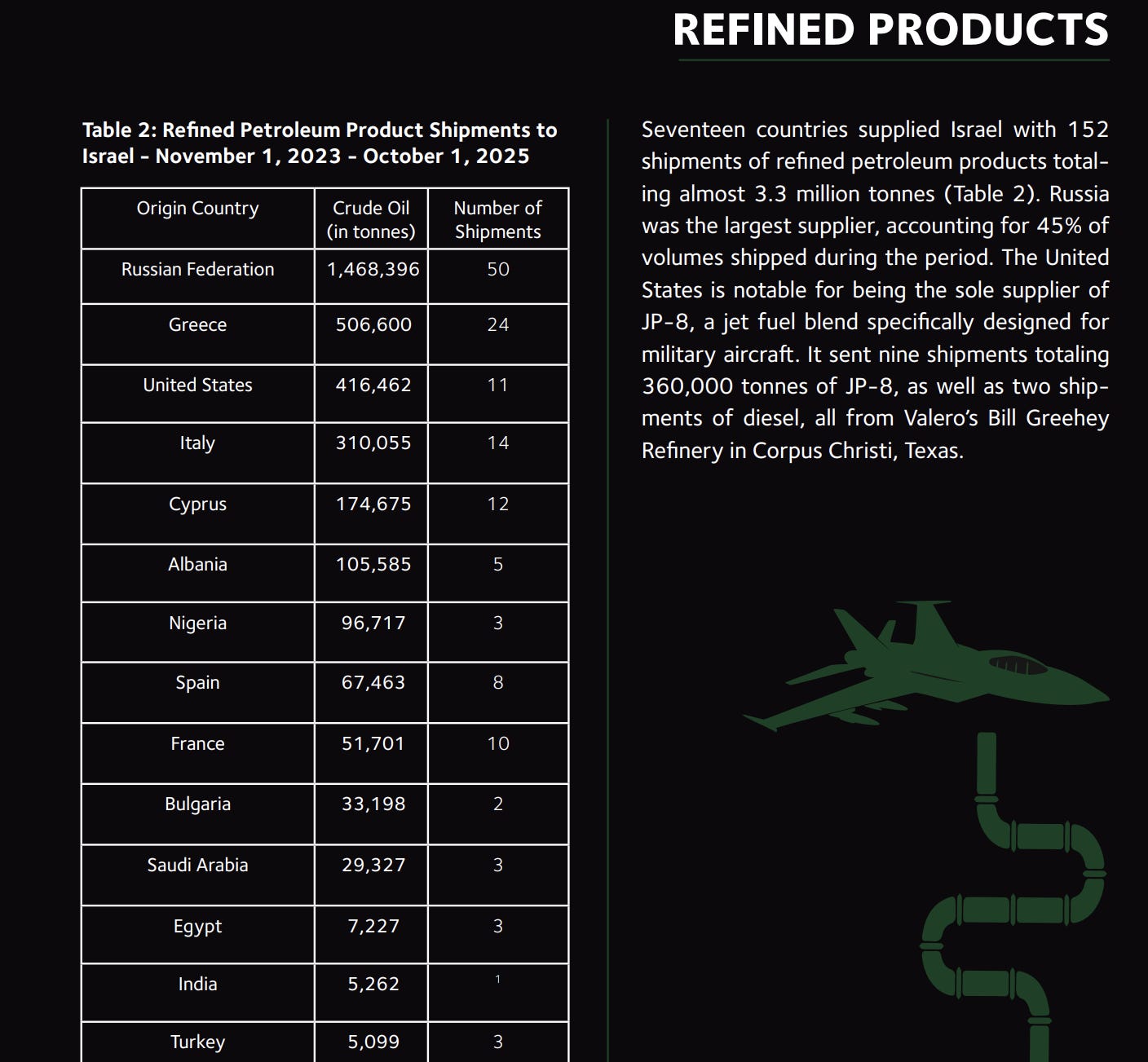
Energy trade tells the same story, and the numbers are now documented in detail. An Oil Change International analysis tracking 323 fuel shipments to Israel between November 2023 and October 2025 found that Russia was the single largest supplier of refined petroleum products, accounting for roughly 45 % of all refined fuel shipments to Israel during that period, ahead of every other country tracked. That fuel kept flowing even after the International Court of Justice found Israel’s conduct unlawful and a UN commission concluded Israel had committed genocide in Gaza. Russia has been functioning as the backbone of the fuel supply chain underwriting Israel’s war effort, precisely at the moment it was posturing internationally as a defender of Palestinian rights.
The grain trade adds another layer. Since spring 2026, Ukraine has formally accused Israel of importing wheat stolen from Russian-occupied Ukrainian territory. This is grain that Russia seizes from farms in occupied land, launders through ship-to-ship transfers in the Black Sea with transponders switched off, and sells abroad to help finance the war. A Haaretz investigation found this was not an isolated incident but a systematic pattern dating back to 2022. Documents obtained by the paper show at least 31 shipments of Ukrainian grain from occupied Crimea alone were bound for Israel between November 2022 and June 2023, and at least four more shipments of the same stolen grain were unloaded in Israeli ports in 2026 before Kyiv’s public pressure led one Israeli importer to finally refuse a cargo. Ukraine summoned Israel’s ambassador over the practice and threatened sanctions on the individuals and companies profiting from it. In other words, Russia has been able to convert territory seized from an internationally recognized sovereign state into a revenue stream by selling the proceeds directly into the Israeli market. Israel’s own government has explicitly declined to take concrete steps to stop it even after being formally notified.
In February 2025, Israel demonstrated alignment with Russia diplomatically when it opposed a UN measure affirming Ukrainian territorial integrity. Reporting from that month also indicates Israel was even lobbying Washington to let Russia keep its military bases in Syria. None of this reads as the conduct of a state that regards Russia as a hostile power.
structural and cultural connection
What makes the Russia-Israel relationship different from ordinary great-power diplomacy is how far it runs beneath the level of state visits. Israeli military data released under a freedom-of-information request shows more than 5,000 active-duty IDF soldiers hold Russian citizenship, making Russian the third-largest foreign-citizenship bloc in the Israeli military after the United States and France. A country that considered Russia a genuine adversary would likely find it strange to have thousands of Russian passport-holders serving in its own army.
The travel relationship reinforces this. Israel and Russia have operated a bilateral visa-free arrangement since 2008, and it has never been suspended. Russian is Israel’s de facto third language, spoken by roughly a fifth of the population, complete with its own dedicated broadcaster. Since Russia’s 2022 invasion, roughly 80,000 Russian citizens have made aliyah to Israel, granted citizenship, property rights, and a ten-year exemption on foreign-earned income under the Law of Return. Even as the West was trying to economically isolate Russia, Israel was operating an open emigration and asset-protection valve for Russian citizens, including sanctioned oligarchs like Roman Abramovich, German Khan, and Mikhail Fridman.
what this means for the “russia works against israel” narrative
None of this is to say Russia and Israel are perfect allies, or that Moscow has been indifferent to the genocide in Gaza rhetorically. But the narrative of Russia as an anti-imperial champion of the Global South and Palestine requires Russia to be read as a genuine adversary of Israel, and the actual record does not support that reading. Instead of acting as an ideological counterweight, the Kremlin is practicing a strategy of transactional multi-alignment. Moscow does not actually want to destroy the Western-backed security architecture in the Middle East. It simply wants to rent out access to it. The goal is to become an indispensable broker to all sides, remaining equally vital to Tehran, Damascus, and Tel-Aviv. True anti-imperialism requires taking a definitive side to overturn a status quo, but transactional multi-alignment requires preserving the status quo so that Russia can continue selling its leverage to opposing factions.
This strategy explains why hosting Hamas delegations costs Putin nothing operationally but yields massive diplomatic dividends in the Global South. It allows Moscow to strike a revolutionary pose at the UN while maintaining the structural, material pipelines of fuel, grain, and intelligence deconfliction that actually keep the Israeli state running.
A state that keeps its citizens serving in the IDF, maintains uninterrupted visa-free travel, supplies Israel’s fuel through a war the UN has called genocidal, restrains itself from meaningfully arming Iran against Israeli strikes, and gets used by Netanyahu as a personal back channel to Tehran is not functioning as an adversary of the Israeli state. It’s functioning as one of its more reliable (even if unofficial) working partners, running in parallel to whatever positions Russia strikes at the Security Council. Treating Moscow’s UN statements and its Hamas contacts as the full picture while ignoring the citizenship rolls, the flight guarantees, and the fuel tankers, produces a badly distorted account of where Russia’s actual interests and behavior lie.
ever-shifting goalposts
Confronted with this record, Russia’s defenders on the left tend to reach for the same escape hatch every time. When facing indisputable fact, suddenly none of it counts, because it’s “just trade.” Point to the fuel data and the response is that Russia is simply monetizing a commodity, not making a political choice. Point to the grain and the response shifts again to frame it as Russia scrambling to bypass Western sanctions, not as evidence of anything resembling alignment with Israel. The explanation changes shape depending on which fact is on the table, but the conclusion never changes. Russia’s material conduct is never allowed to count as evidence, no matter how much of it accumulates. This is a standard nobody applies consistently elsewhere.
When Israel imports American weapons, that dependency is treated as proof of alliance. When Gulf states buy Chinese surveillance tech, that’s treated as a meaningful signal of realignment. But when Russia becomes the largest supplier of the refined fuel running Israel’s genocidal machine, that commerce has immediate, lethal utility. Russian diesel and refined oil materially contribute to the IDF’s armored columns moving through the ruins of Gaza and provides the domestic energy grid the cushion it needs to sustain a high-intensity war of annihilation. While the US supplies the specialized jet fuel for the air strikes, Russia provides the foundational energy infrastructure required to keep the ground operations functioning and the domestic economy stable. Likewise, when Russia sells grain seized from occupied Ukrainian farms to Israeli importers, it isn’t just “incidental commerce”, because it directly buffers Israel’s domestic food security against the supply chain shocks of its own making, ensuring the home front feels no material pressure to halt the slaughter.
radical dumpling: screaming into the void about anti-fascism and anti-imperial consistency, from somewhere between east and west.
This article originally appeared on the author’s Substack.
More content from this blog
- Latest US Restrictions on Aid ‘Bully’ Recipients to Accept ‘Extremist Ideology’, by Kerry Cullinan – 29 January 2026
- “Netanyahu and Khamenei Are Both Murderers of Defenseless People”. Statement by the Hekmatist Party – 17 June 2025
- The Minority Voters Moving Right. Interview with Daniel Martinez HoSang – 18 August 2025
- Turkey: ’Nobody announces that democracy ends now’. Interview with Can Koçak – 7 September 2026
- Manipur’s Conflict Has Harsh Lessons for All of India’s Northeast, by G Kanato Chophy – 25 September 2023
Except where noted otherwise, original writing and translations produced by the Left Renewal Blog Collective are published under a Creative Commons Attribution–NonCommercial–ShareAlike 4.0 licence. Republished and translated material remains subject to the licence and terms of its original publication.